On 9 November 2012, this popped up on the Register of Artists’ Models website:
Art Fabricators based in Peckham, South London are looking for life models to be cast in plaster to be used in artwork by international artist. Models to be cast from neck down, but models are to wear underpants. All genders and body types considered. If interested please send a photo of fully clothed body.
I applied that same day and, always maintaining modest expectations, was pleasantly surprised to be accepted three days later. I would be one of several models to be cast, one per day over a two-to-three week period.
Casting would be full body excluding the head. Although the notice stated underwear would be worn, a later update said “no longer to be worn”, and a final update flipped to the other extreme of “you’ll have your body wrapped in cling film and then you’ll be wearing a body sock”. I was happy working with any of these possibilities. Plaster would be used for the casting on all body parts below the neck except hands, which would be set separately in alginate. The completed figures would be clothed and brought together to create an extraordinary variation of an iconic tableau.
The Saturday of my casting was a crisp, clear winter’s day. Certainly it was nice enough for a long leisurely stroll down from London Fenchurch Street station to the railway-arch workshop of Big Soda in Peckham, in good time for a ten o’clock start.
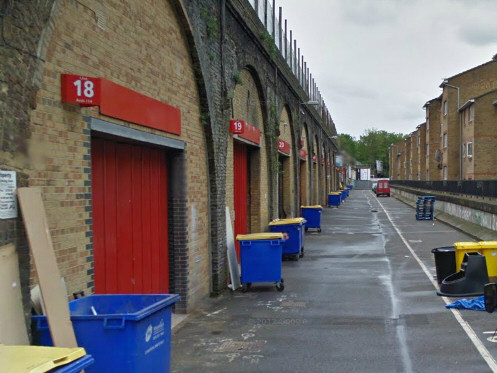
I was greeted by Rolo and Sam – founders of Big Soda – and their colleague Krister. We were later briefly joined by Anthony, with whom I had made all the booking arrangements via email, and finally Kate who together with Sam and Krister would be undertaking the actual casting.
After a friendly welcome and a little discussion about the project over mugs of tea it was time to start work. My figure in the tableau was to be standing, curved over the back of a smaller hunched figure, with one arm reaching around their torso to create the effect of an oppressive embrace. The top half of my body would be cast first, followed by the hands, then a break for lunch, and finally the lower body. It was expected that the whole process could take us up to six o’clock in the evening.
I was shown upstairs by Kate, into the small enclosed office that was to be my changing room next to the work room where the casting would take place. Towels and assorted personal hygiene and cleaning products had been set out in readiness, so I was left alone to undress. Thoughtfully, the team had somehow succeeded in getting the ambient temperatures of both rooms to a perfectly comfortable level with neither a chilling edge nor an excessive warmth. No mean feat in mid-December.
The towel I wore as I entered the work room was soon dispensed with, first to be replaced by swathes of cling film for the protection of body hairs. Stiff-legged, I was then helped into a small pair of underpants, followed by a bit more wrapping in cling film, and finished off with the black figure-hugging one-piece body sock that covered everything from feet and hands up to the Adam’s apple. This last item created a smooth surface over the uneven rippling rolls of plastic. Finally the body sock was rubbed all over with Vaseline and conditioner to prevent the plaster clinging to the material. Thus I was prepared.
The next challenge was to create the correct pose and establish a means for holding it steady throughout all phases of the casting. Helpfully, the hunched figure I was to embrace had already been fashioned in fibreglass. It was propped against a wall and I adopted the necessary position relative to it: my feet next to the figure’s feet, my knees at the back of its knees, my left hand on the wall above it, and my right arm folding under its belly.
Tape was used to mark my hand and feet positions. We made use of an inverted broom with its pole wedged into the angle between with the wall and the floor so my chest could rest on the brush head. Krister and Kate fastened wooden wedges onto the wall and around the broom handle. These would keep the broom steady and create supports for both hands so that my arms would not drift out of position when the plaster was applied.
Time for the plaster. Kate did the mixing; Sam and Krister took care of the application. I had been told it would feel cold when first applied (I wasn’t looking forward to that) and then quite warm as it set, before cooling down again when it was ready to be removed. In practice, however, with the insulating layers of cling film and a body sock around me it was never cold, and would rise only to a mellow warmth. Kate and Sam checked how I was feeling throughout the day, and perhaps had their doubts as I repeatedly answered ‘fine’, but really I could not have been more comfortable while we worked.
First the plaster was applied to my shoulders, then across my back, halfway around my sides and all the way down to the upper curve of my buttocks. Postcard-sized scraps of a rough hessian-type rag were soaked in plaster and added as a second strengthening layer all over, with a final smooth smearing of plaster on top. As Sam tidied the edges it was decided we may as well do the arms at the same time. Thus, the procedure was repeated for the outside of the arms and then the insides, leaving a weaker seam between the two halves so they could be cracked and neatly separated when set.
These first parts seemed to go very well but the hardest part would be next. As my pose was leaning forwards it would be necessary somehow to apply the plaster on my chest and stomach against gravity. Furthermore, I would no longer be able to support my chest on the inverted broom. The solution: plaster and rags were applied as quickly as possible with the whole team rallying round to hold them in place with their hands, and also helping to take some of the overall weight while I supported the pose with both hands against the wall.
The plaster took little more than 15-20 minutes to set so it was not necessary to sustain such peculiar arrangements any longer than a short life model pose. Once all the upper body plaster had been removed, Kate set about preparing lunch for everyone while Sam worked on the casts of my hands. The procedure for hands involved pouring a heavy gel into a small wooden box, immersing up to the wrist, wiggling the fingers to ensure a good covering, and then waiting for it to set. After about five minutes the hand could be squirmed and slid free, the box unscrewed and the solid mould removed. Simple.
Lunch was a handsome selection of thick tasty soup, salad, cheeses, bread, fresh fruit, chocolate cake and tea. I’m a light eater so this was more than generous for my needs. Delicious and filling. I had removed the body sock and cling film after the upper-body session so, back in my own clothes, I could dine with the others in comfort. This also meant that the first task of the afternoon session was to re-wrap my legs. It was assumed I could wear the body sock simply as a pair of trousers but as this left them hanging baggy and misshapen I zipped-up all the way to become once more fully attired from neck to toes.
Having re-established the pose and double-checked its accuracy by donning the pieces previously cast, we then set about the legs. Again, the plaster was applied in two lengthways halves with a weaker seam between each to make them easier to remove. Even so, a fair bit of wrestling and straining was necessary in order to break free. But once free, that was it: job done.
I withdrew to the office changing room where Kate had left a large bucket of warm water and a cloth. While I gave myself a bucket-bath the others busied themselves tidying the work room. My body was quite free from fragments of plaster – the cling film had done its protecting job – so only a few dye stains from the body sock needed a light rub over.
Freshly cleansed and dressed, I said my goodbyes and was on my way home with the time still only four o’clock. It had been an excellent day, working with as nice a team of professionals as anyone could hope to meet. This was my first experience of body casting. If it was a typical experience then I sincerely hope it will not be the last.
Two hours’ modelling on a Wednesday night, from 7pm to 9pm. It was a debut session for me at Wanstead House, just a good stone’s hurl from Epping Forest in north-east london. This would be a lovely location to pick up regular bookings as it’s just forty minutes by train from my day job to Leytonstone High Road, and then a leisurely twenty minute walk to the venue with a good amount of time to spare.
The booking was with Patrick, who I found setting out an arc of chairs in the top (second) floor room – a long, light painted attic space. He was happy for me to adopt any pose as the artists would never have drawn me before. Timings of 10 mins, 20 mins, 30 mins – a break – and finishing with 35-40 mins were suggested, which was fine by me. I was then shown to a spacious changing space that was rougher than the rest of the building, but had bags of character – a real artists’ work room – and a comfortable armchair. Perfect.
Artists started to arrive while I changed into my lightweight robe. There were about eight or nine by the time I took to the centre of their semi-circled chairs, slipped off the robe and struck the first standing pose. Immediately I could feel the warmth of heaters and lamps behind me, so comfort was assured. My second pose was also standing; the third was seated; and the final pose after the break was an open curl on the floor.
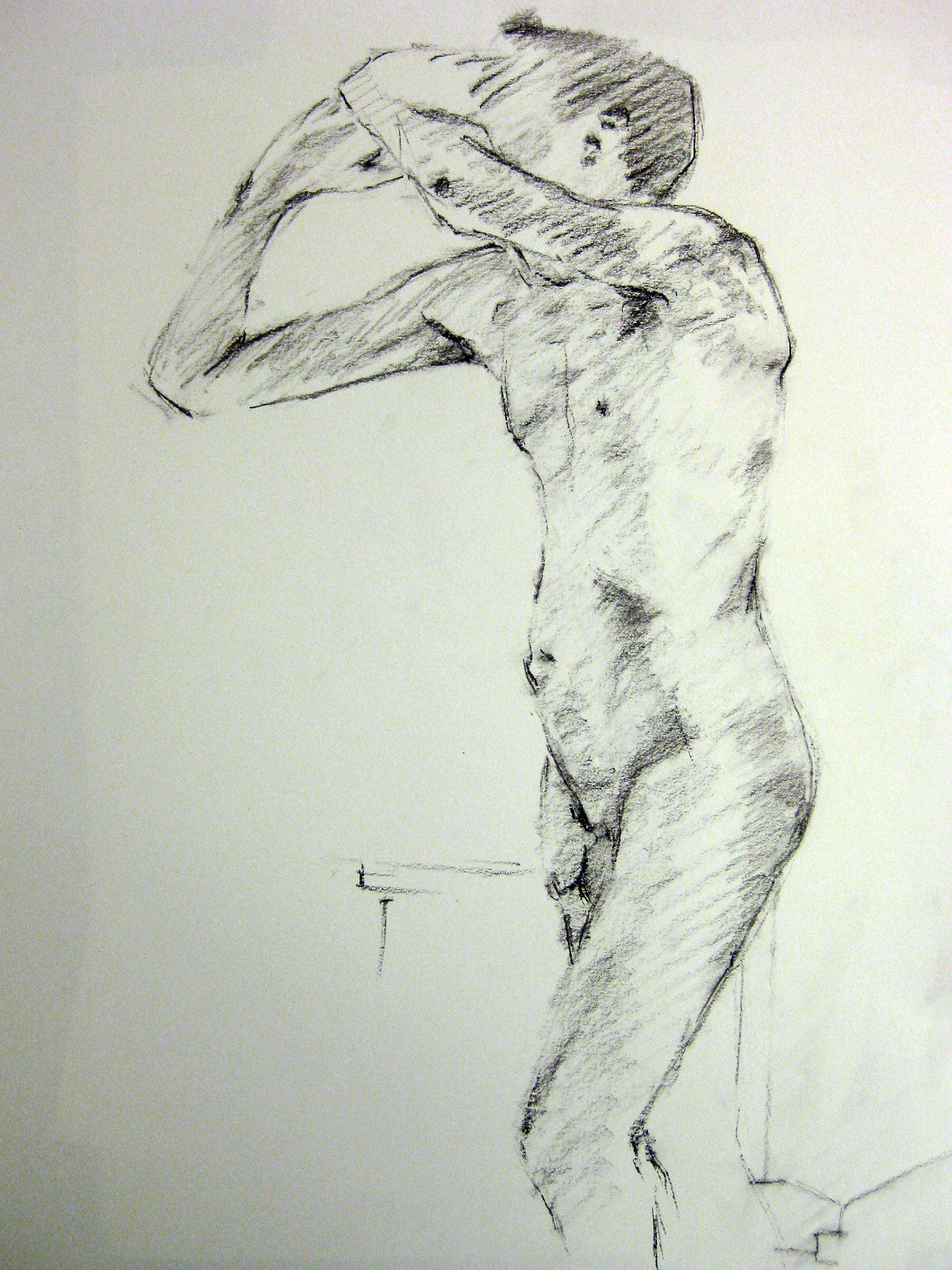
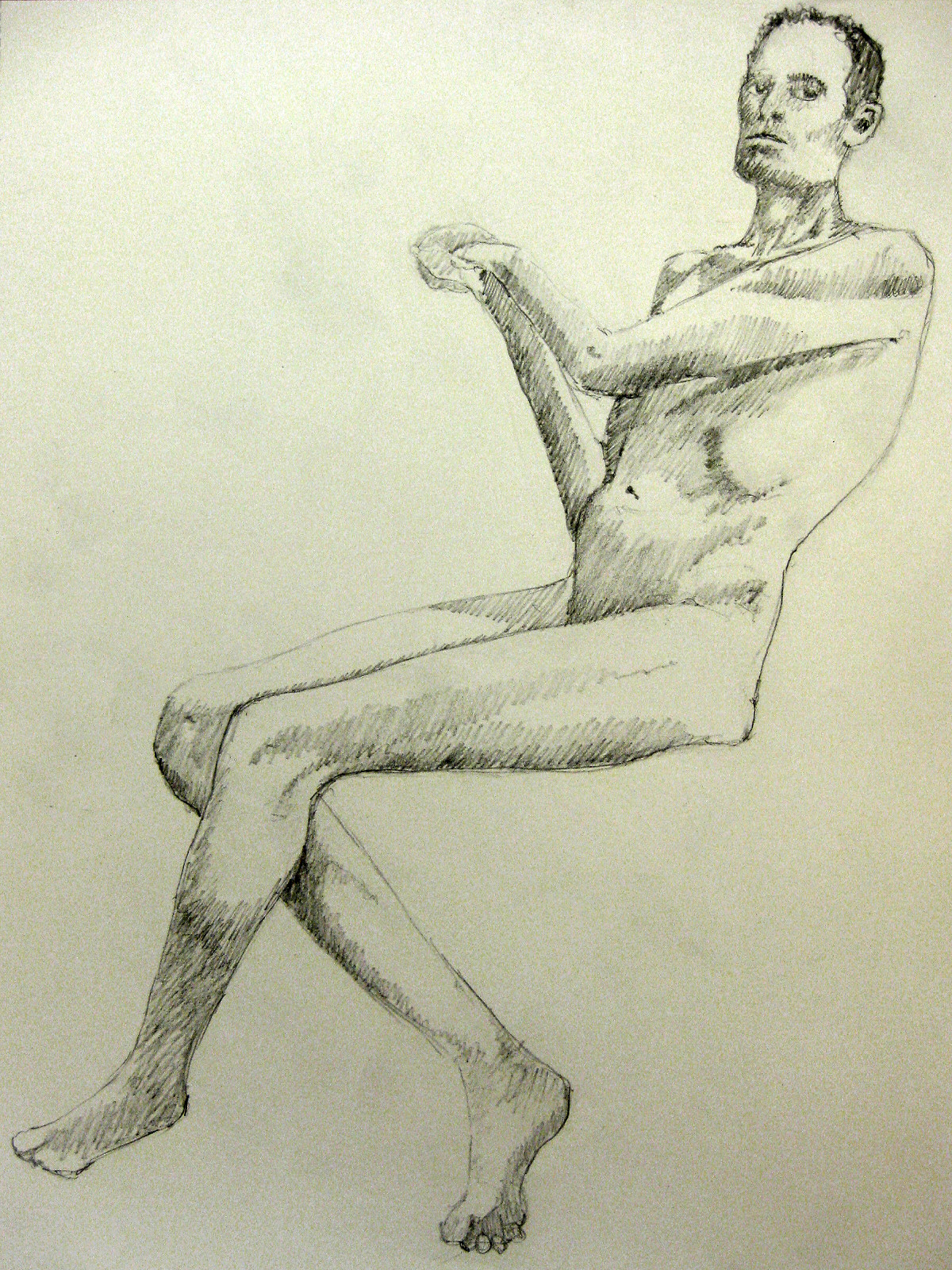
Five minutes into each pose Patrick walked softly around the artists, offering a few words of advice on lines, spaces, foreshortening, etc. One or two artists felt they were not ‘in the zone’. As a model it’s difficult to know how best to respond, if at all. My poses tend to emphasise my longer-than-average limbs and fingers, which I’m conscious may present unfamiliar challenges to artists. Should I tuck them away and close up in subsequent poses if I hear this feedback, or would it be presumptuous to change my approach? It’s an interesting dilemma.
The two great makers of life drawing events in the capital – London Drawing and Spirited Bodies – came together on 20 October 2012 to present ‘The Big Draw’. Around 50-60 life models and 60-80 artists converged on Battersea Arts Centre for a grand day of creative art, unprecedented in its fluidity, daring and challenges.
London Drawing corralled the artists and Spirited Bodies marshalled the models. My own involvement was on a Spirited Bodies ticket, but with the event generating so much interest among experienced models and potential first-timers alike, the extent of my participation would be limited.
There would be a morning group and an afternoon group, each 30-35 strong, posing for more or less two hours together on a central platform with artists seated around.

In the weeks before, some consideration had been given to developing tableaux with sub-groups of models, using experienced models as coordinators for each group, but on the day the models were given free rein to create and change their own poses.
It would have been nice to model in both sessions but realistically I would have to settle for just one and count myself lucky not to be among the many applicants that could not be accommodated at all. Nonetheless, as a familiar face to Spirited Bodies’ Esther and Lucy, I was on the team for the whole day taking care of admin and backstage duties in the morning, and helping them to pack away after an excellent modelling session in the afternoon.
Although my vantage point changed between morning and afternoon, it seemed to me there was a greater warmth and interaction between models in latter group. This would have been partly due to deliberate contrivances in the second half of the afternoon session such as asking all the models to make a small physical connection to the persons next to them at the outset. Greater confidence seemed to grow within individuals from this collective gesture, and this boldness remained throughout.


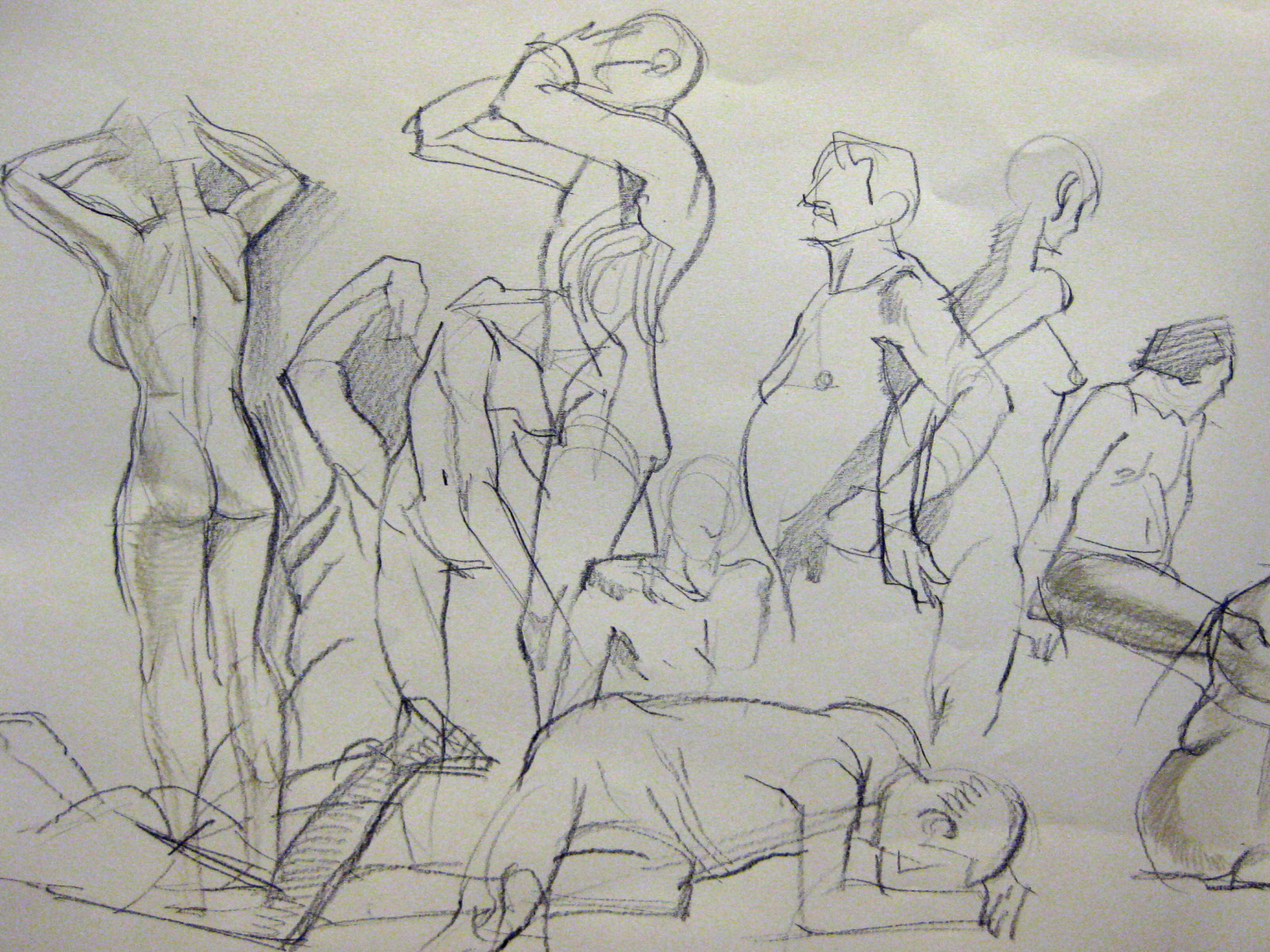
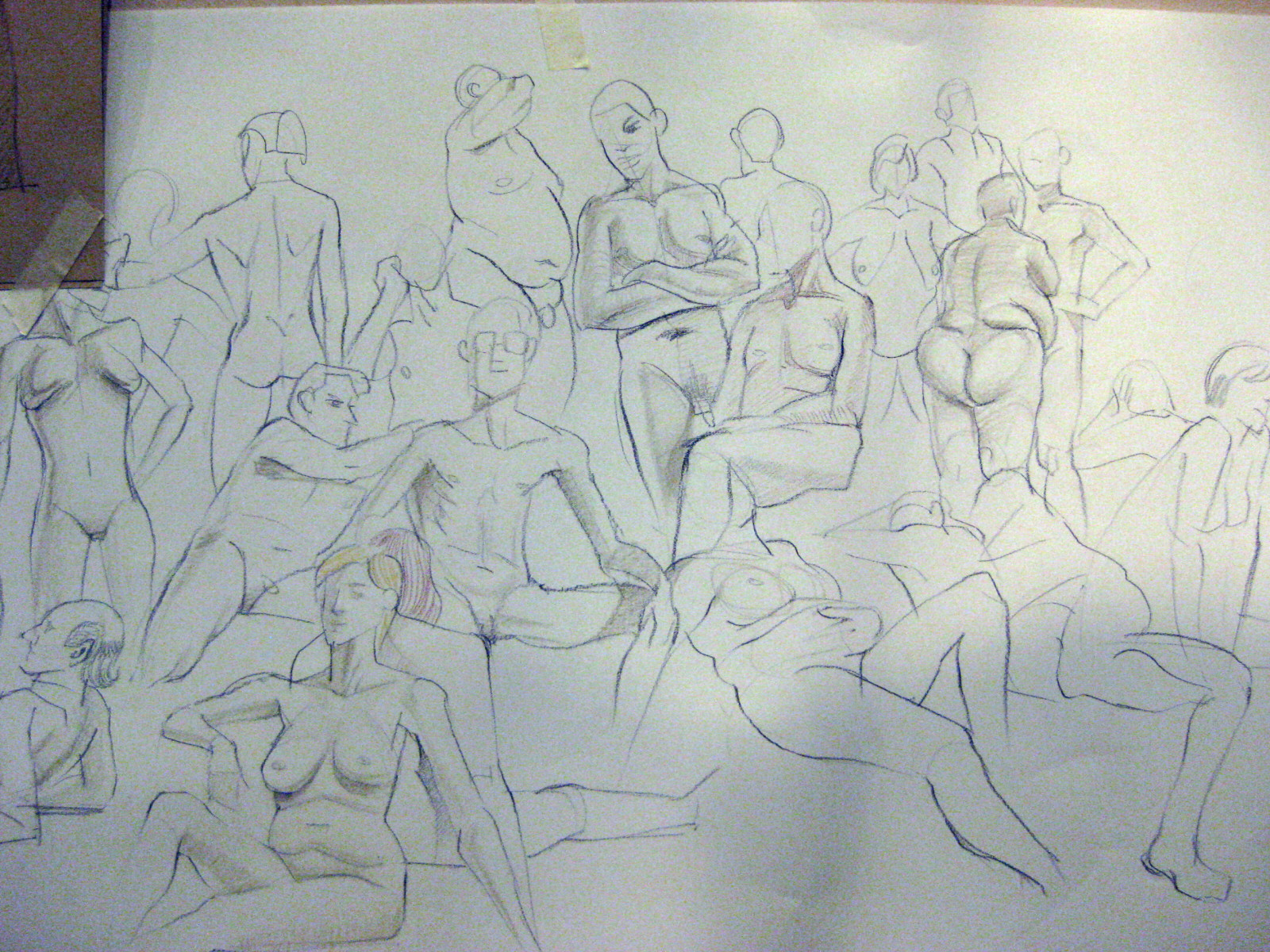

Only a well trained eye would have detected who were the experienced models and who were the first timers. Superficially at least, confidence seemed to be distributed in equal measure. Perhaps the experienced models were more inclined to hold a pose for greater lengths of time. All models had the freedom to change pose whenever the mood took them, which possibly vexed a few of the artists. For some this meant every 5-10 minutes, whereas others would hold position for 20-30+ minutes at a time.
In addition to my time at admin, backstage, modelling and tidying up, I also pitched in as one of Lucy’s two semi-official helper photographers of works produced by the artists. One of the great joys of Spirited Bodies events is that artists are always encouraged to make their works available for others to see at the end of each session. All photos went into a Spirited Bodies Facebook album.
The London Drawing team captured the official photographs of the day as it unfolded. I am the standing male figure in the three London Drawing photos copied below.

A full collection of official photos can be found in the London Drawing Flickr set (these ones reproduced with kind permission).
The journalist Lydia Slater took part in this event and documented it, including interviews with other participants, in her article in ‘You’ magazine:
‘Undress Code, My Naked Ambition’ (PDF 789KB).
Of course, if there is a downside to finding so much enjoyment in working with a group like Spirited Bodies it’s that they specialise in creating opportunities for those who wish to model for the first time… and there can only ever be one first time. Any other time is borrowed time, so future opportunities to part of something this wonderful are likely to be even more scarce. Still…
…carpe diem, and dream for tomorrow.
The email that confirmed my debut at The Clayton Centre, Potters Bar for 4 October 2012 said: “we take the art serious but are a friendly informal group.” How true this turned out to be. Life drawing is often a sombre business but it need not be so. A small gathering that is not afraid to chat while they work, share a few laughs and be encouraging about each other’s art, makes for a lovely atmosphere.
As the outsider in their midst I could not have been made to feel more welcome. Tea and cake was served, and the two hours flew by. A very pleasant evening.



There is more to Spirited Bodies than multi-model life drawing extravaganzas like the one at Mortlake in July. They also arrange small workshops in which newcomers can try out life modelling for the first time. I offered my services at one such workshop on 26 September 2012, both as an experienced model to get the ball rolling, and also to bandy around a few ideas ahead of a real spectacular planned for late October.
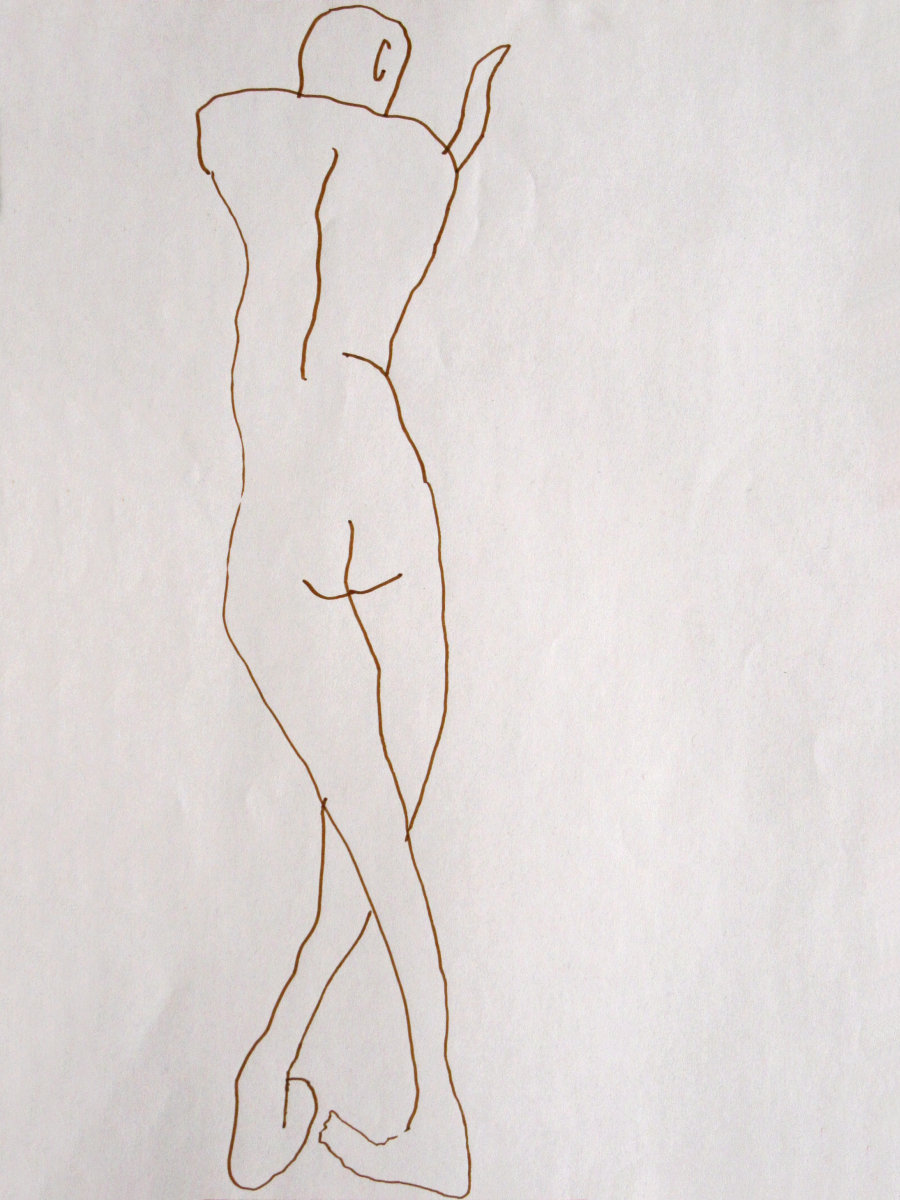
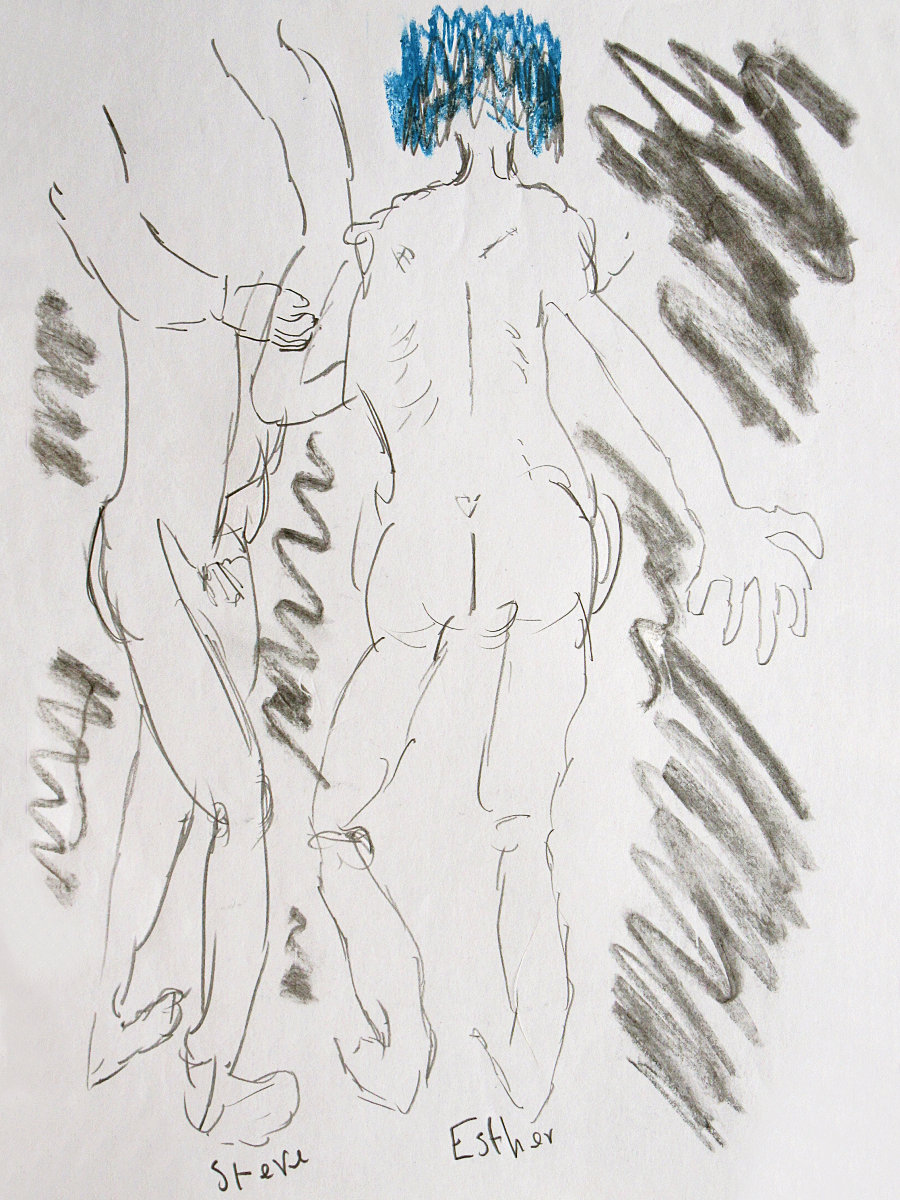
The workshop was attended by ten first-timers, Esther and Lucy, and me. Everyone would have a chance to pose for ten minutes, clothed or naked, in twos or threes, while those not posing would draw. I was on first with a solo icebreaker, followed by two poses with Esther. Then the rest of the group stepped up to take their turns in pairs. I joined the last two first-timers for a final group of three.
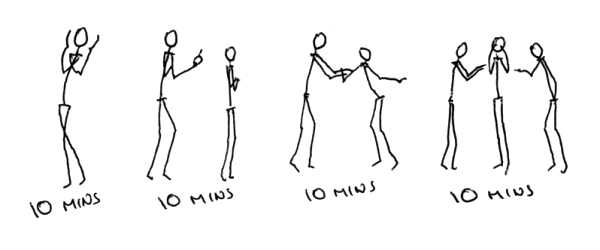
With Lucy and Esther offering their insights, ideas and encouragement throughout, it was a remarkably relaxed feel-good session. Everyone found something new in themselves. For me, the greatest revelation came whilst drawing: not through the observation of models, but through the observation of time.


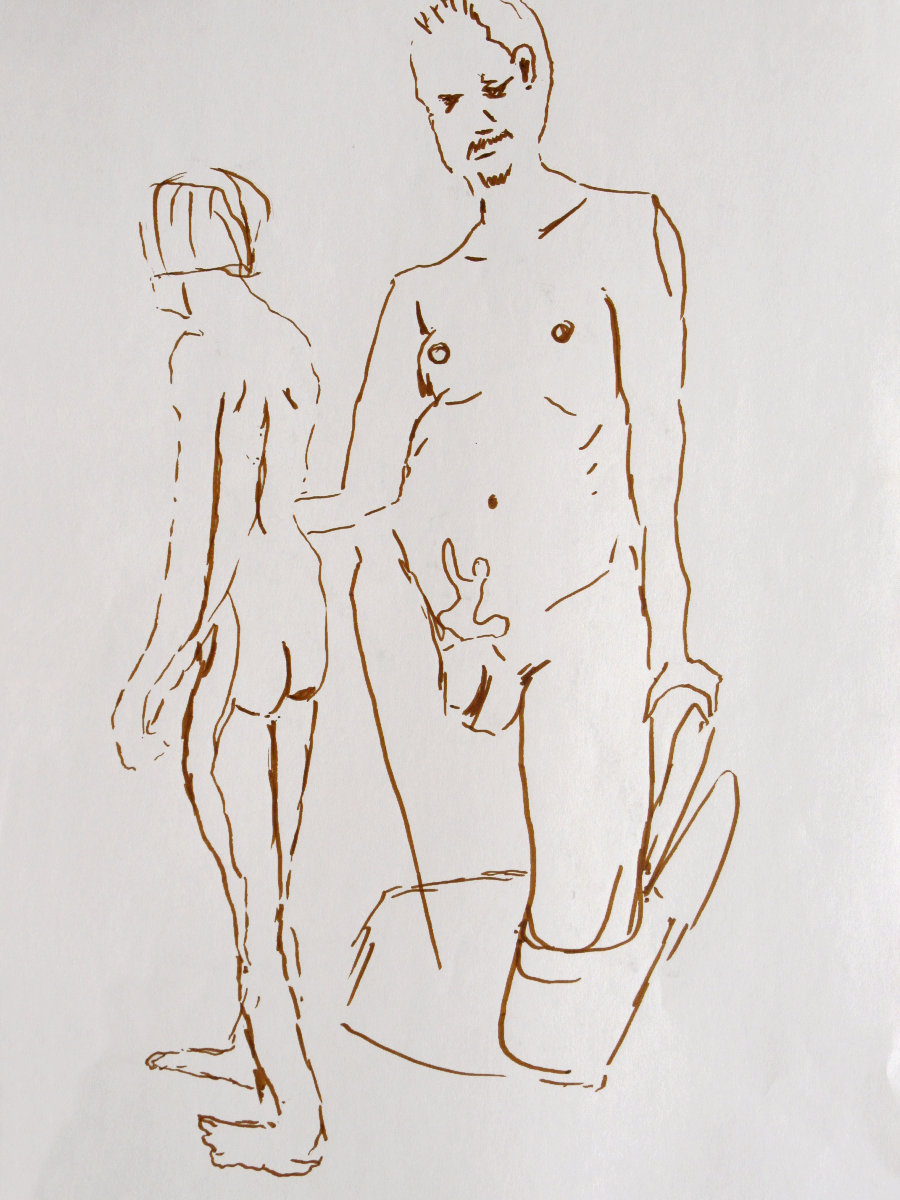
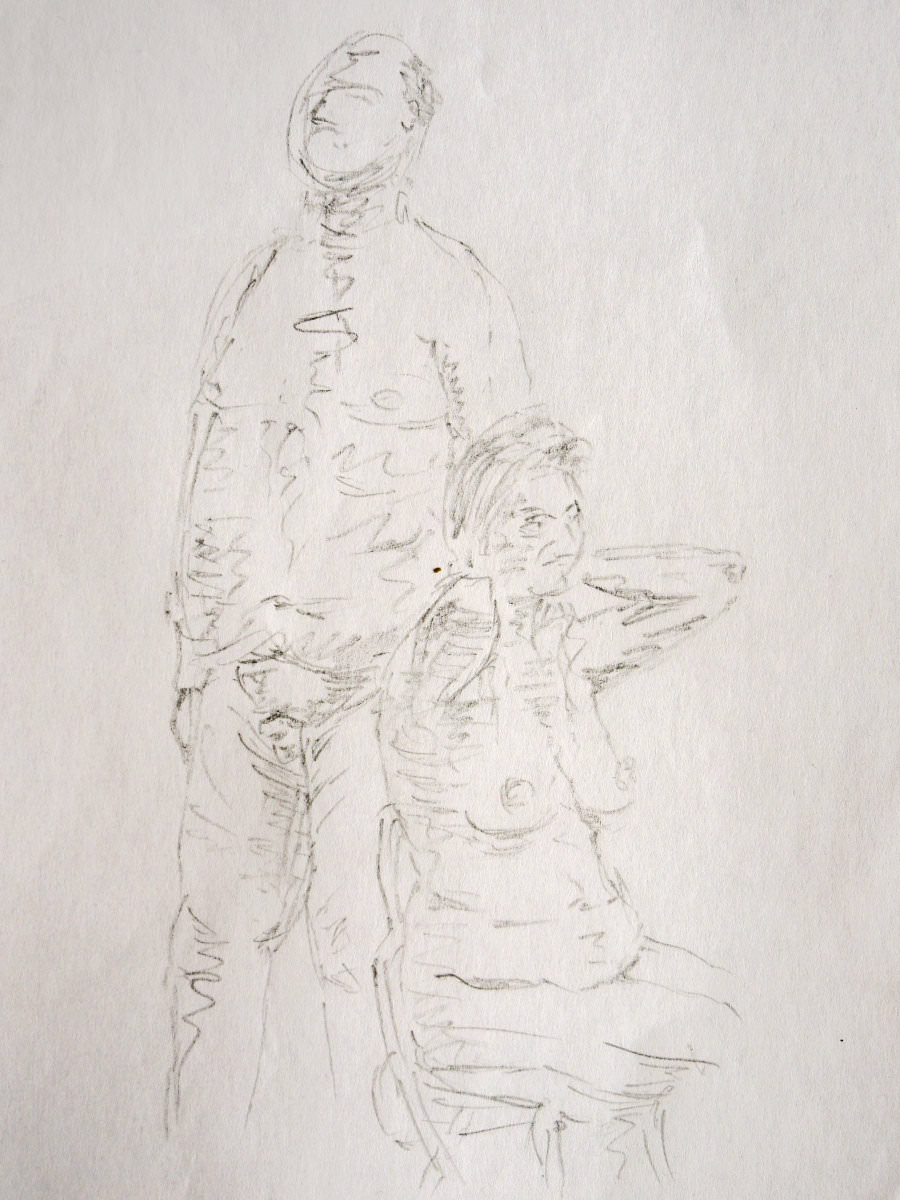
While posing, my concentration is on achieving a linear performance; maintaining a consistent position, and using various techniques to count down the seconds. While drawing, however, I found that I started in a hurry, trying to capture outlines and forms; then I slowed and looked again and noticed new details; then I would apply detail in sporadic bursts of scribbling; then I would go back methodically and make small refinements to feathered lines, and so on; and throughout I had no sense of the minutes ticking by. It was quite fascinating.
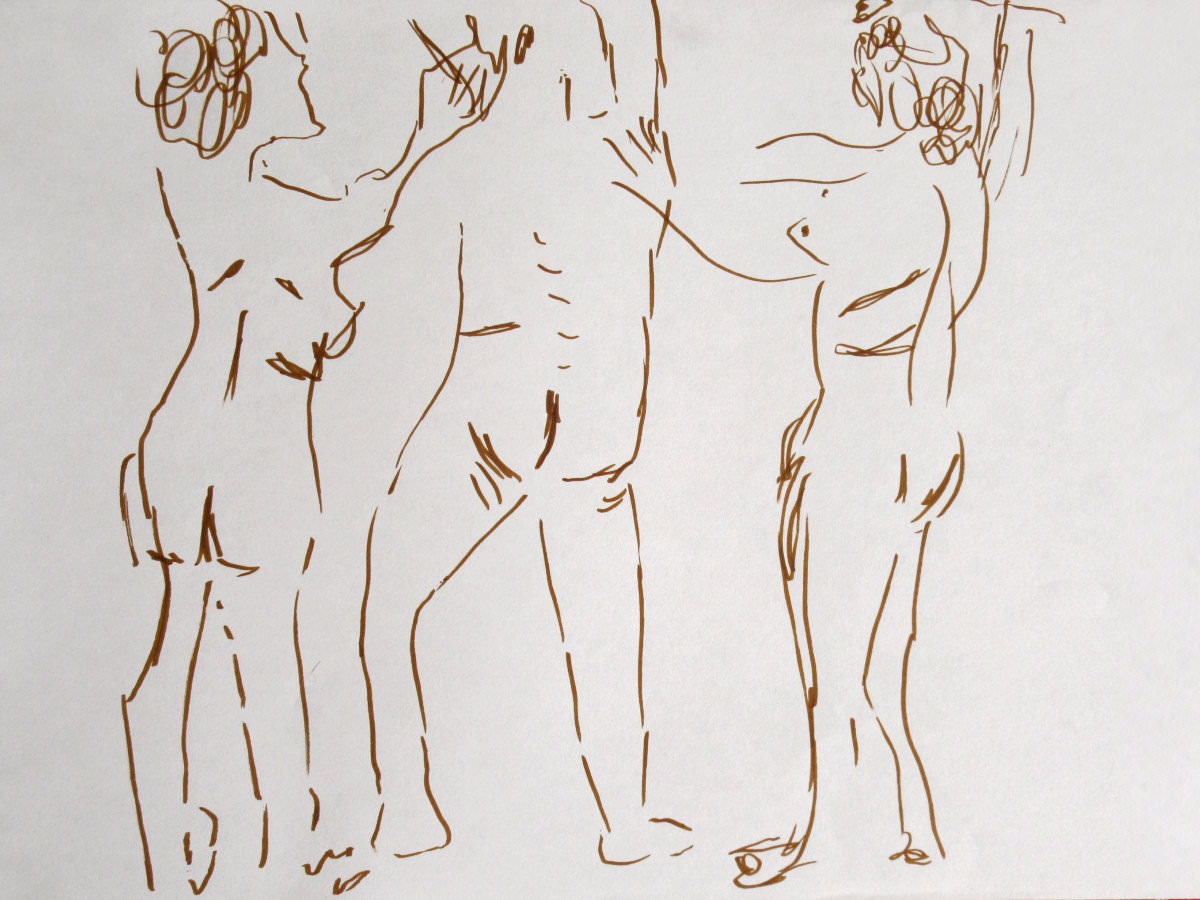
All models should try drawing, and artists should try modelling, clothed or not.
22 September 2012 was originally scheduled as a repeat of the group life model event held at the Storey Gallery, Lancaster in July. When organiser Alan Ward kindly invited me to return, I accepted immediately and bought an advance train ticket while fares were low enough to make the day profitable. Thus it was disappointing when the event was forced off due to financial uncertainties blighting the future of the gallery. Being a true gentleman, however, Alan found me alternative work on the day: a two-hour solo session at the neighbouring Storey Auditorium.
A series of short standing poses was followed by a half-hour reclining pose, then a tea break, and finally a forty-five minute seated pose with a gentle twist.
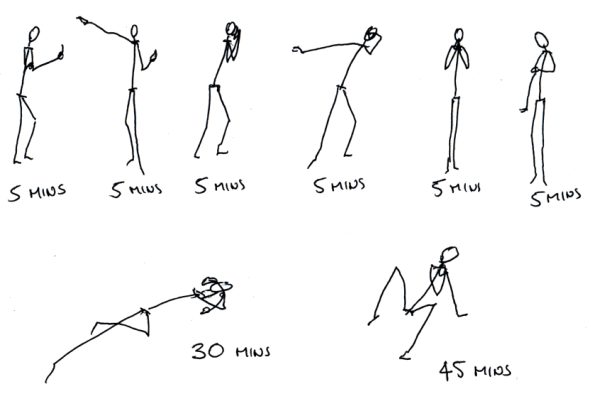
I misjudged my pressure points during the reclining pose. After twenty minutes my ‘upper’ leg lost feeling and a slight tremble set in. When the half-hour was up, all the artists withdrew for their tea while I literally dragged myself off the platform and onto a chair. Sensation soon returned and I joined the others for a brew. There, one artist observed with a compassionate smile: “I saw your leg fibrillating…”
I made a mental note that if this were to happen again then I too would describe myself as “fibrillating”, and thereby sound more technically-minded and professional than if I simply apologised for getting the shakes.
Ghost Bird is probably the most extraordinary and dramatic art project that I’ve had involvement with. Conceived and created by Louise Ann Wilson, it was scheduled to take place over the weekend of 15/16 September 2012 in the Trough of Bowland – a high and remote area of outstanding natural beauty about ten miles south-east of Lancaster. Louise was one of the artists at the Storey Gallery in Lancaster for the life model group event back in July. The essence of her project was:
“Referring to the ghostly grey feathers of the male harrier and the absence this year of nesting pairs in the Trough of Bowland, Ghost Bird celebrates the beauty of the hen harrier and draws attention to their sometimes fragile existence within the North of England. In doing so, the work also becomes a means of reflecting on the journey taken 400 years ago over the Bowland Fells to Lancaster Castle by the Pendle Witches. In this new piece, installations and acts of live performance combined to create a unique walking experience set within a stunning upland landscape.”
Over two days, along with 24 other models, the intention was to take four forty-minute shifts in foetal positions within semi-circular dry stone grouse-shooting butts dotted about on the wild hills while audience members hiked among us. I was in a team of three, with Anne and Janet, rotating between two butts and the hidden base camp. At any given time, two of us would be laying naked and isolated in the butts while the other was back at base, five minutes’ walk away.
This system worked well enough on the Saturday, albeit dreadfully cold when exposed to unforgiving winds. Only once did I overhear a comment from our audience (always unseen). It was during my third shift as I lay curled up and braced against the biting conditions – what sounded like a mature couple conversed as follows:
He: “Over there.”
She: “Yes, there’s one.”
(their footsteps approached and they stood over me in silence for a minute or two)
He: “Shivering with cold.”
She: “It is cold… but bloody effective.”
How gratifying that my body’s natural response only served to enhance the piece.
If participation was tough when it was merely cold on the Saturday, it was nigh impossible when raining on Sunday. Sadly for all concerned, the day had to be abandoned quite early as the safety of participants stood to be at risk. As relieved as I was to escape the harshest weather, I felt desperately sad for Louise and her team who had committed so much time, love and resources to create a vivid and uplifting experience.
For me, the biggest positive was the friendships made over two days, forged in a common experience of art and adversity. These shared moments were undoubtedly testing at the time, but I think we’ll all look back on them fondly as time goes by.
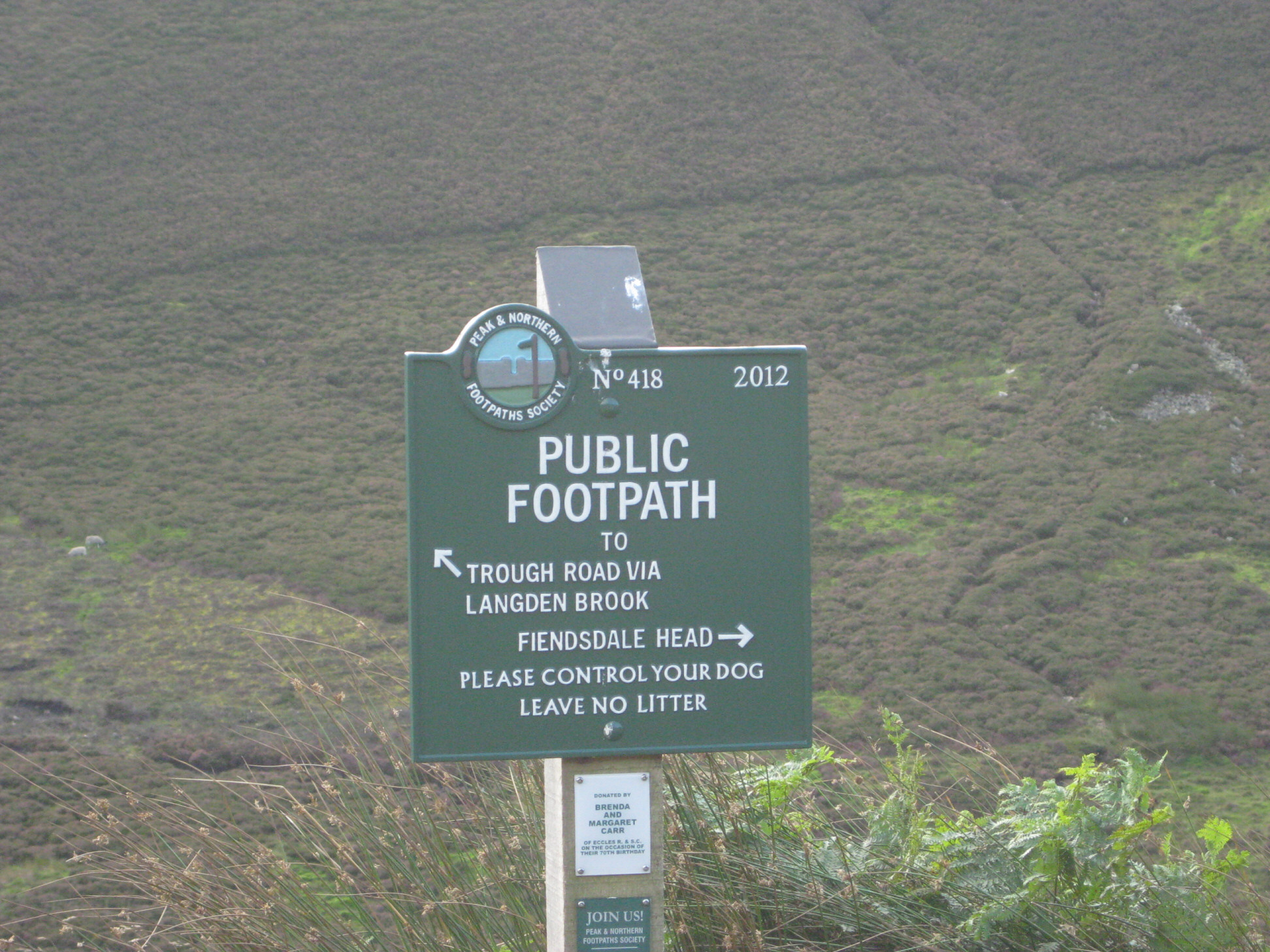
Which way to Ghost Bird? We headed in the direction of Fiendsdale Head.

First encounter with art – a woman laying eggs, each a different pastel hue.

Still a long march ahead to where models would be exposed.

Another many-hued art installation, to contrast with the fragility of eggs.
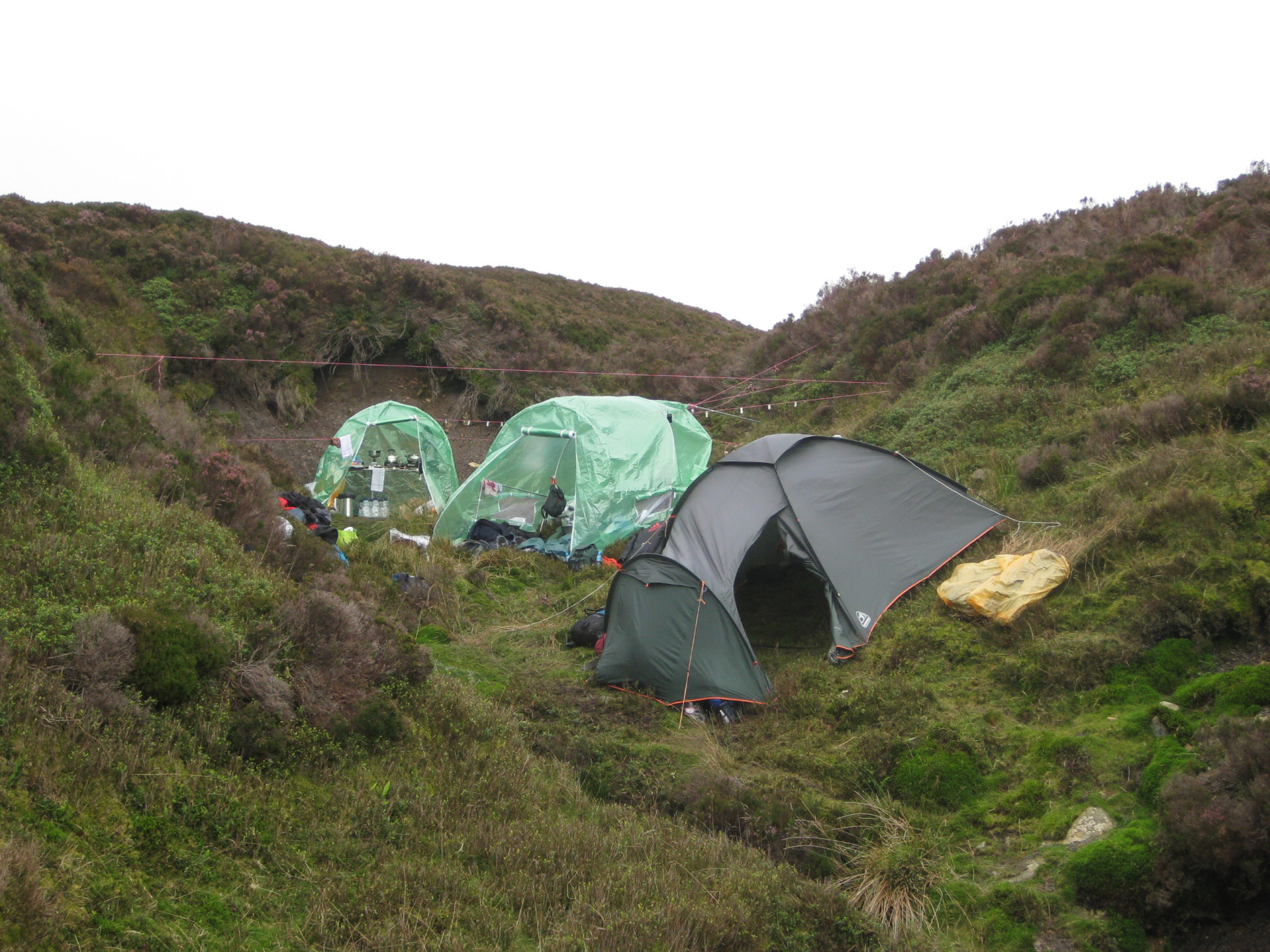
Life model base camp, before it became a slippery quagmire.
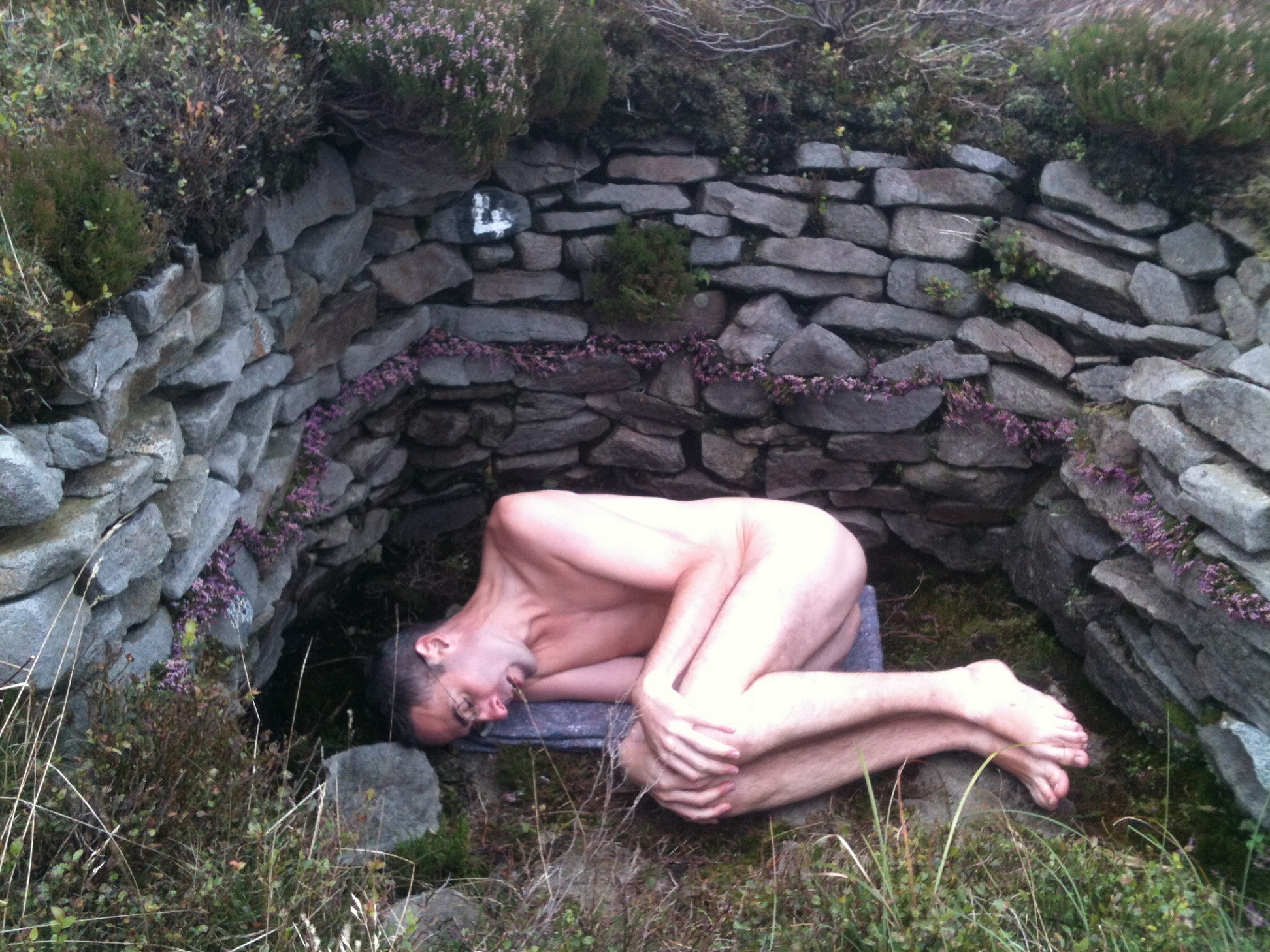
Me, installed within a grouse-shooting butt.
 steve ritter