On Wednesday evening I returned to Wanstead House to model for Patrick’s midweek group. It was a two-hour session, seven artists attending, with Patrick providing words of guidance from time to time. The programme of poses was: five minutes standing; 10 minutes standing; 15 minutes standing; 30 minutes seated; then a break, followed by 45 minutes reclining. All together a good mix.
I enjoy working for groups that have an element of tuition or some supportive chatter between artists. Primarily because it helps to speed the passage of time, providing a distraction from any physical discomfort that might set in, and rendering unnecessary any contrived mental exercises.
It’s also quite fascinating. I can put myself out of body, imagining how my pose might appear from the direction of each conversation and which lines or spaces might serve as the artists’ primary reference points.
Occasionally there is an unintended comic element. During one pose an artist said, “his head is too bulbous…” During the next another said, “his head is too narrow…”
I hoped they were referring to their compositions rather than some bizarre real-life cranial fluctuation I might have been experiencing.
The group as a whole had a pleasant vibe making it an enjoyable session in which to pose. A few works from the evening are copied below.
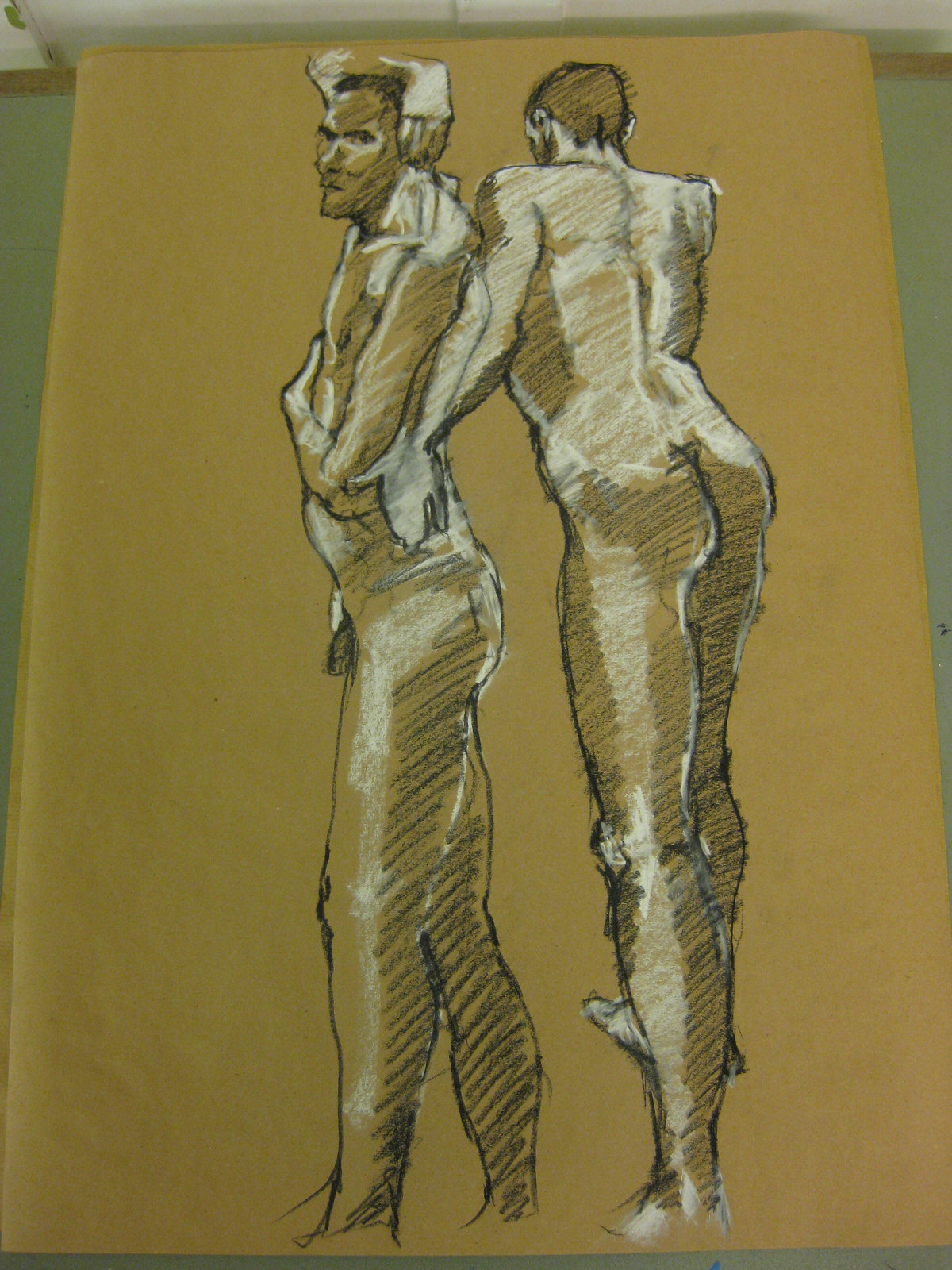
Five minute standing pose and 10 minute standing pose
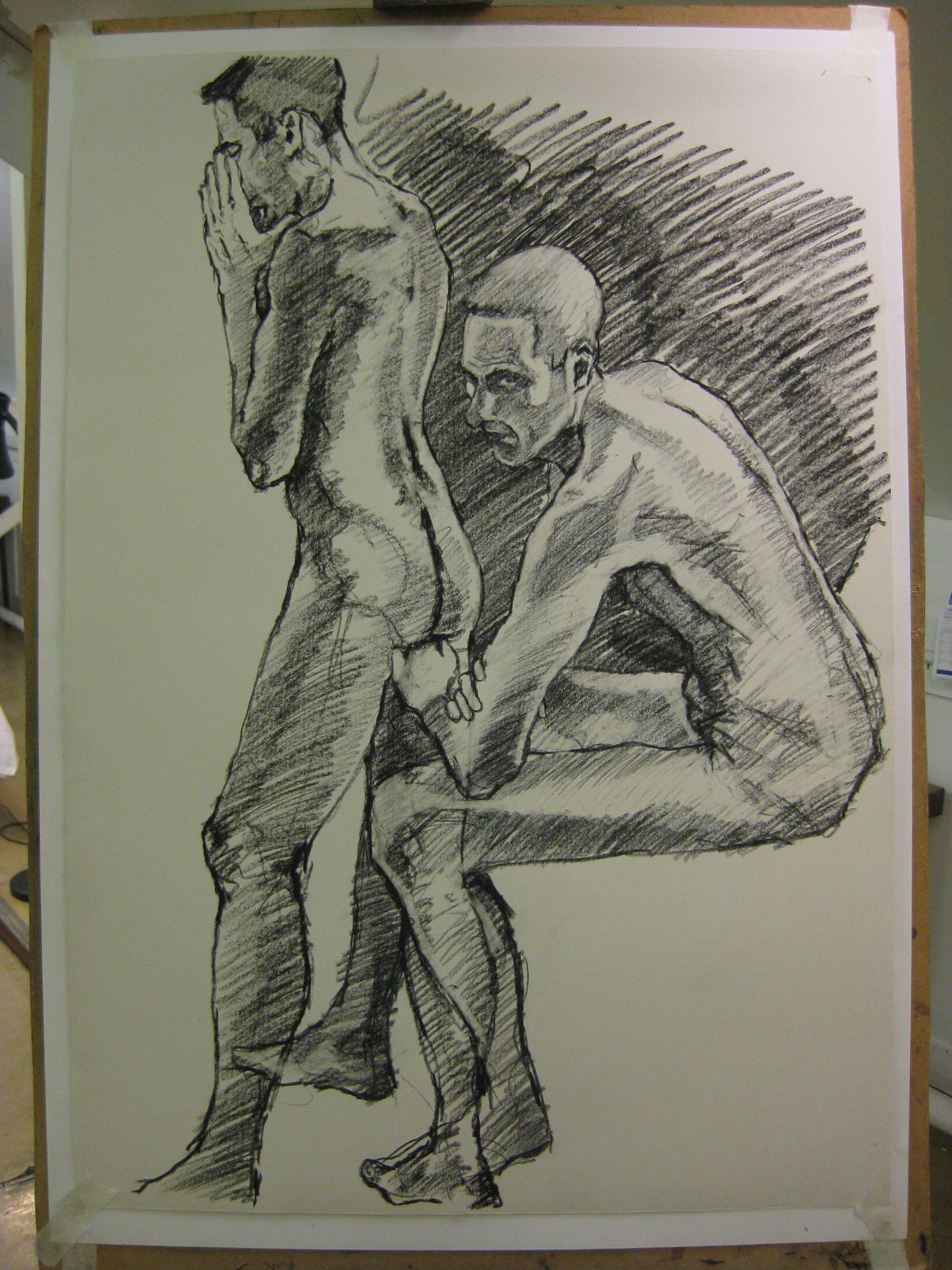
15 minute standing pose and 30 minute seated pose

30-45 minute reclining pose
Guerilla Galleries broke new ground in January by staging a clothing-optional private view of their ‘100% Nude‘ exhibition at London’s Daniel Libeskind Space (check the review). Three months later they were back, bringing with them ‘Art & Protest‘. This too broke new ground by offering a clothing-optional private view for an exhibition that did not have a nude theme. A mainstreaming of freedom? Now that would be radical.
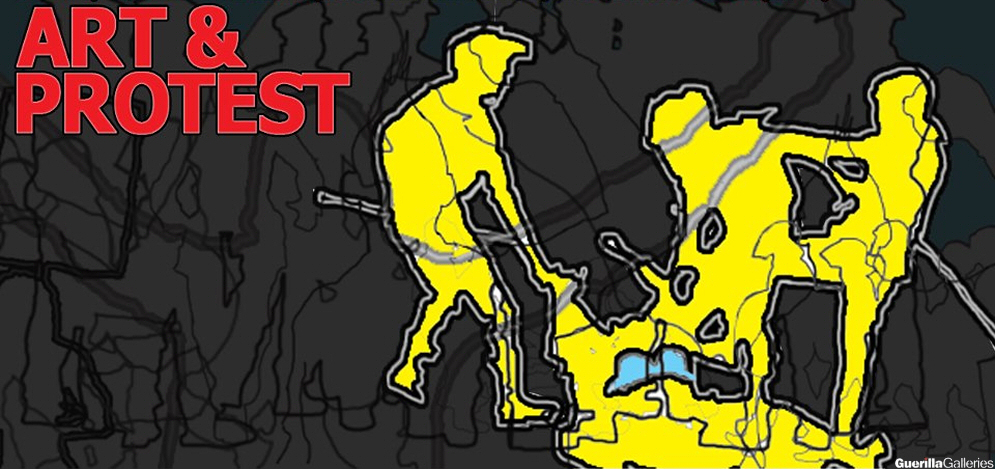
The benefit of arranging two such events within a matter of months is that only a slight polish and a sprinkling of new talent is needed to keep the whole experience feeling fresh and absorbing. This latest view, like the exhibition as a whole, was impeccably well organised from start to finish.

Nicholas Baldion’s homages to the miners’ strike of the 1980s
Once more Tony André was present to greet his guests at the door. I was astonished and flattered to find he remembered me from January. The man truly has an eye for every detail. An assistant then checked my free ticket and invited a discreet donation. It was heartening to see the glass collection box looking very well fed.
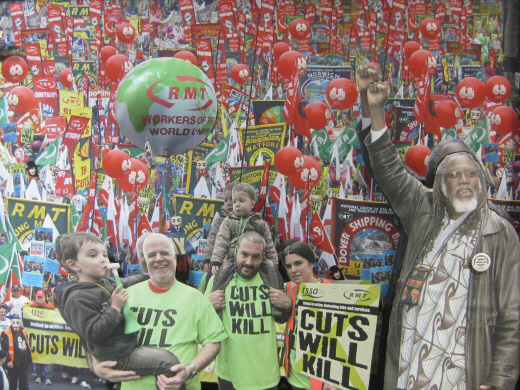
Natansky, ‘Cuts will kill’, 2013
There were two notable refinements since January: first, that everyone on duty wore a red neckerchief, whether clothed or unclothed, making it easier to tell who was part of the team; second, there was a very strict line on no cameras or camera phones being allowed before 7:30pm.
Unchanged, however, was the complementary wine that flowed generously throughout the evening. Art appreciation can be thirsty work.

Michaela Mysakova / Michelle Roth, ‘Are we free?’, 2013
With clothes removed and glass well charged I made my way around the art space. In the first room mellow music played as accompaniment to the Michaela Mysakova / Michelle Roth video installation and artwork, ‘Are we free?‘ This was the least obvious protest piece on display but by far the most mesmerising. When I’d seen all the other works this was the one to which I returned and stood transfixed before for the longest period, while music and movement looped and looped.
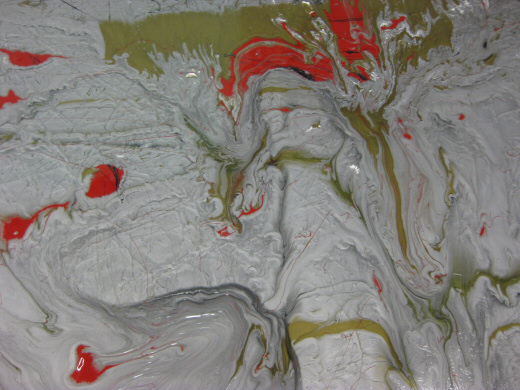
Michaela Mysakova / Michelle Roth, ‘Are we free?’ (detail), 2013
Elsewhere artists interpreted the protest theme in one of four ways: scenes of protest; figures of oppression; anger and alienation; or protest statements. Nicholas Baldion recalled the miners’ strikes of the Thatcher era, capturing the mood and personality of workers, forces, negotiators and oppressors alike. Natansky presented strikes in the modern era with ‘Cuts will kill‘, where smiles replace grimaces but lives and livelihoods are still at stake.

iCON, ‘Mario Stop & Search’, 2013
Politicians are the fair target for most protests. iCON directed his firmly at the face of David Cameron, but also injected some sardonic humour into proceedings with ‘Mario Stop & Search‘. I’ve always believed the use of humour is the most memorable way to make a protest point beyond desperate acts of self-immolation and fatal sacrifice.
Different works were eye-catching in different ways. Angela Chalmers‘ ‘Head 1,2,3,4‘ presented four stunningly distorted faces, each hollering its protest in silence. If I had bought just one piece of art at this exhibition it would have been one of these.

Angela Chalmers, ‘Head 1’, 2013
It was great to see Pílar Camíno Alcón (Piluca) return with new works. Faced with the nigh impossible task of presenting an image even stronger than her magnificent self-portrait from the ‘100% Nude‘ exhibition, she rose to the challenge with portraits of inspirational protest figures. These included a personalised reworking of J. Howard Miller’s iconic ‘We Can Do It!‘ poster. If anyone can do it, Piluca can do it.
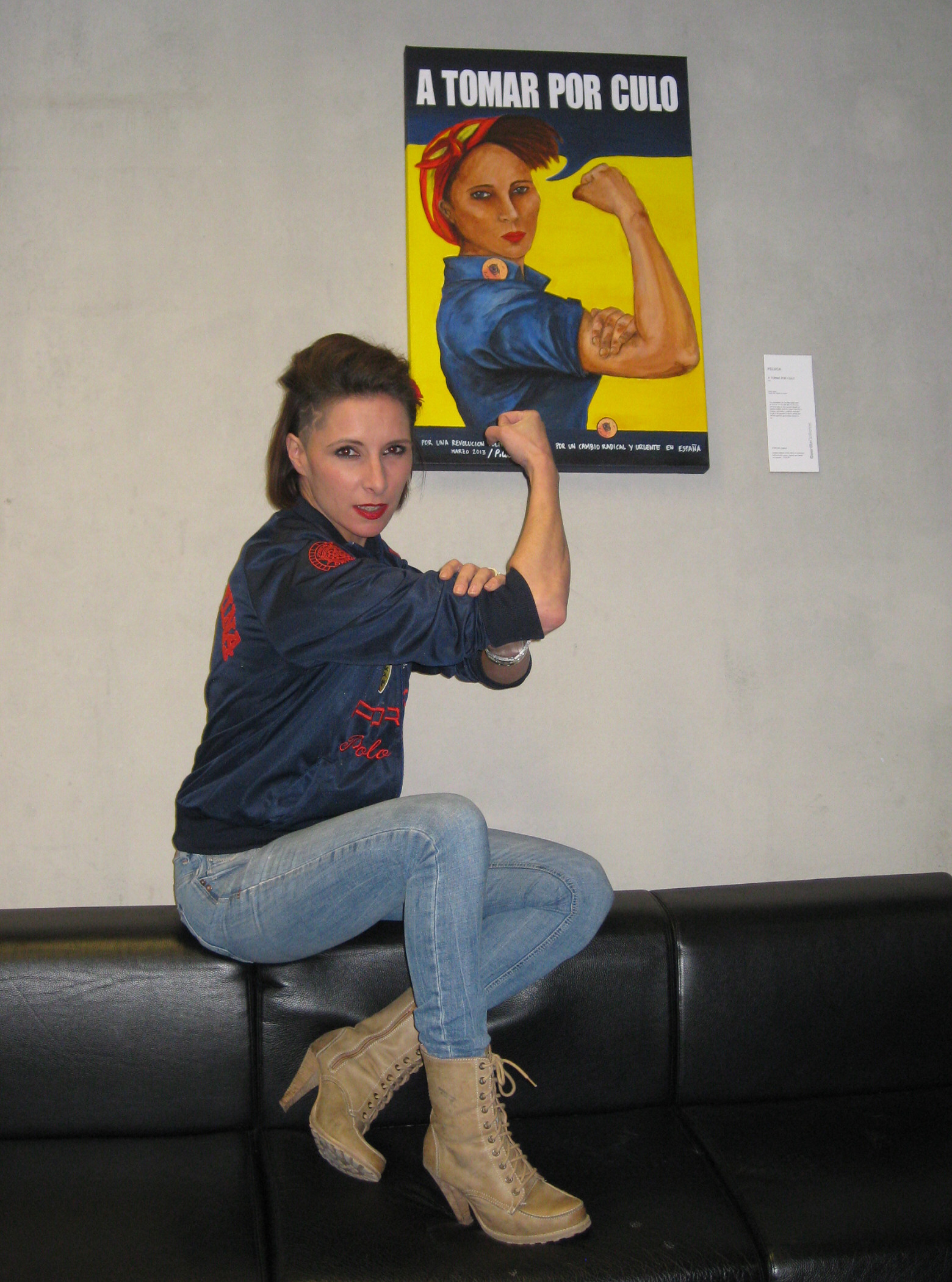
Piluca sends a direct message… although not an exact translation of ‘we can do it!’
At ‘100% Nude‘ Piluca had posed nude alongside her self-portrait; at ‘Art & Protest‘ the central nude figure was Natansky. Throughout the two hours of the exhibition she was in the main hall being body-painted into the illusionary outfit she had worn at last year’s London Naked Bike Ride – a pro-cycling protest against oil dependency that I too had ridden with on three occasions. When I asked her permission to photograph ‘Cuts will kill‘ she not only consented but offered to pose naked next to it – you don’t get that kind of response too often from artists.

Natansky the artist / Natansky the art
Like Natansky and many others, I remained naked throughout the two hour viewing. There didn’t seem to be quite as many visitors taking the no-clothes option this time, which was a shame, even though all one hundred event tickets had been snapped up. Perhaps some got cold feet. Well, actually we all had very cold feet…
For me the novelty of my own nudity at an art exhibition came and went very quickly, but the event itself remains quite unlike any other. It has to be experienced to be fully understood. Hopefully this won’t have been the last chance for art lovers in London to discover the experience for themselves.
Featured artists included Nicholas Baldion, Miguel Ivorra, Pouka, Binty Bint, Carl Hoare, Randolph Hoyte, Caroline Truss, Angela Chalmers, Michaela Mysakova, Piluca, Reza Moradi, iCON, Keeley Wynn, Charlotte Ratcliffe, Gee Street Artist, Ashley Reaks, Tisna Westerhof, Katerina Konstantara, Dr Bingo Bongo, Natansky, Paula O’Connell, Gareth Morgan, Irene Godfrey, Dan Fox, David Folan, Sarah Wyld, Marta Lapillo and Ben Mellor.
The Telegraph Hill Festival in south London packs in more than 130 events over two weeks and three weekends. Now in its nineteenth year, it’s all about creativity and involvement – the work of the community to benefit the community. As a part of this year’s festival, Spirited Bodies had been invited to stage a multi-model life drawing event at Café Fed. It came as pleasant surprise when, with six days to go, I received an email inviting me to participate too.
Come the day, I travelled to the venue direct from work, catching a train from London Blackfriars to Nunhead, arriving at Café Fed half an hour before the planned start time. There would be eleven models participating so we had been asked to turn up a little early to allow time for coordinating poses.
Esther and Lucy – Spirited Bodies’ twin engines – were already in action, projecting serenity whilst juggling the innumerable inescapable responsibilities that come with organising such events. Esther was arranging artists, marshalling models and preparing the platform on which we would pose. Lucy was bookkeeping, catering, blacking-out windows and generally hammering down any potential problem before it could arise.
Once the majority of models had arrived Esther explained the plan. We were to combine in three tableaux: the first would imagine a 1920s cocktail party; the second would be a protest rally; the third would be a sauna. These creations would last 30 minutes, 30 minutes and 60 minutes respectively. We should connect with one another and present good poses for the artists who would encircle us.
We practised all three arrangements with the models choosing their individual stances and Esther directing refinements to make the whole piece work better from the artists’ perspective. Once satisfied we withdrew to an adjoining room to change into our various gowns and robes.
Seven o’clock was show time. With the minute hand teetering upright, ever more artists arrived and set about preparing their space with cacophonous grace. It was a pleasure to see regular artist and frequent model Rodger amongst them. Happiness increased further with the arrival of poet, life model and all-round bringer of joy, Ursula; the final piece in our jigsaw of bodies.
We disrobed and took our positions for the cocktail party theme. Our platform comprised two tables pulled end-to-end and covered by a white duvet, with pillows piled around on the floor. I perched on one table corner, leaning forward as if in conversation with Ursula who mirrored the pose from the opposite end.
It was all laughs as we settled into position, yet when the pose formally commenced I realised I could be looking into Ursula’s eyes for a full half-hour. Shared nudity in front of friends and strangers can pass without a glimmer of embarrassment but to hold a stare in the direction of another’s eyes for even a minute can be awkward. I quickly found an alternative gaze point over Ursula’s left shoulder.
Halfway through, my attention shift from eyes to legs – specifically my own right leg, which was curled under the weight of my body and rapidly losing all feeling. By the time the pose was complete the leg was entirely numb, hanging dead to the foot. As if by design, to maintain our symmetry, Ursula’s left leg had gone the same way.
For the protest pose a volunteer was needed to stand on the table and look ‘dynamic’. I stepped up and, being rather tall, it was suggested I steady myself with one hand on the ceiling. Having once before held a half-hour pose with one arm outstretched and no adverse effects I was keen to give it a try. Alas, it proved a test too far.
Four times during the thirty minutes I had to drop the arm and shake it out for a few seconds. On the last occasion I feared I wasn’t going to be able to raise it again but somehow got through to the end. For about ten minutes after completing the pose my muscles told my brain the arm was six inches lower than where my eyes reported it to be. Very strange. Esther congratulated me on discovering what it’s like to take ketamine. I doubted I would try it again in a hurry.
Having achieved a dead right leg in the first pose and a dead left arm in the second, I thought it best simply to curl up in an isolated corner for the last hour. I wasn’t truly connecting with the other models but I was filling a gap that would otherwise have disadvantaged one row of artists. The pose was gentle and the hour breezed by.
When Esther called time our bodies reanimated and rose as if in accompaniment to the contented hubbub of artists packing away. Our work as models wasn’t quite over, however, as one of our number – Sophie – asked if we might kindly reprise the poses for photographs to support her third-year university project on visual anthropology. Having regained use of my arm, I climbed the table and grabbed that ceiling for one last time.
Upon retiring to the side room to get dressed, we shared with Sophie our views on life modelling. It’s always fascinating to hear other models’ motivations and experiences. One unshakable truth I have learned is that there is no life model stereotype. We are united by a dedication to the discipline, but otherwise are a broad cross-section of humanity with the full gamut of personal philosophies, sensibilities and backgrounds.
Here are a few artists’ works from the evening, lifted with kind permission from the Spirited Bodies Facebook page.


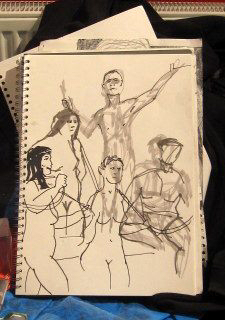
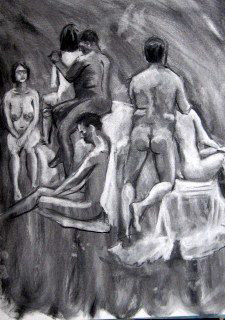

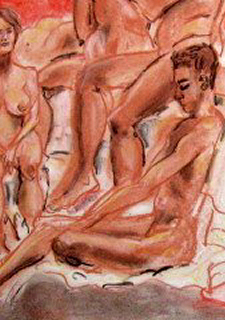

On 2 June this year I shall be stripping and dipping for Skinny Dip 2013, Essex to help raise funds for Marie Curie Cancer Care.
Four different events – at Dorset, East Lothian, Essex and South Wales – will take place at the same time on the same day in a bid to set a new Guinness World Record for the world’s biggest skinny dip.
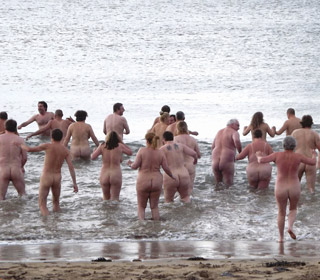
It promises to be good fun but the whole point is to raise funds for Marie Curie Cancer Care. The charity is best known for its network of 2,000 Marie Cure Nurses who work in the homes of terminally ill patients across the UK providing practical care and support. In addition there are nine Marie Curie Hospices across the UK, plus an on-going programme of research into the best ways of caring for people with terminal illnesses.
If you would like to help support this cause then please make a donation to Marie Curie Cancer Care via my sponsorship link below. £20 provides a Marie Curie Nurse for one hour in a patient’s home; £180 provides a full nine hour shift for a Marie Curie Nurse in a patient’s home. Any amount you are able to pledge towards these targets would be welcomed as a vital contribution.
justgiving.com/steveritter – now closed
Rest assured that donations will bypass me and go direct to the charity itself.
Participants won’t be allowed to photograph the dip but I’ll post my experiences here.
Thanks again for your much needed support!
It’s just four weeks since the 18 January premier of ‘Does My…Do I?‘, choreographed by Leda Franklin and presented as part of Resolution! 2013 at The Place. My own experience of taking part is described in “Resolution! Dance theatre at The Place“. Now you can see it for yourself.
The video here is titled “excerpts from ‘Does My…Do I?‘”, not because any part of the Resolution! performance has been omitted, but because that performance itself was a truncated version of a much longer piece.
We still wait in keen anticipation to learn whether it will be possible to stage the work in its entirety. In the meantime let’s enjoy this memento of a joyous event.
It’s two months since my first experience of body casting courtesy of Big Soda in their Peckham workshop. As I eagerly await a private view of the exhibition featuring my casted figure, my warm memories of that December day have been revived by the arrival of photos taken during the creation process.
To recap: the process required me to be tightly wrapped in cling film, then zipped into a one-piece body sock, smeared all over with Vaseline and conditioner, and finally to have plaster applied to my body in four phases: back torso; arms; front torso; legs. Here are a few pictures:
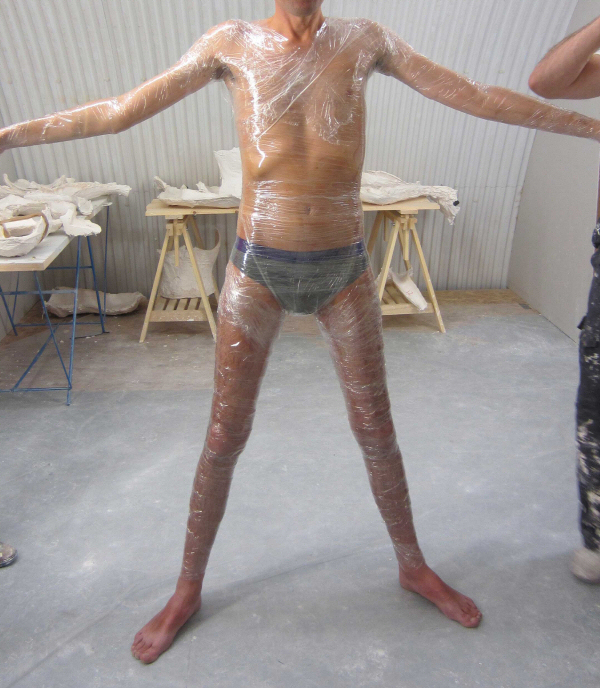
Shrink-wrapped, looking alarmingly like a butcher’s bag of chicken feet.
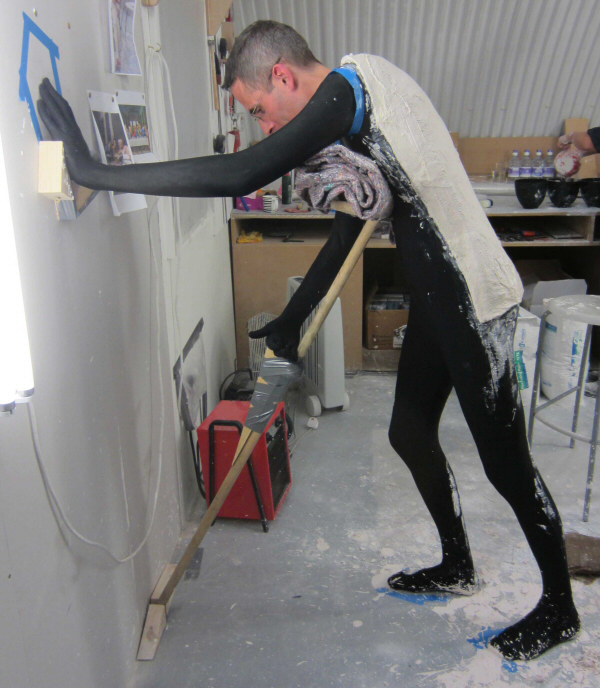
The first stance, propped on a broom handle with arms precisely placed.
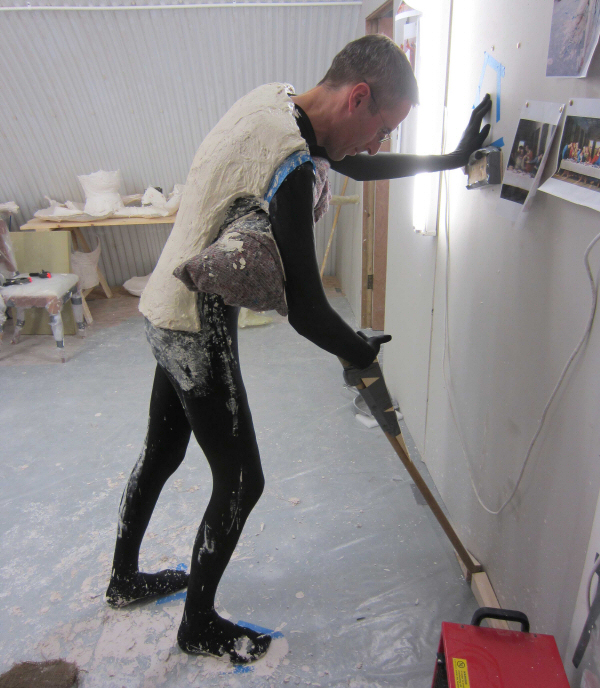
Patiently waiting to set, appreciating that little red heater in the foreground.

After lunch, feet correctly re-positioned ahead of leg casting.

Legs wholly encased, fully immobilised – these boots are not made for walking.

A little refinement around the feet completes the piece.
I’d never thought of the camera as my friend. At best it has been a dispassionate recorder of harsh truths; at worst a brutal critic. Whereas artists have appraised and interpreted me through the creative filter of their imaginings, cameras had simply transposed me from flawed life to flattened form. But perhaps this was because no camera had ever been pointed at me as an individual from the expert hands of a professional photographer…
Towards the end of 2012 I had signed-up to participate in a large-scale project for photographer Rachell Smith. With the date for that piece still to be set, Rachell emailed to say she was looking for “interesting people” with whom she could test new lighting equipment in her studio. Would I consider some portrait and nude work on a time-for-photos basis that weekend? Certainly I would.
Come two o’clock on the Saturday afternoon, I arrived at the Hackney studio to find Rachell and her assistant, Gordon, already outside waiting to greet me. They knew to expect someone extremely tall and I was glad not to disappoint.
The studio itself was a windowless room. Not one object stood within its walls without serving a practical purpose. Cables criss-crossed the floor to rise like tendrils around tripods and lighting stands. There were tables, a couple of chairs, a couple of stools, a couple of boxes, an assortment of backdrops, scrims and reflectors, plus an all-knowing computer. Most crucial of all on a raw January day, there was a heater.
In contrast to the hard functional nature of the studio, Rachell herself was open, engaging and cheery throughout. There were periods of professional contemplation and quiet analysis – trial and error with lighting was the session’s raison d’être – but mostly there was laughter and ease while we worked.
We began with some portrait shots, me still wearing the coat and scarf I’d walked in with. Next came a series of shirtless poses in profile: “chin up, higher, eyes lowered, lean forward, a bit more.” After a tea-break and a change of backdrop we moved onto nude poses in two series. In the first I was seated on a low foot-stool, curving my spine, with one or both knees drawn up. In the second I was almost horizontal across two stools with back arched and twisted. These were landscapes of the body.
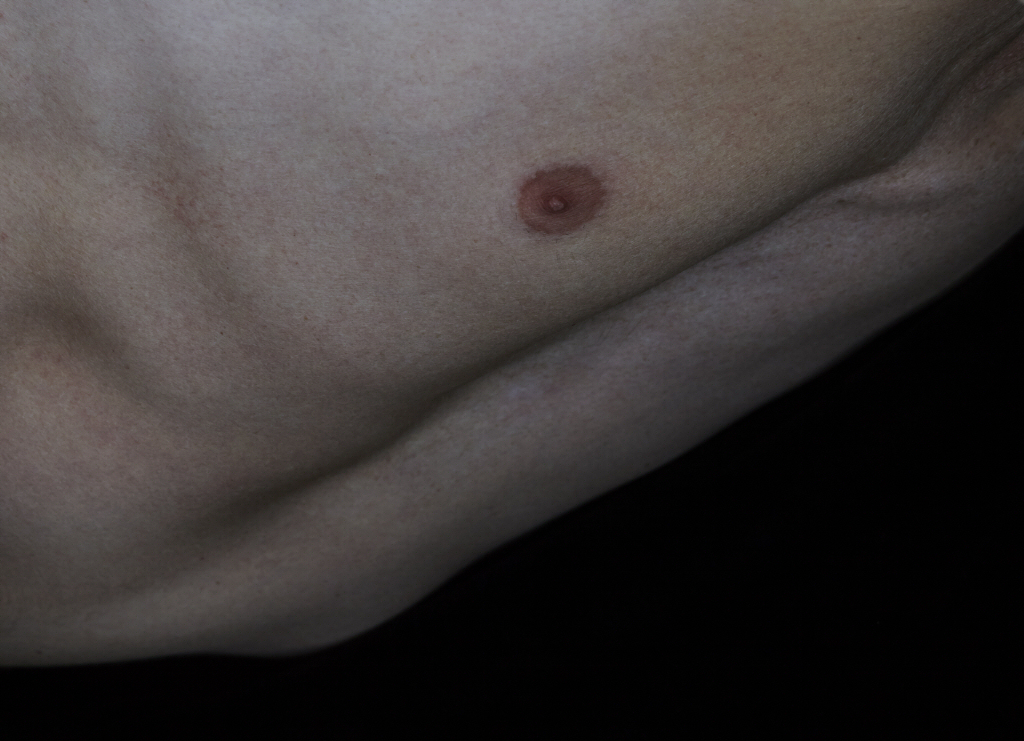
Some of the resulting images are reproduced below. It is me as I had never seen myself. It is me as visualised by the photographer as artist. Certainly for me it was a new type of encounter with the camera, hopefully the start of a new understanding. Truly a fascinating and enjoyable experience.




 steve ritter