When the life drawing world went online from the start of the coronavirus (COVID-19) pandemic, Esther and I were reluctant to follow. We both derive greatest satisfaction from sharing all our spatial dimensions with artists and were slow to embrace change. However, when Esther’s Spirited Bodies turned 10 years-old in November 2020, the anniversary was too significant not to be celebrated with past participants. At the time her only option was to stage an event online, so she did. It was a great success.
In early 2021, Spirited Bodies collaborated successfully online with organisations like The Barber Institute of Fine Arts and LSE Mental Health Collective, yet ironically Spirited Bodies’ own events only went online once lockdown restrictions had lifted. In July, Esther launched a new hybrid format, Life drawing Living Room, where a strictly limited number of tickets are offered for people to draw models in-person (and maybe even try modelling too) in the safe space of her flat, whilst others draw online.
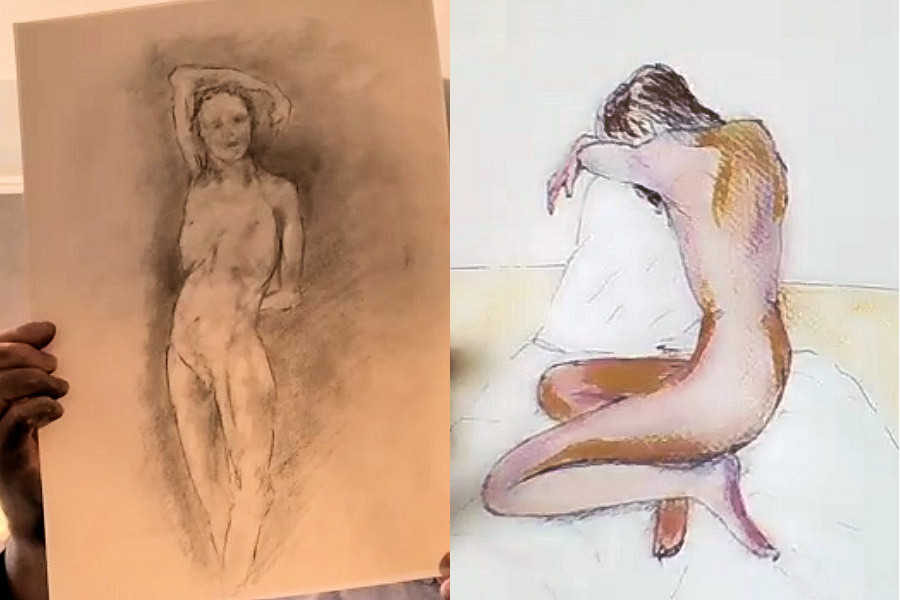
Art from the room: Ken Bruin.
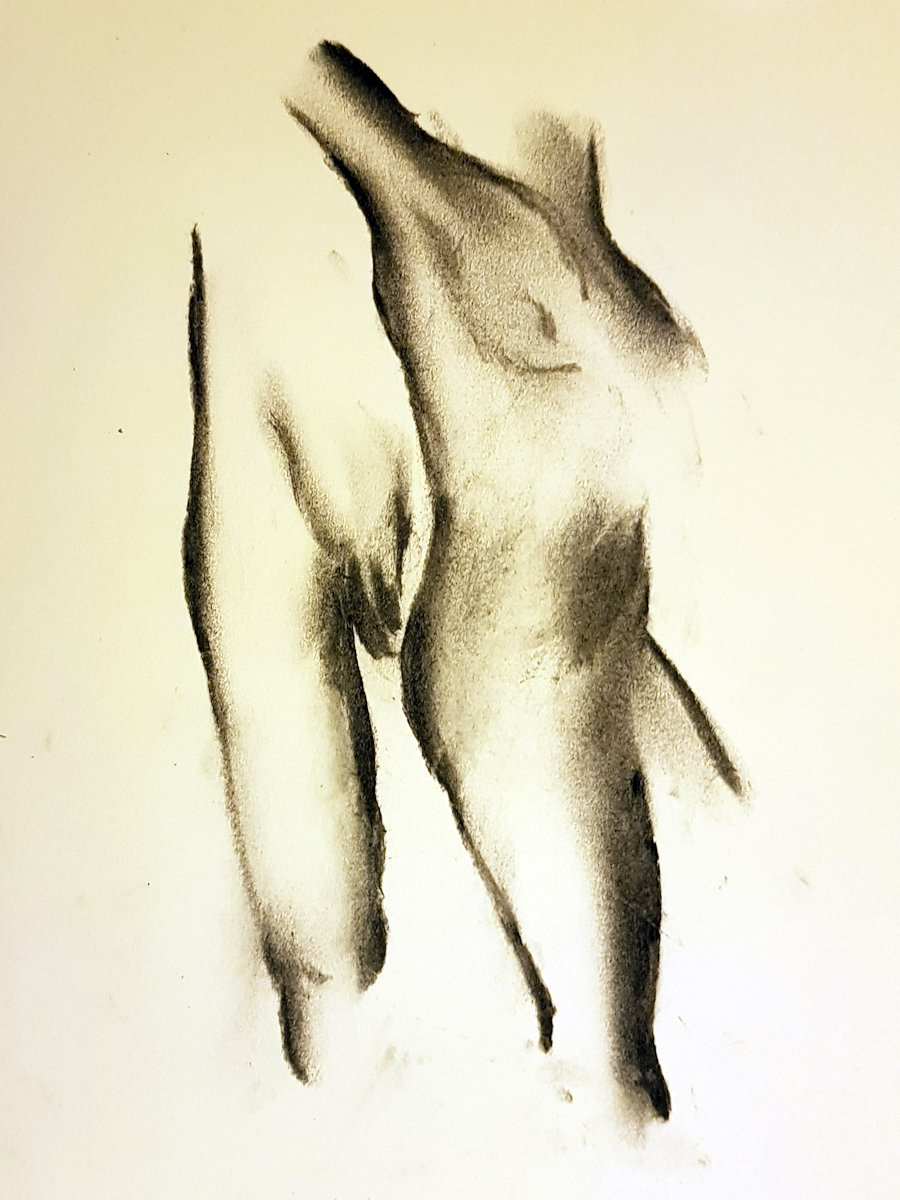

Spirited Bodies empowers models to express themselves through their own words as well as their poses. Esther spoke at Life drawing Living Room #1, Peter at #2, Leo at #3, then I joined Esther for this fourth session. We posed solo and as a couple, whilst Esther spoke on the theme of sexuality and relationships; not specifically our own but observing how – for many Spirited Bodies participants – the opportunity to pose nude in front of others can address a deep-rooted need to be seen, understood and valued.
Art from online: Robert Black.
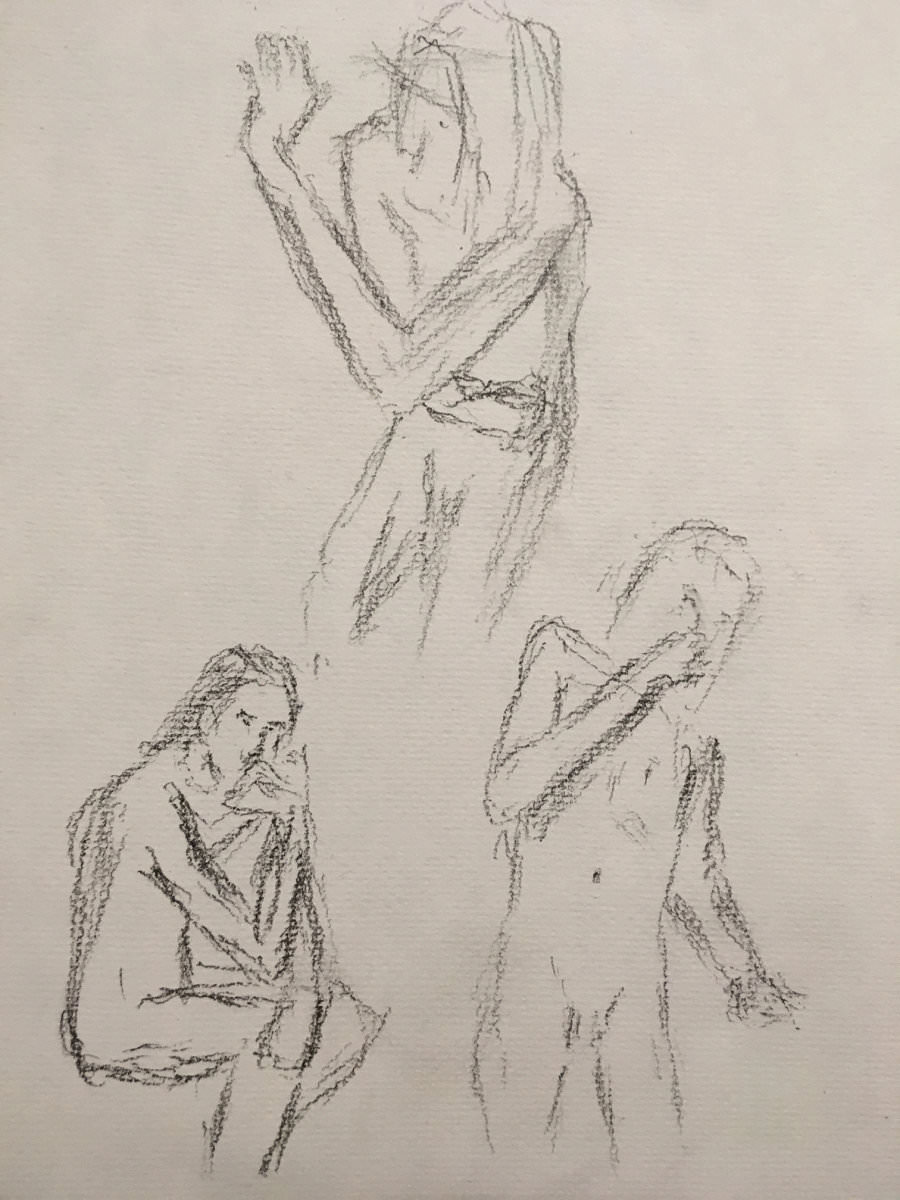


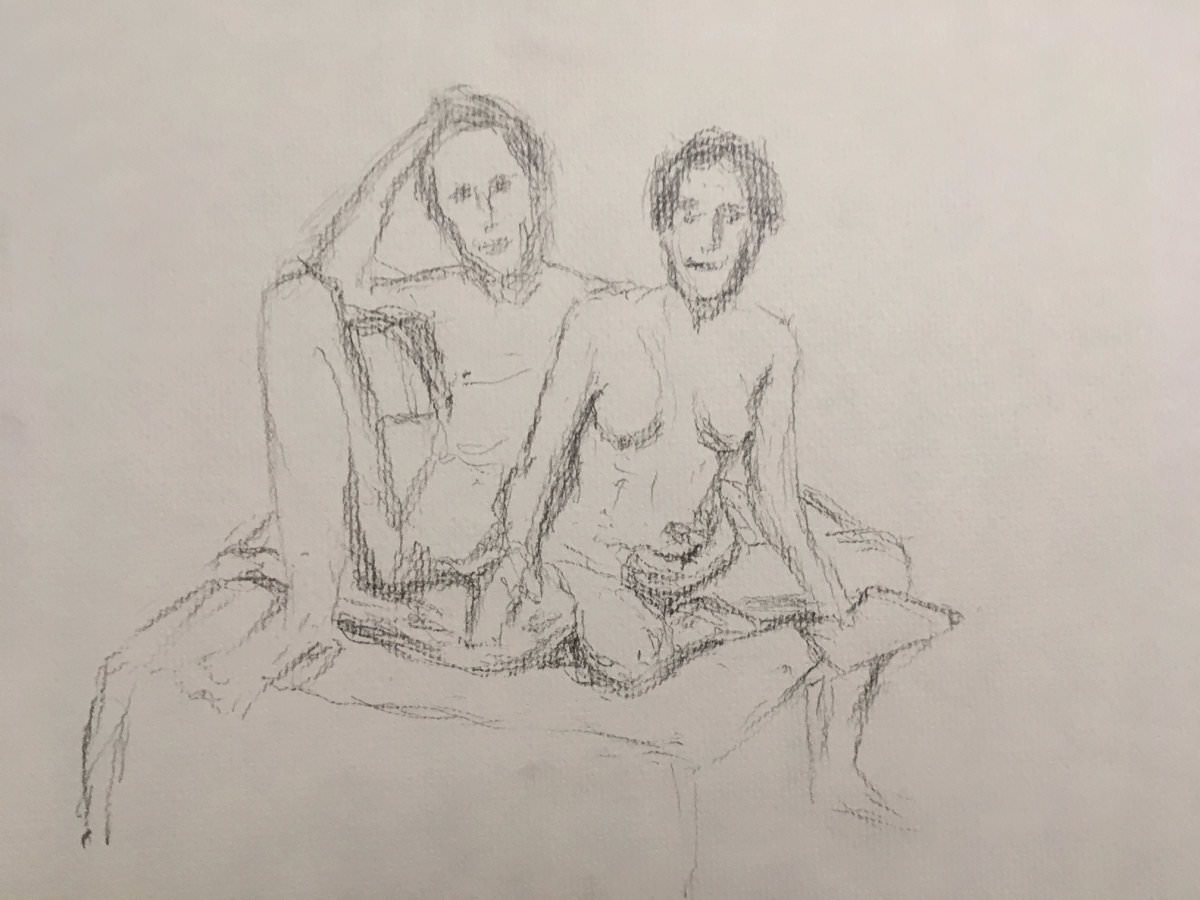

At 7pm, 11 August 2021, with three artists in the room and plenty more online, Esther asked me to get us underway with three 5-minute warm-up poses. Not any old poses either. She wanted me to show vulnerability (I cringed and raised one protective arm), curiosity (I rubbed my chin and gestured outward) and masculinity (I tried to come up with a form that’s not essentially toxic, and settled on the masculine figure of Rodin’s ‘The Thinker‘ – or as close as as my scrawny figure could replicate).
Art from the room: Richard Norman.


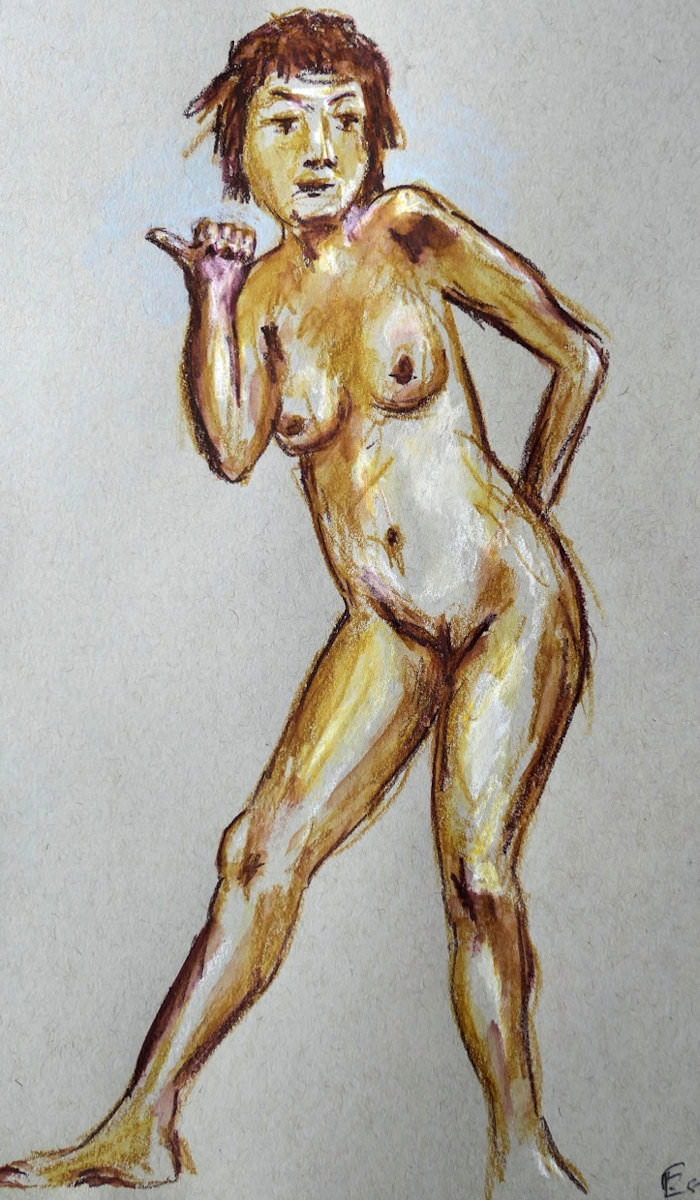


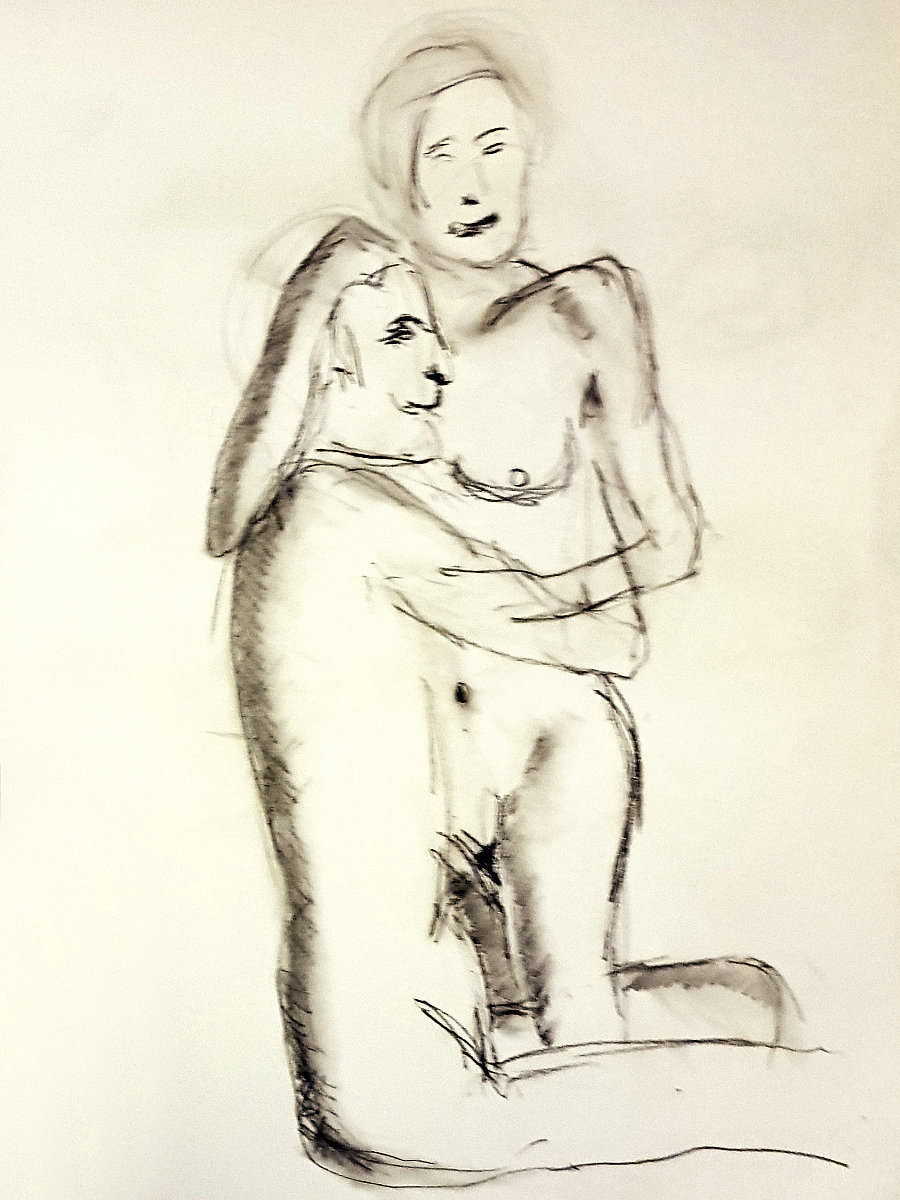
Next it was Esther’s turn to go solo. She opted to represent of female sexuality with a slow-motion dance movement pose to music. The track lasted 5-minutes, after which she froze in position and spoke more about her subject. I take my hat off to any artist who can do magical things with movement poses, so I go bare-headed for Richard in the room and Sarah online. We completed our first half with duo poses of 15 minutes and 10 minutes; each an intimate embrace.
Art from online: Sarah Davis.

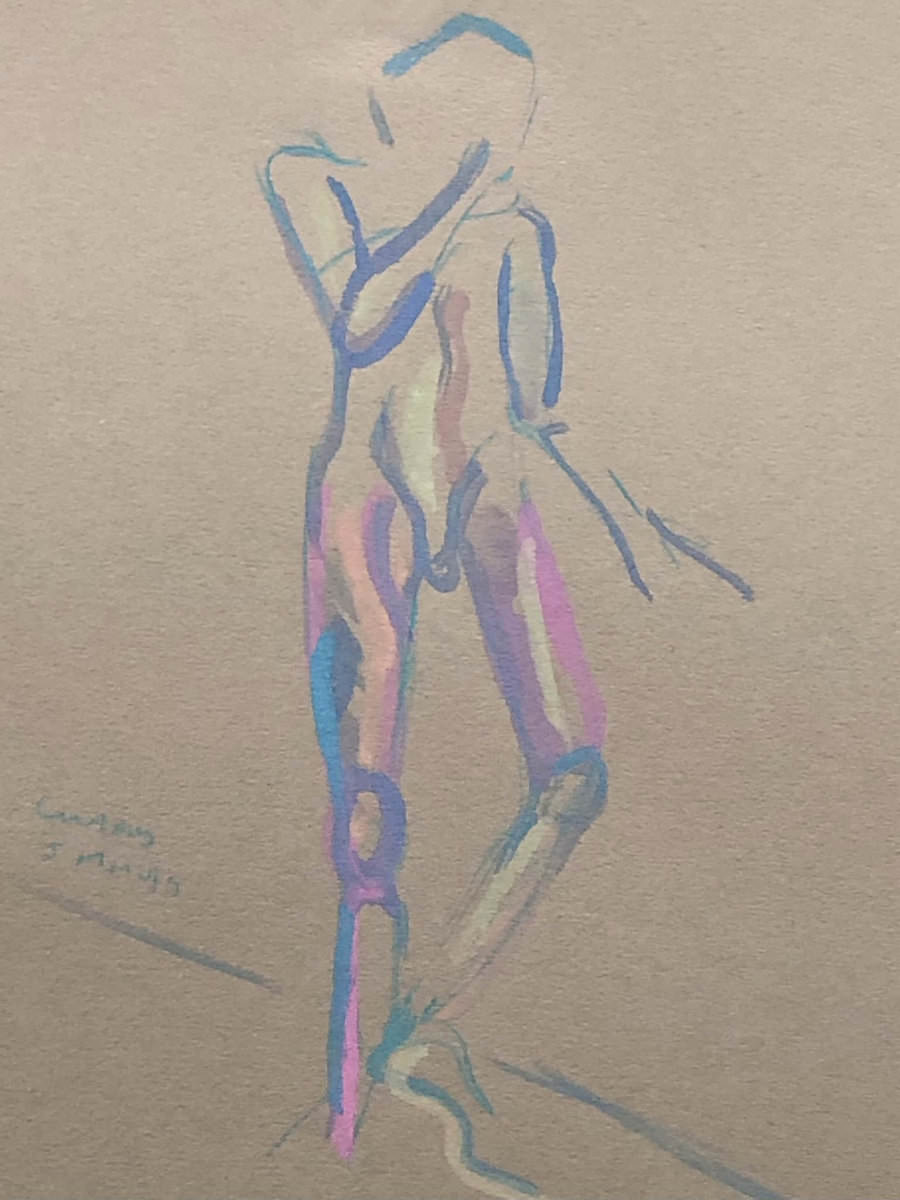
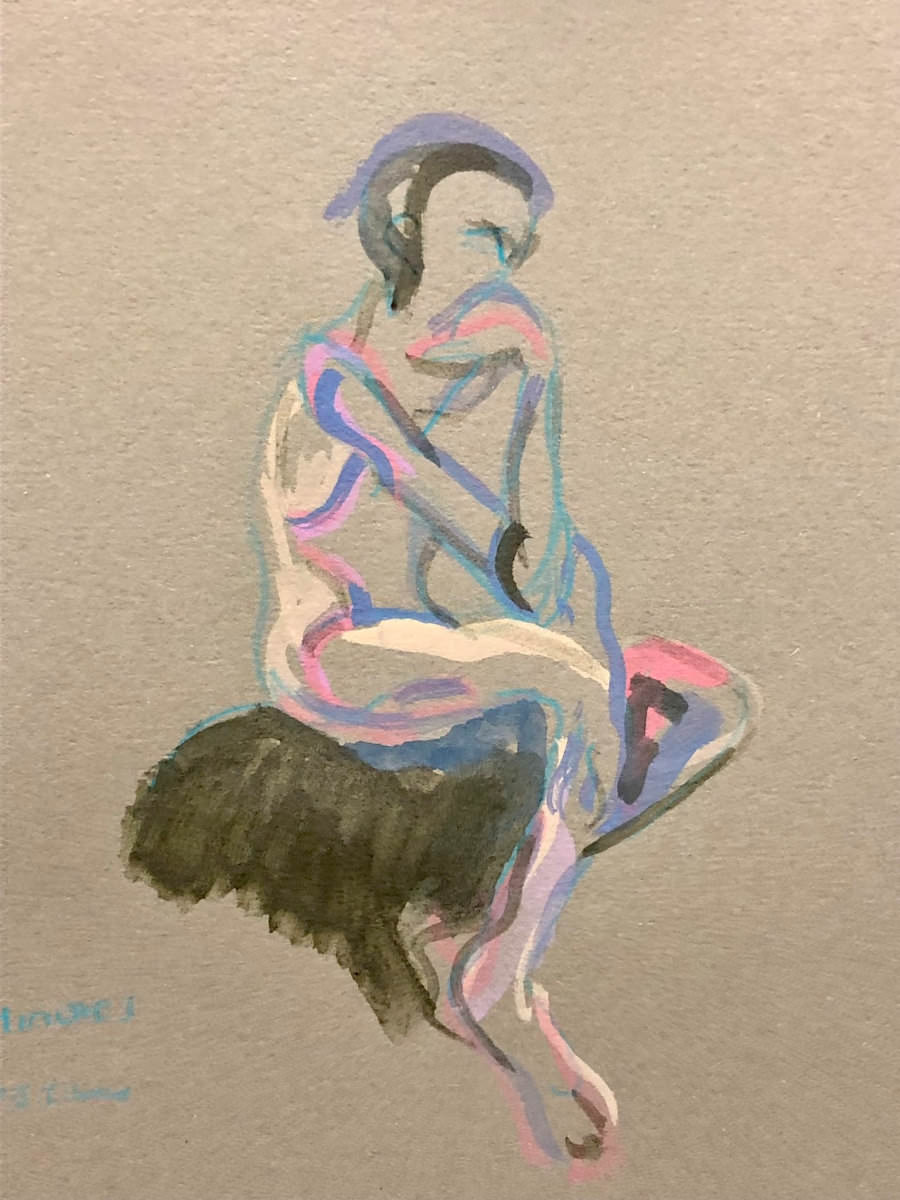


After a break of ten minutes, we completed our evening’s work with two longer poses. For the first we sat side-by-side for 20 minutes, making our own shapes with a gentle connection whilst Esther talked. I blurted a couple of unbidden monologues, although these probably spoke rather more of the red wine I’d swigged at the interval, than our subject matter. We let a playlist take over for our last pose of 30-minutes. By the end, Jane Birkin was moaning in ecstasy as Serge Gainsbourg remained nonplussed.
Art from the room: Steve Wilson.


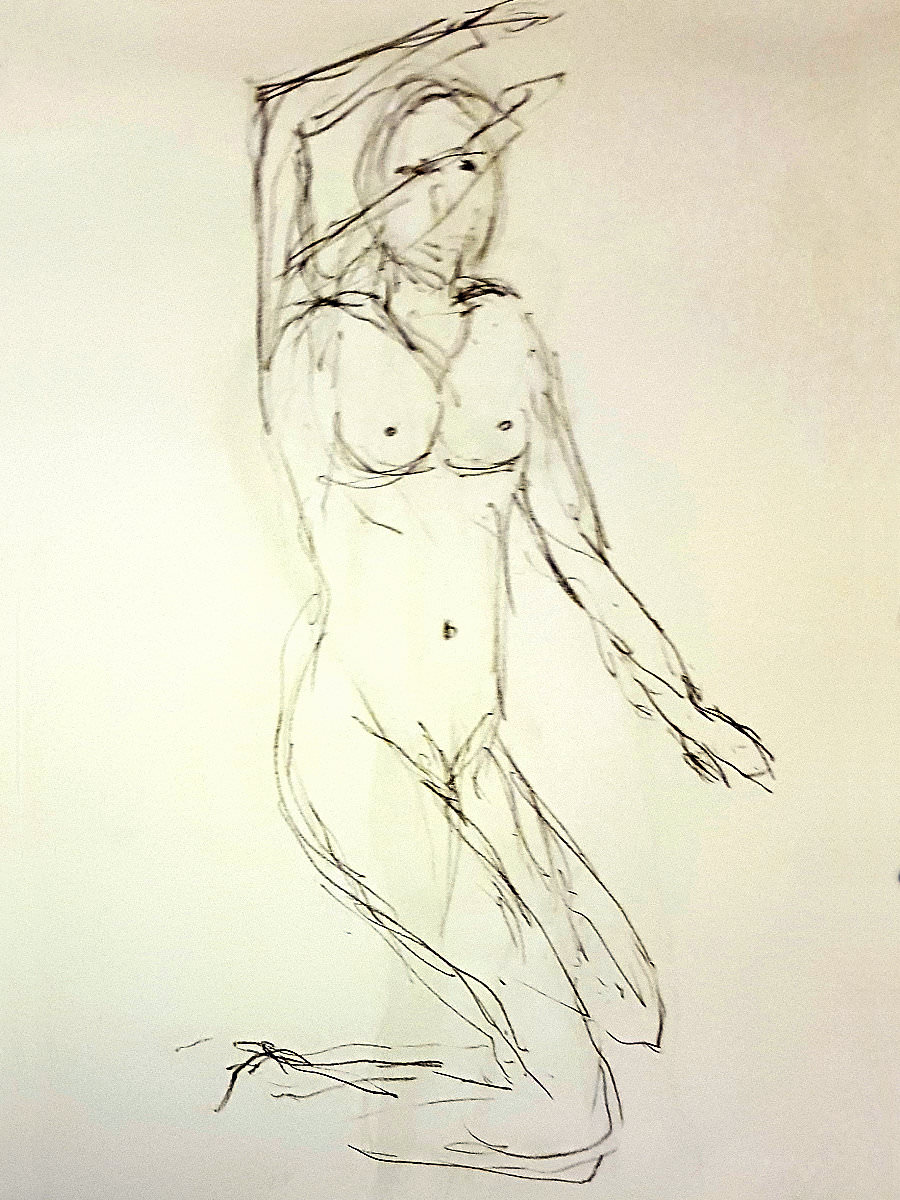


It had been an uplifting two hours. We felt appreciation and warmth, both in the room and online. All artists joined in sharing their works, and several stayed to chat with us afterwards. Life drawing Living Room events are set to continue with different models posing. Get details via spiritedbodies.com and facebook.com/spiritedbodies. You can also enjoy a video of this session, which is still available to watch or download by donation to paypal.me/EstherBunting – email info.spiritedbodies@gmail.com! 😀
Hesketh Hubbard Art Society has booked me to life model at Mall Galleries every few months for over half a decade. It was among the last groups that I’d worked with before the first coronavirus (COVID-19) lockdown, and one of very few with which I’d worked in person during the UK’s brief reopening before its second lockdown.
Whether I’m booked for a portrait pose, one long pose or a short pose format, I always look forward to being present in this setting, mingling with the multitude of characterful artists and being an inspiration for so much strong and idiosyncratic creativity. Even in our happy places, however, not every day can be the best day.
On this occasion I’d been booked for the long-pose slot. It would be my first time back on this format in nearly three and a half years. Where did the time go? As ever, I gave careful thought to a pose I would be required to hold for two periods of 1-hour each. It would be a pose I hadn’t previously used here; angular, but sustainable without pain.
Upon arrival, I changed into my dressing gown, practised the pose I had in mind, and arranged various cushions to provide maximum support at pressure points that might be most vulnerable. I draped my own white sheet over the lot and with a minute to go till 6pm, disrobed and got into position. That’s when things began to go wrong.
I’d bent my legs beneath me, with knees forward and my right hand holding an ankle for balance. One artist didn’t like it; they wanted one foot on the floor, so as not to be “drawing half a person”. Another artist then said I should face to the left to fix the line of composition. Stupidly I complied, turning a tolerable 2 hours into 1h 45m of hurt.
When half-time was called after my first hour with no stretch break, an artist shouted: “don’t move”. Without asking for permission from me or anyone else, they walked up with a stick of charcoal and drew a thick black outline around me – on my own white sheet – with little care about brushing my legs or backside as they went.
Next, come the second half, I’d barely started getting back into pose when they were up again without so much as an ‘excuse me’; fussing about in my space, inches from my face to arrange me how they believed I was before, as though I was incapable of managing myself. As they walked away, they told me bluntly they’re “a control freak”.
It shouldn’t need explaining to anybody that these are breaches of basic courtesies in any setting, and absolutely cross the line of taboo behaviour toward nude models. I’m experienced enough to look after myself but I hate to think younger models might feel that accepting low-level indignities, discomfort or disrespect is all part of modelling.
I must stress I attach no blame to Hesketh Hubbard organisers who, due to on-going COVID-19 precautions, are unable to move about and directly supervise every pose. Needless to say they were mortified when I later shared my experiences. I have faith there will be no repeat; this was a one-off bad day with an otherwise lovely group.
My concerns may appear petty and trifling at a time when so much of life is a struggle for so many people. In this instance, however, it’s not so much what occurred as what it represents. There is an inherent vulnerability to nude modelling and once we start to normalise the crossing of lines, it creates a potential for worse to follow.
I would all ask those who attend life drawing groups anywhere to remember:
- artists must remain a respectful distance from models while they’re working and never touch models when they’re unclothed or in pose
- whilst artists may wish to share ideas with models for poses or modifications, each model must be allowed to decide what’s right for their own body
- professional models provide artistic challenges for the group as a whole – artists must not treat group sessions like a private commission
Finally, a huge thank you to the organisers and countless artists of Hesketh Hubbard Art Society, who have always been so welcoming, friendly, courteous, respectful and encouraging over many years. I recommend the group to any aspiring model or artist. Rare bad days can happen anywhere. I share only so we can all be better together.
Many thanks to the two kind artists who shared their wonderful works, below.

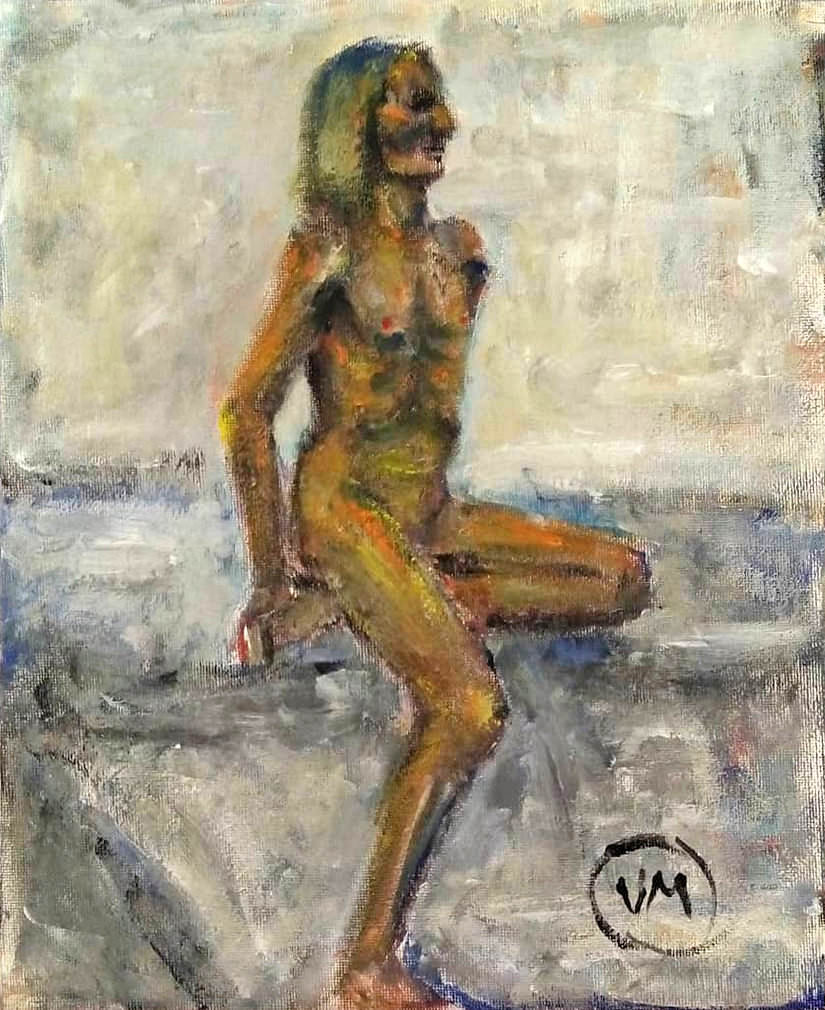
Painting by Vanya Marinova.
Such joy to be back for Life Drawing at The Birds! My last booking here was 7 April 2020; except… it wasn’t. Just 15 days before, the first UK-wide coronavirus lockdown had been declared. Overnight, diaries were wiped clean and futures left unclear. That booking and all others between mid-March and mid-August 2020 were cancelled. Yet here we are again, summer of 2021, returning at last to this wonderful space.

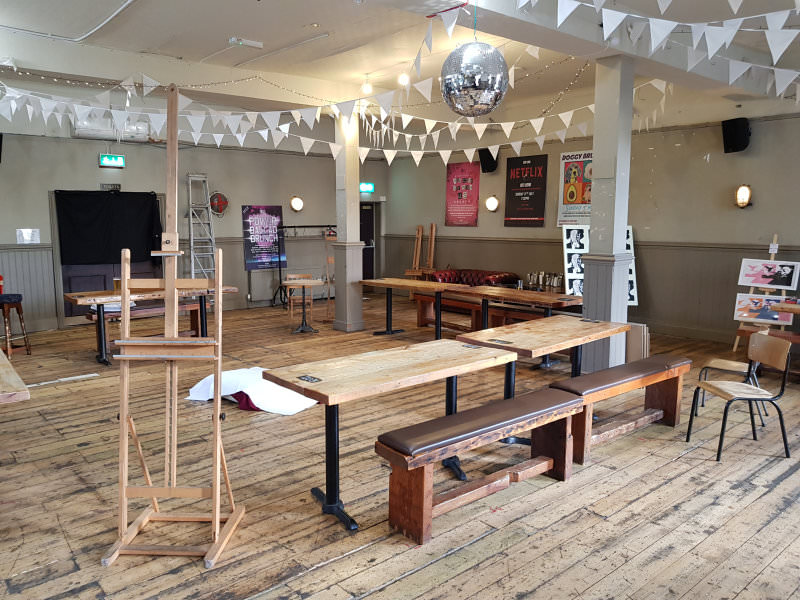
It was a warm evening with intermittent drops of rain during my journey to The Birds. My climate shock came, however, when I entered the upstairs event room and found its air conditioning cranked up to maximum chill. Group organiser, Jenny had needed to cool down after the heavy work of preparing the space. We soon got temperatures back to a bearable level for a naked person though, and began with quickfire poses.

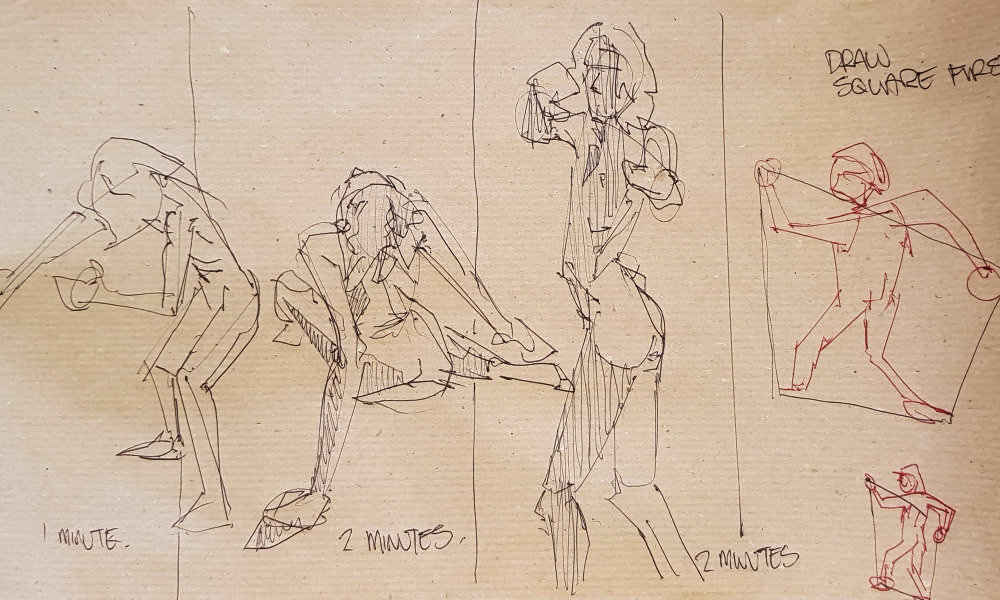


By “quickfire”, I do indeed mean quickfire: four poses of 30 seconds, four of 1 minute, three of 2 minutes. I rattled through a varied sequence, making up each new position as I went along. For the final 2-minutes, Jenny suggested the artists draw a rectangle and try to fit me within it. Rectangle first, model second. A tough ask but it went down well enough for them to try again for the first of two 5-minute poses that followed.


Before our half-time break the artists were given another choice: a 25-minute pose or two of 10 and 15 minutes. With a unanimous show of hands, they opted for the latter. Whether evolution or revolution there’s been a distinct shift in preference from long to short poses at Leytonstone Life Drawing. And that suits me down to the ground. Give me vigour and variety any day.

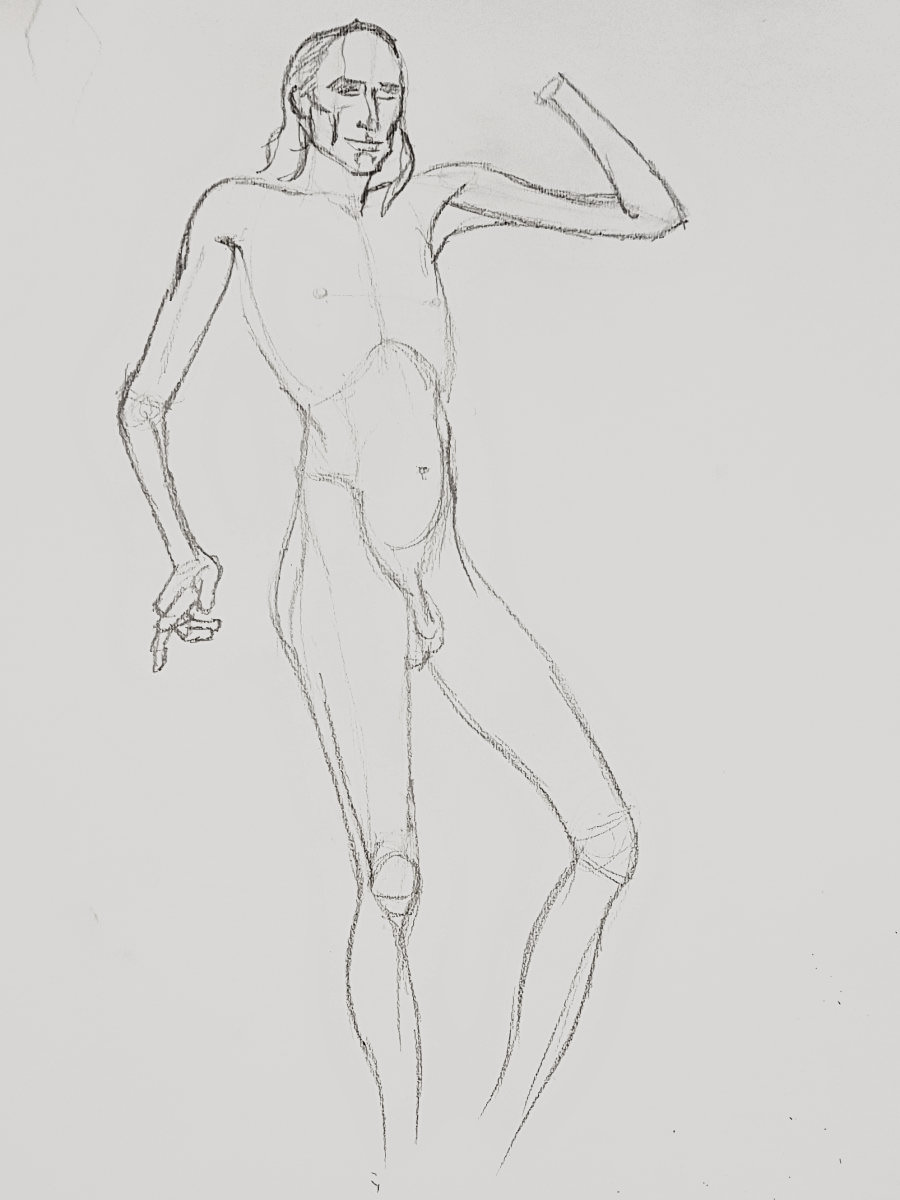

Having got their short pose fix in the first half, normal service resumed in the second. When the artists were given a choice of one or two poses after the interval, the clear preference was for one long pose to take us the distance. I sat upright upon the floor, shaping my limbs into angles that wouldn’t become hideously painful, and there I did remain in static serenity for the next 45 minutes.

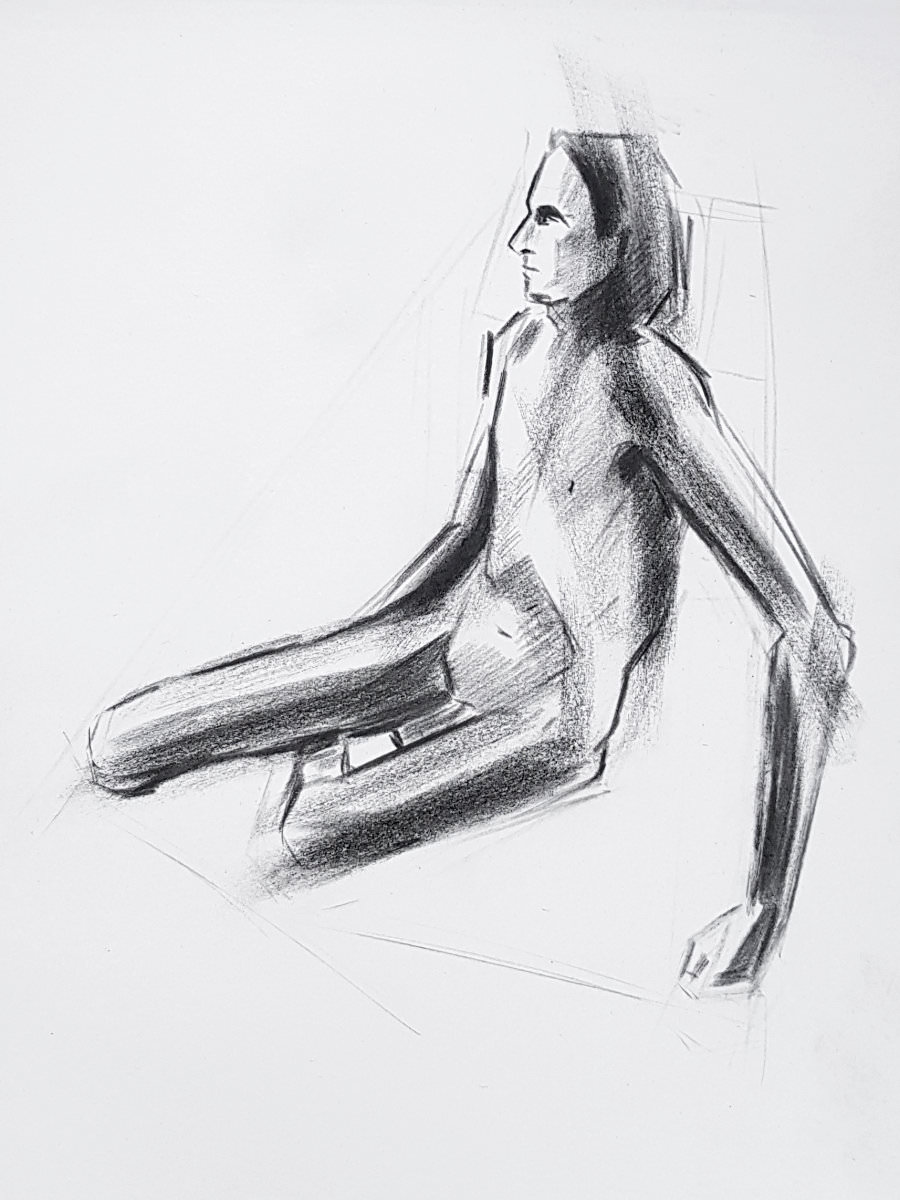


Thus ended a very nice evening. I’d thoroughly enjoyed my life modelling, each artist had – without exception – created good works, and Jenny had been on buoyant form throughout. She asked if I would be happy to model for the group more often, and, of course, I said ‘yes’. Now we just hope future lockdowns can be averted, the business stays afloat and we all stay healthy. These are uncertain times, but we look forward.
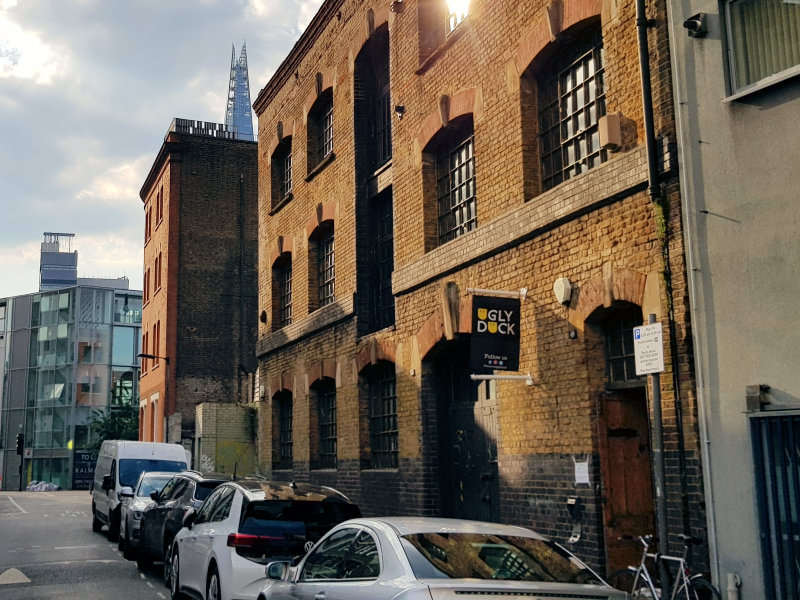
Post-lockdown #3 of our undulating coronavirus (COVID-19) pandemic, Tanner Street life drawing has made a very welcome return. Nothing in life these days seems quite how it was, however; here the group is at the same address, but no longer in the large brick ‘Ugly Duck‘ building. Instead, it now meets in a connected studio to the rear.
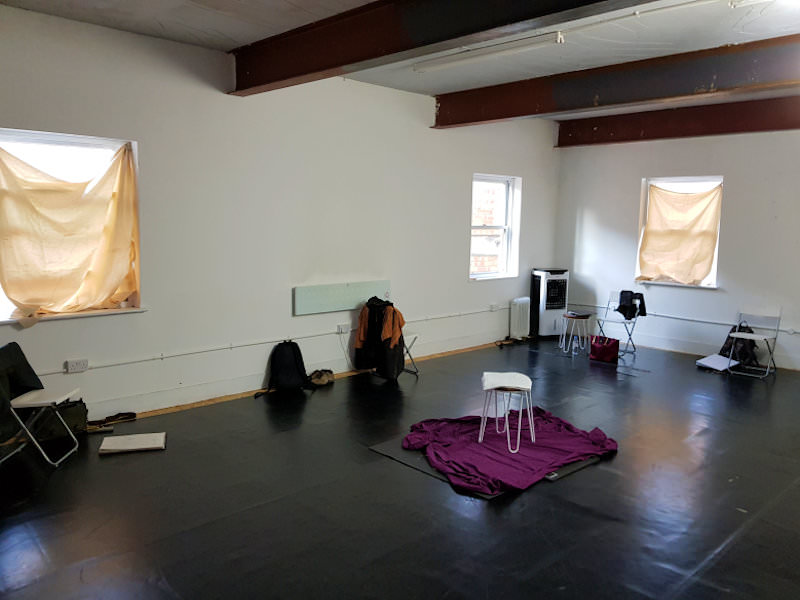
Upon arrival I was greeted by group organiser, Cliff, whose lockdown long-hair growth looked, pleasingly, to be the fruit of a laissez-faire evolution much like my own. In time we were joined by a dozen artists and got underway at 7pm with quick poses: three of 2-minutes and three of 5-minutes each
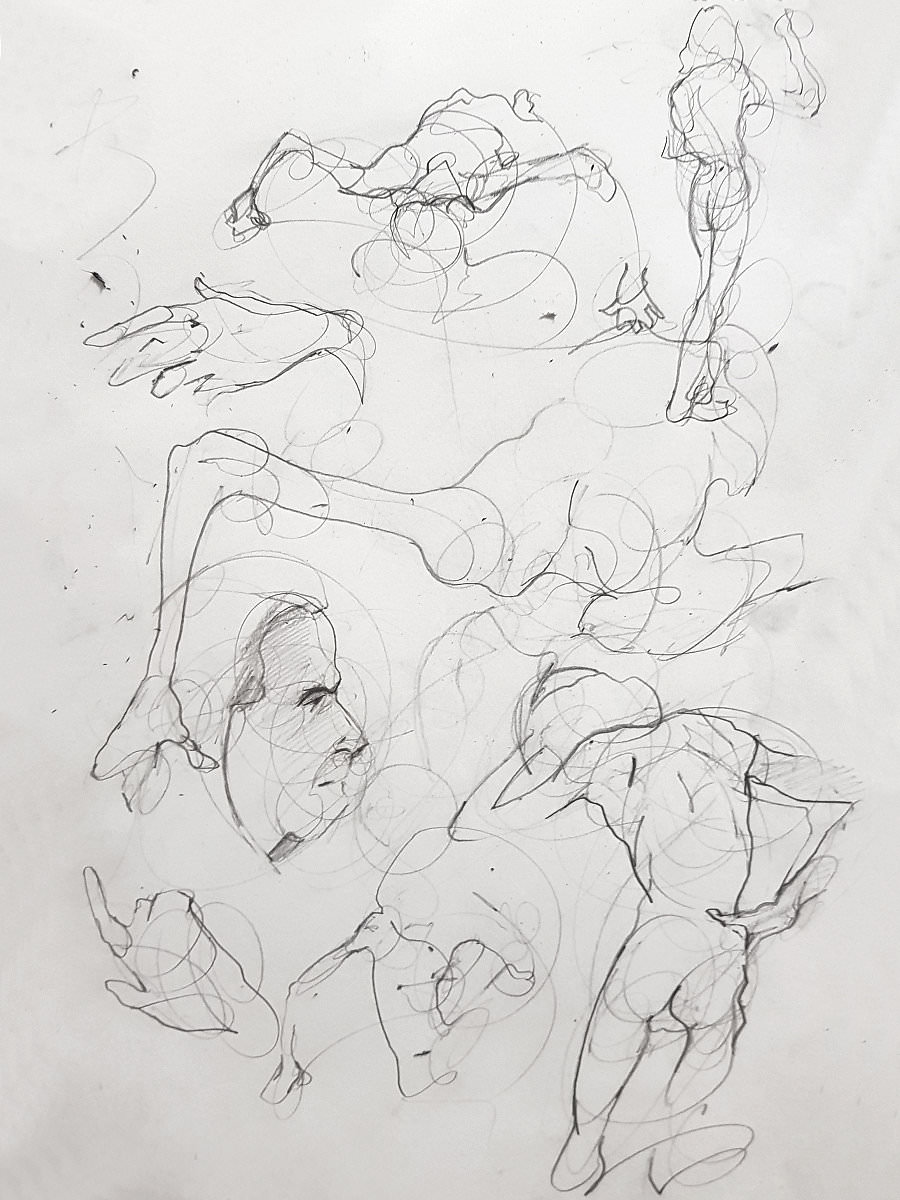

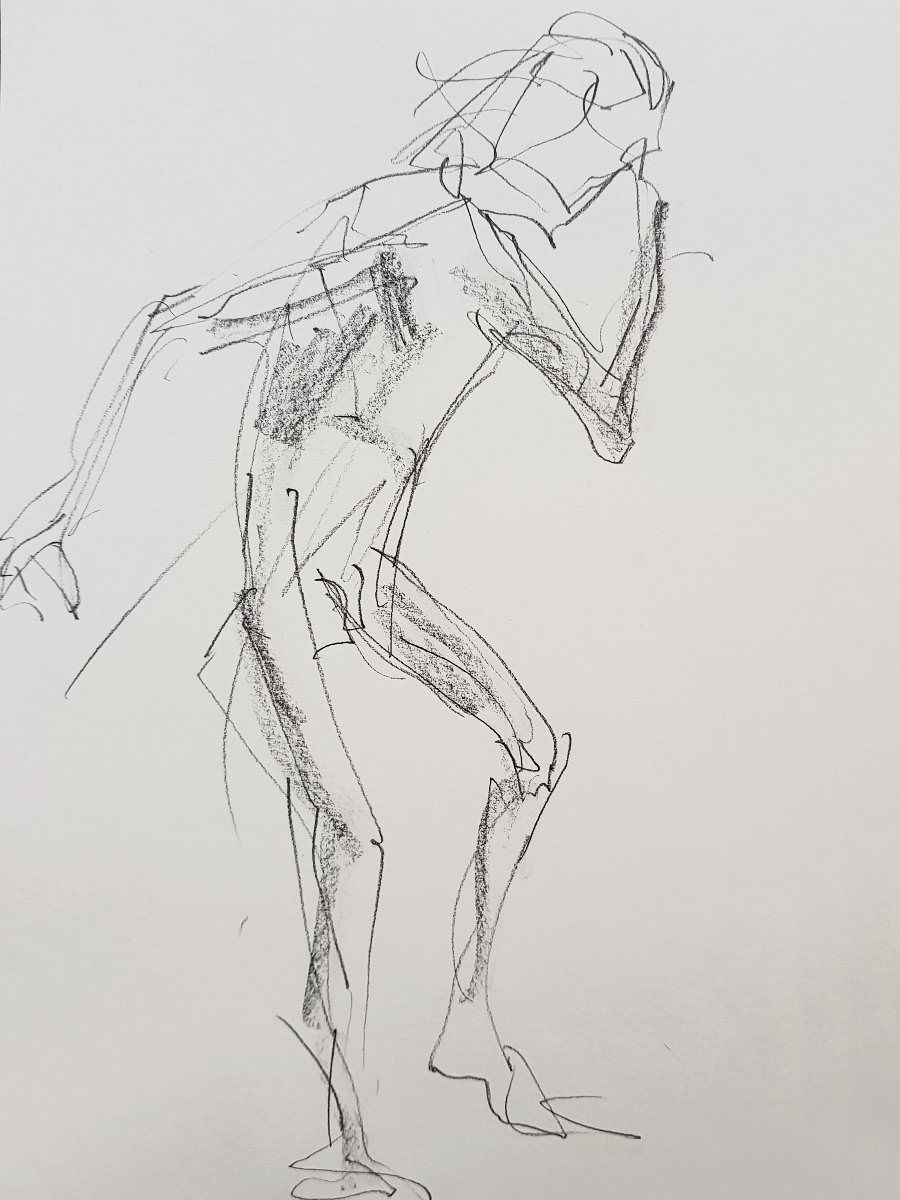
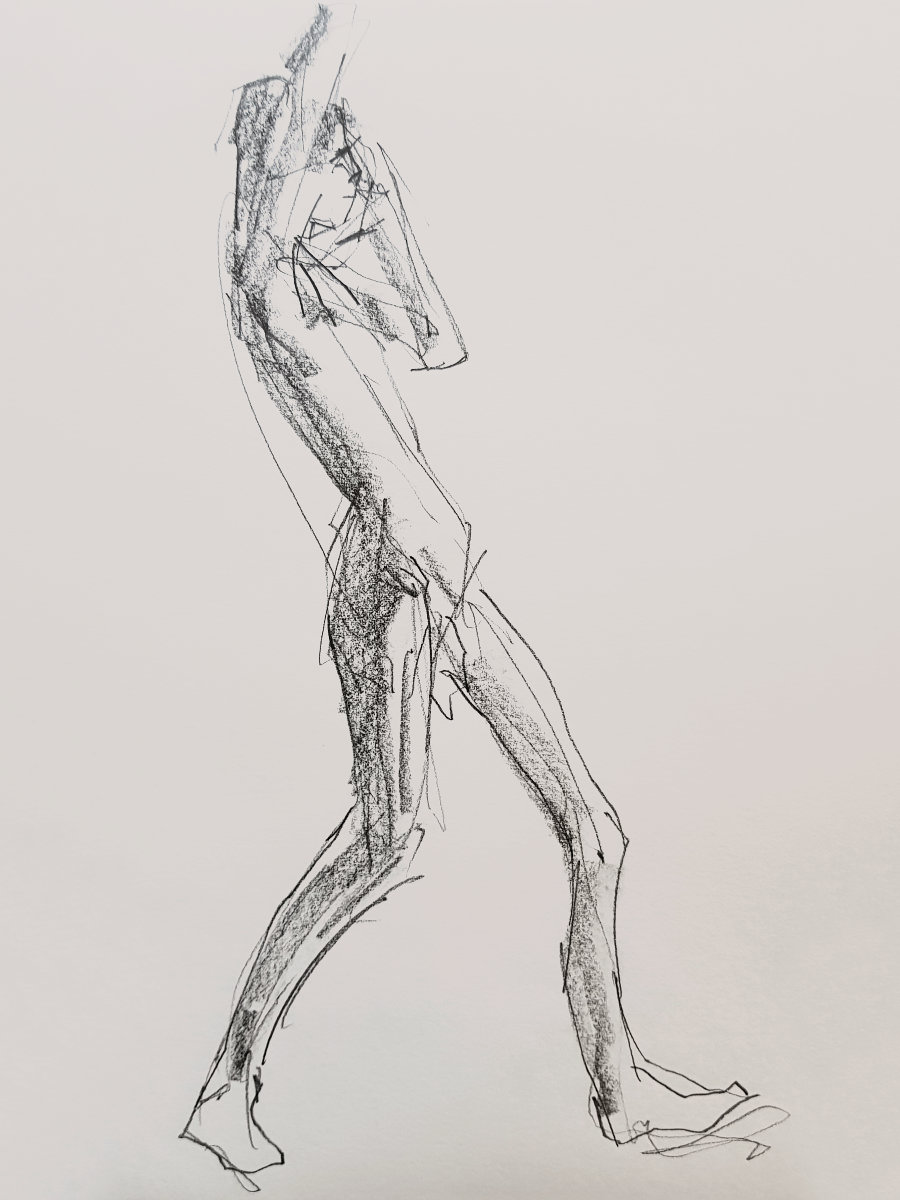
Working in the round, I rotated through a series of poses, adjusting and responding to the relative position of artists, translating my ideas of a silent, invisible communication with them. In these moments, I really felt the full joy of being back doing in-person life modelling. To a degree, short poses are an improvised performance.
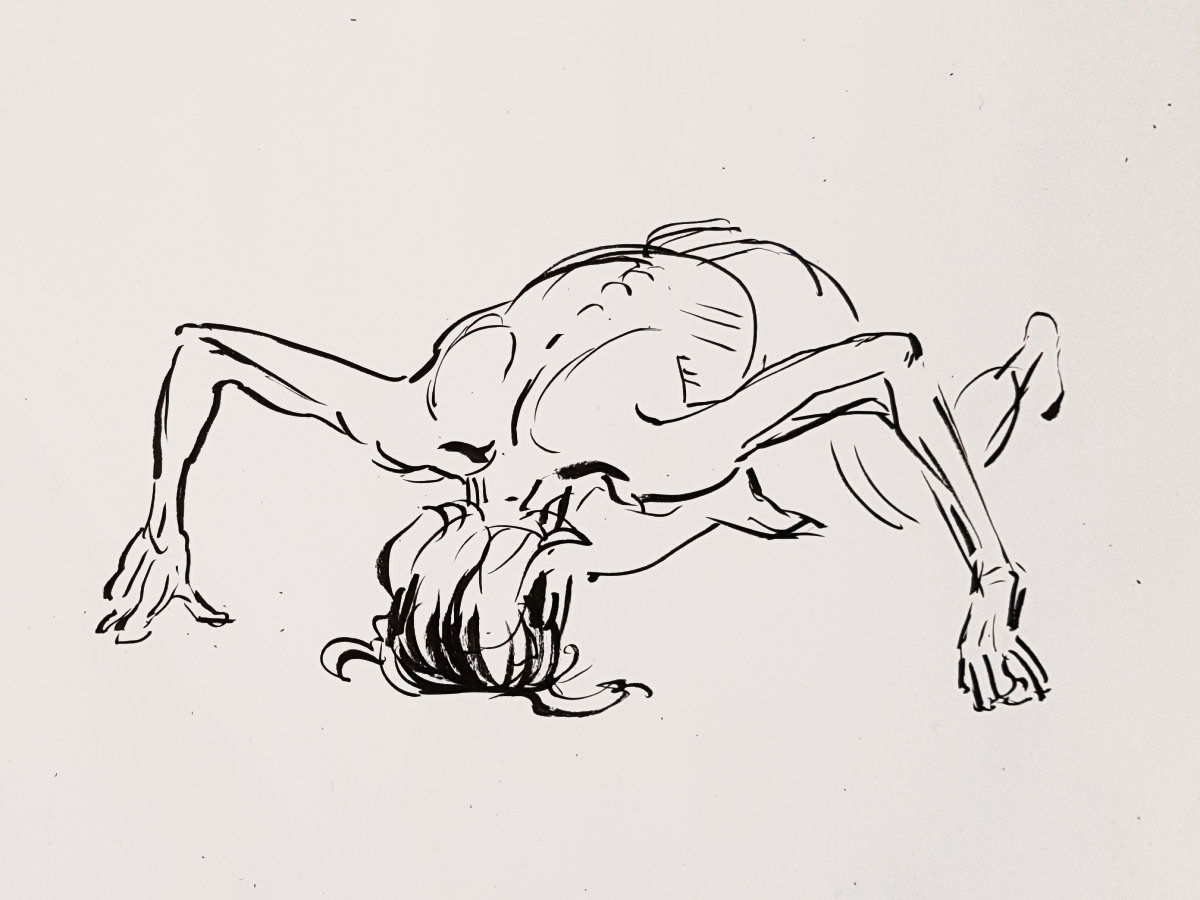

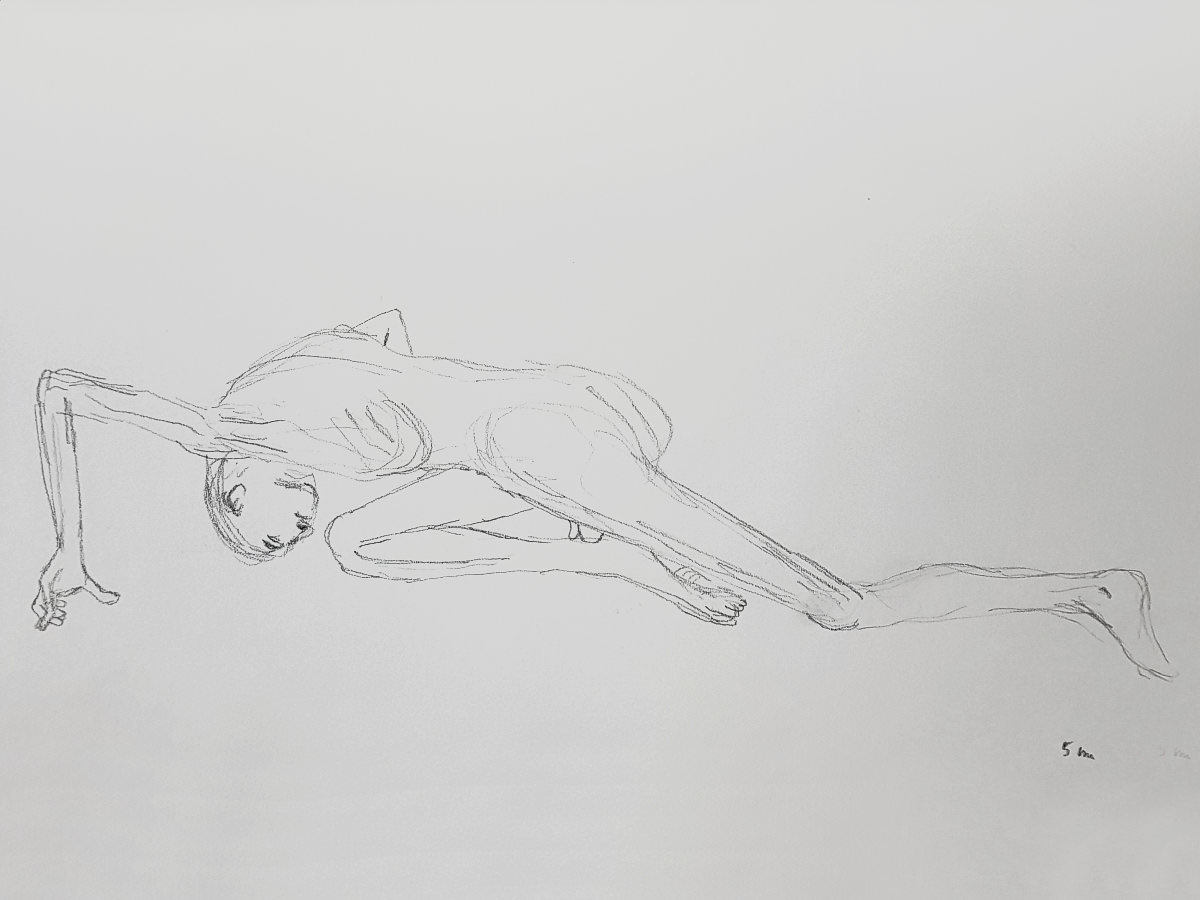
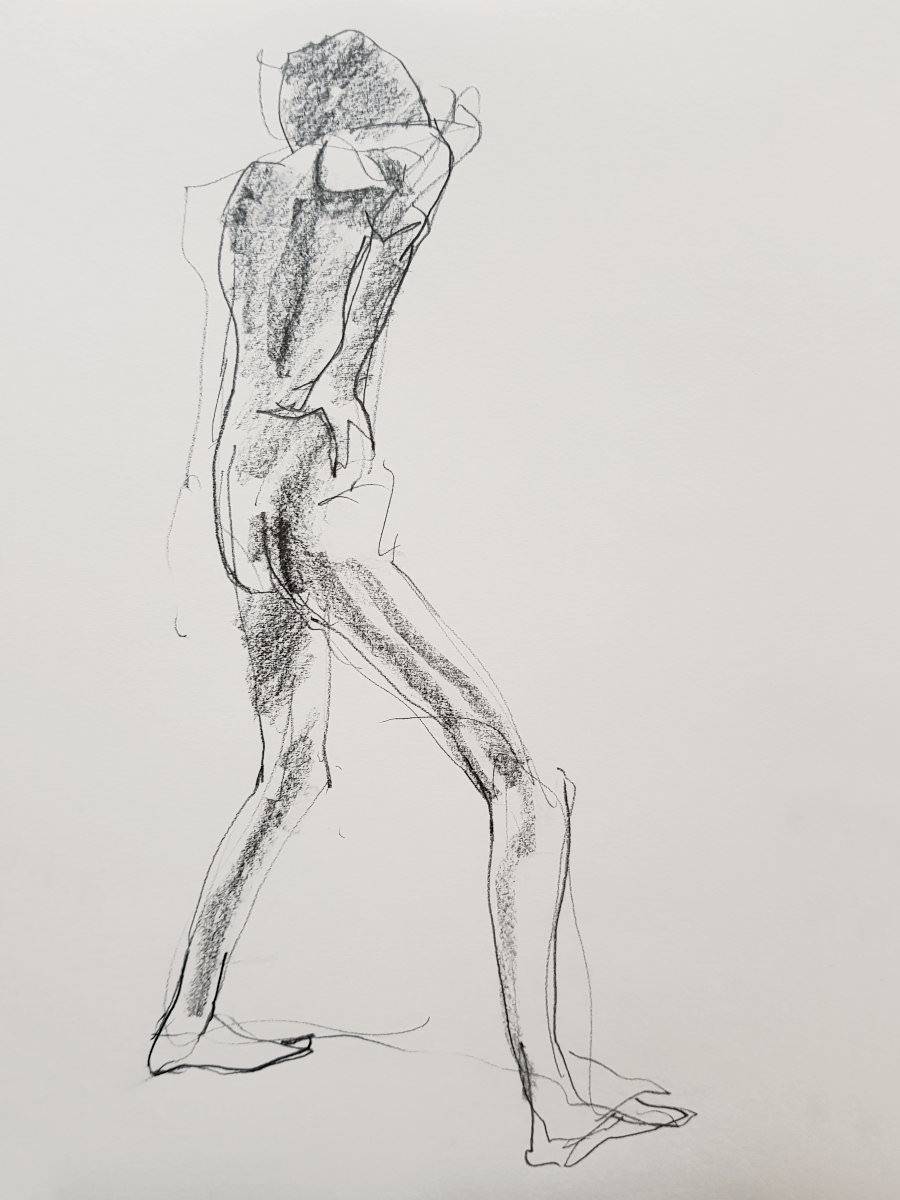
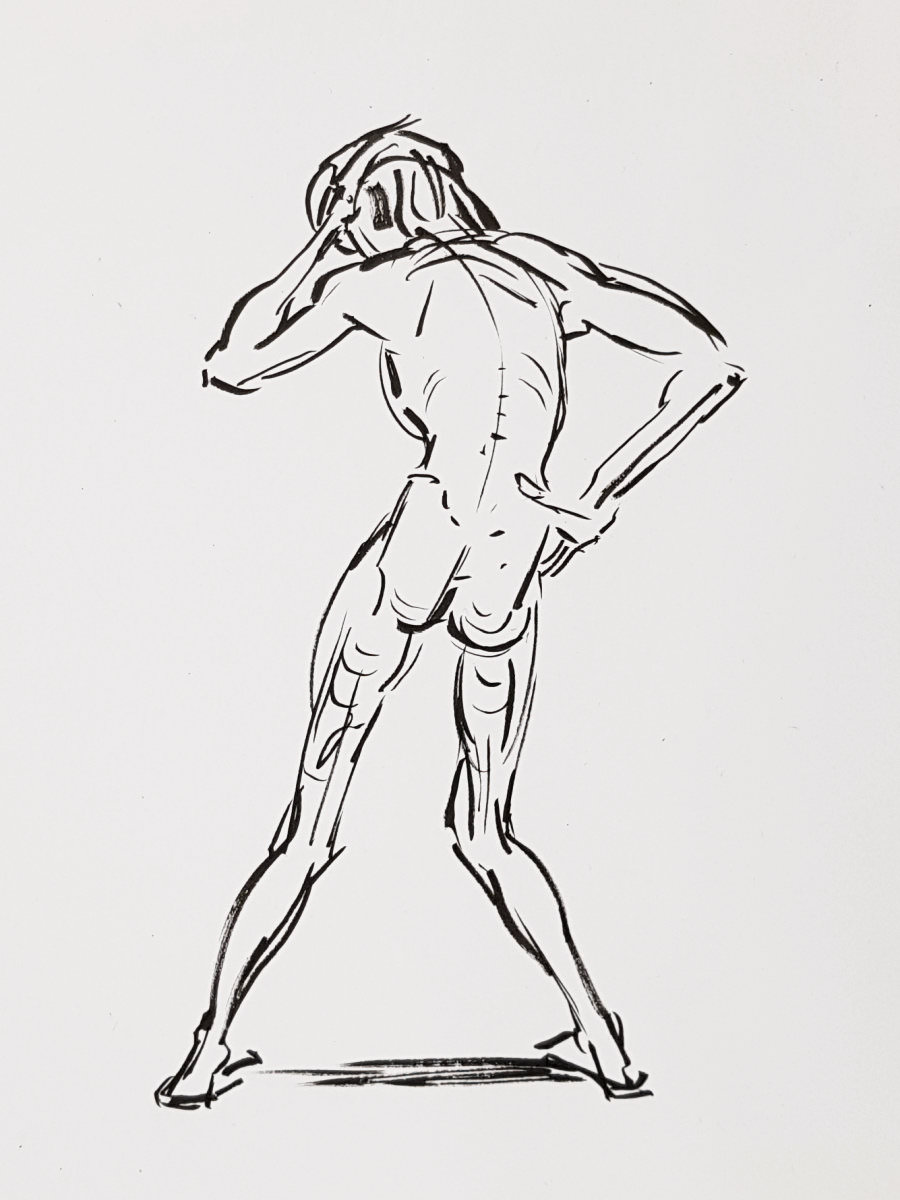
Over-confidence is the muscle killer. For the next 10-minute pose I sat upon the floor and rested my left elbow on my left knee. Alas, enjoyment impaired my attentiveness and I allowed the left arm to tilt inwards a little too far, making this the evening’s most arduous pose. A simple 15-minute standing pose took us to our break.
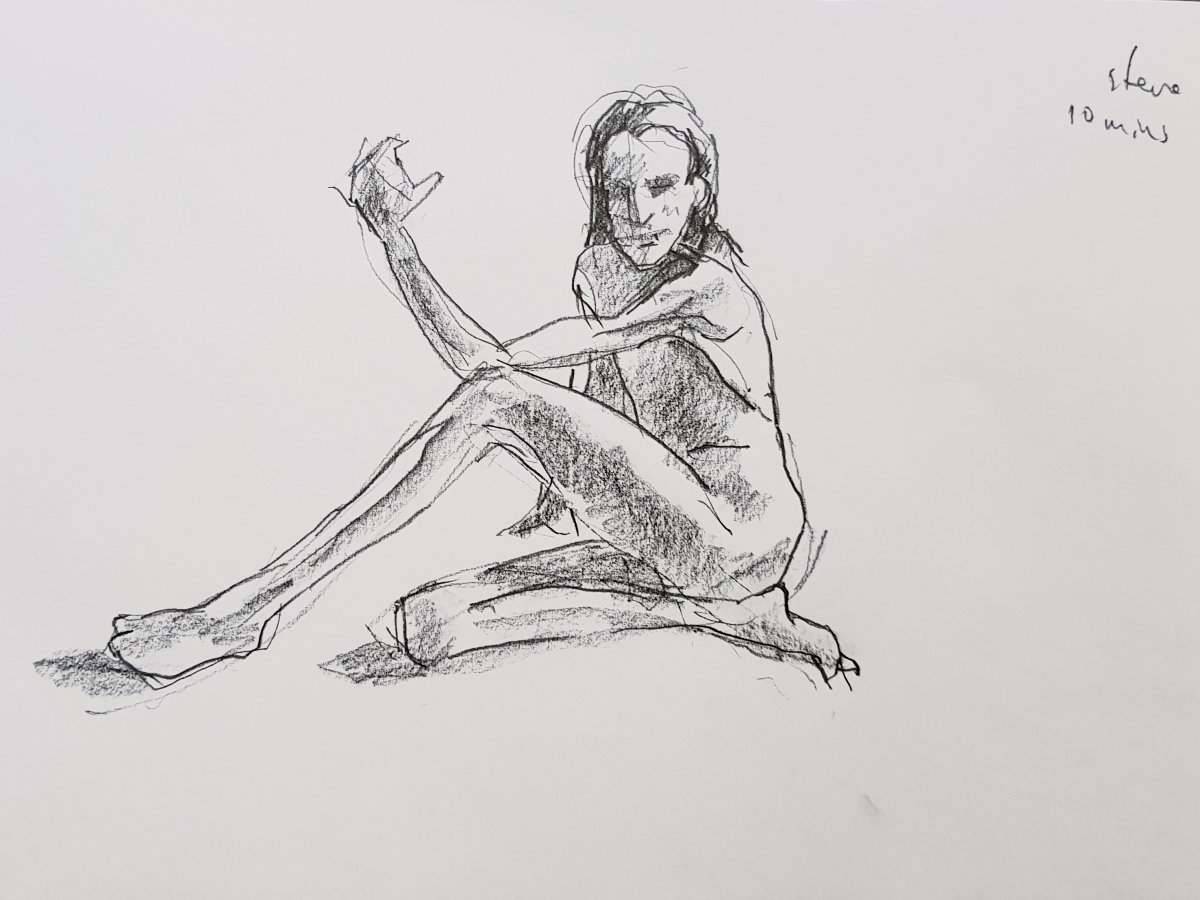


When we resumed at 8pm, it was with a single pose that would occupy all of the final hour. I opted to sit upon a low stool but contrived a few bonus angles to make it more interesting from every vantage point. During my two stretch breaks, I remained sitting to avoid the need for lots of place marking. I was aching by the end, but it was good.

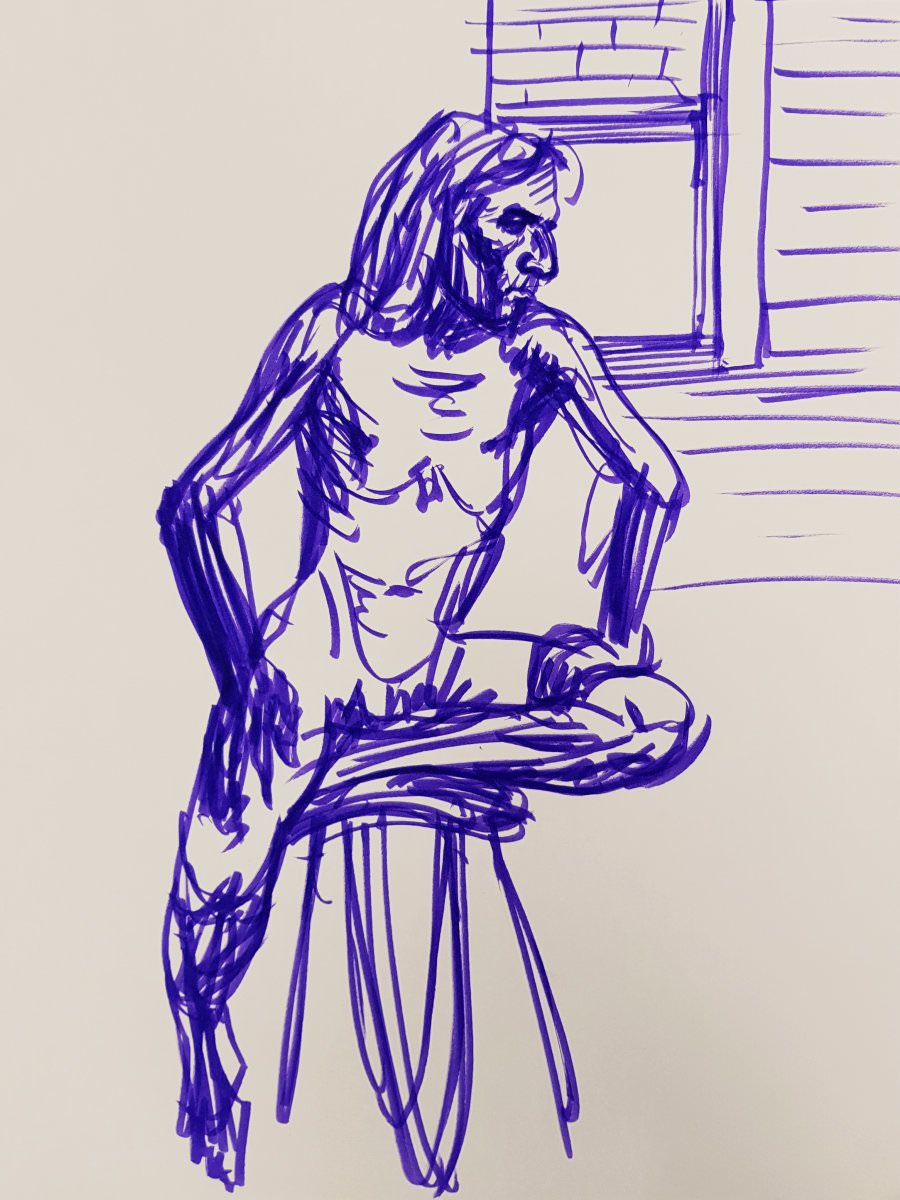


The new Tanner Street life drawing space is perfect. The previous space was so vast that, whilst artists might have appreciated room to move and spread out, I sometimes felt remote and detached in its cathedral-like atmosphere. The smaller space is clean, clear and feels more intimate without being crowded. I hope it remains a success.
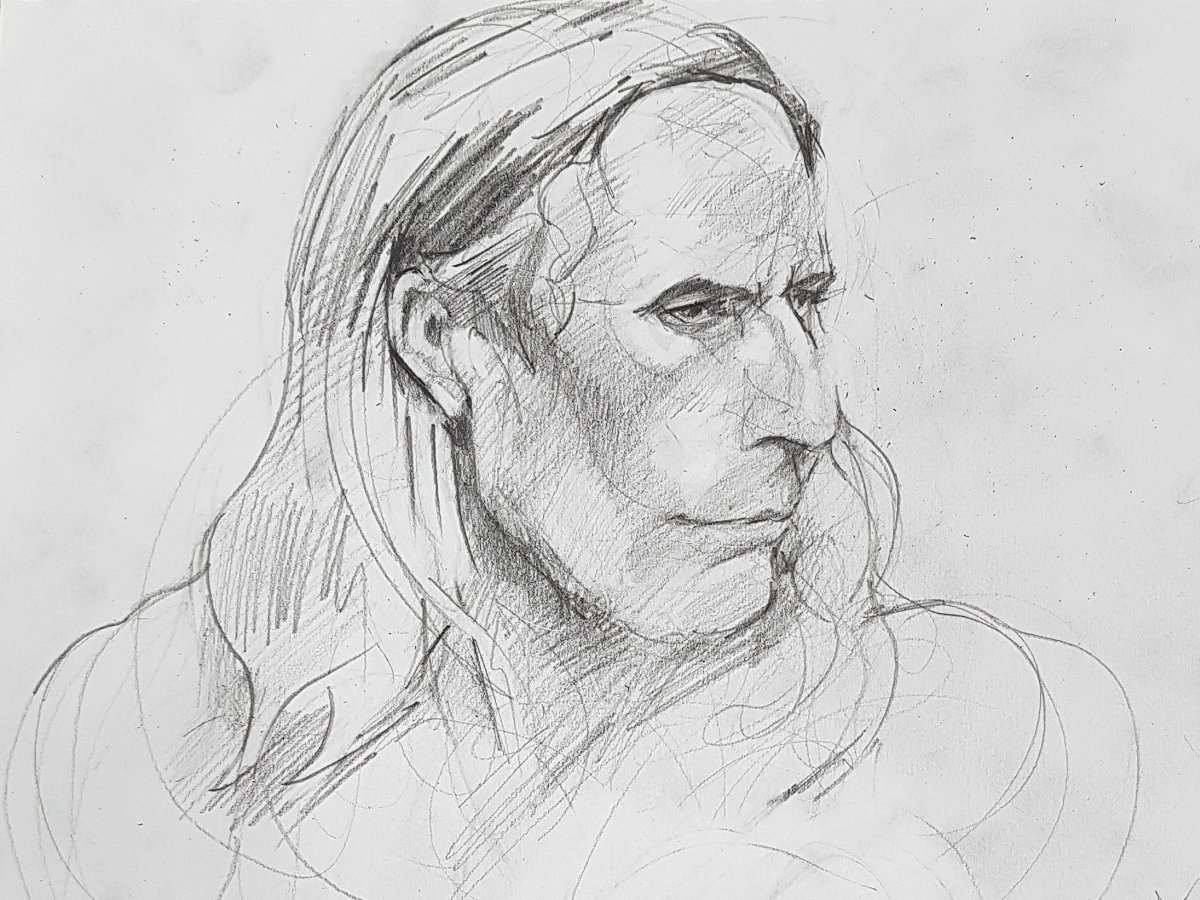
Through the cold dark months of winter, coronavirus (COVID-19) lockdown number 3 seemed tougher than the two that preceded it. There was precious little in-person life, let alone in-person life modelling. I had a couple of tries at the online version – one in March and one in April – but it wasn’t until this booking at The Conservatoire that at last, in 2021, I could once more stand in the presence of artists and do my thing.
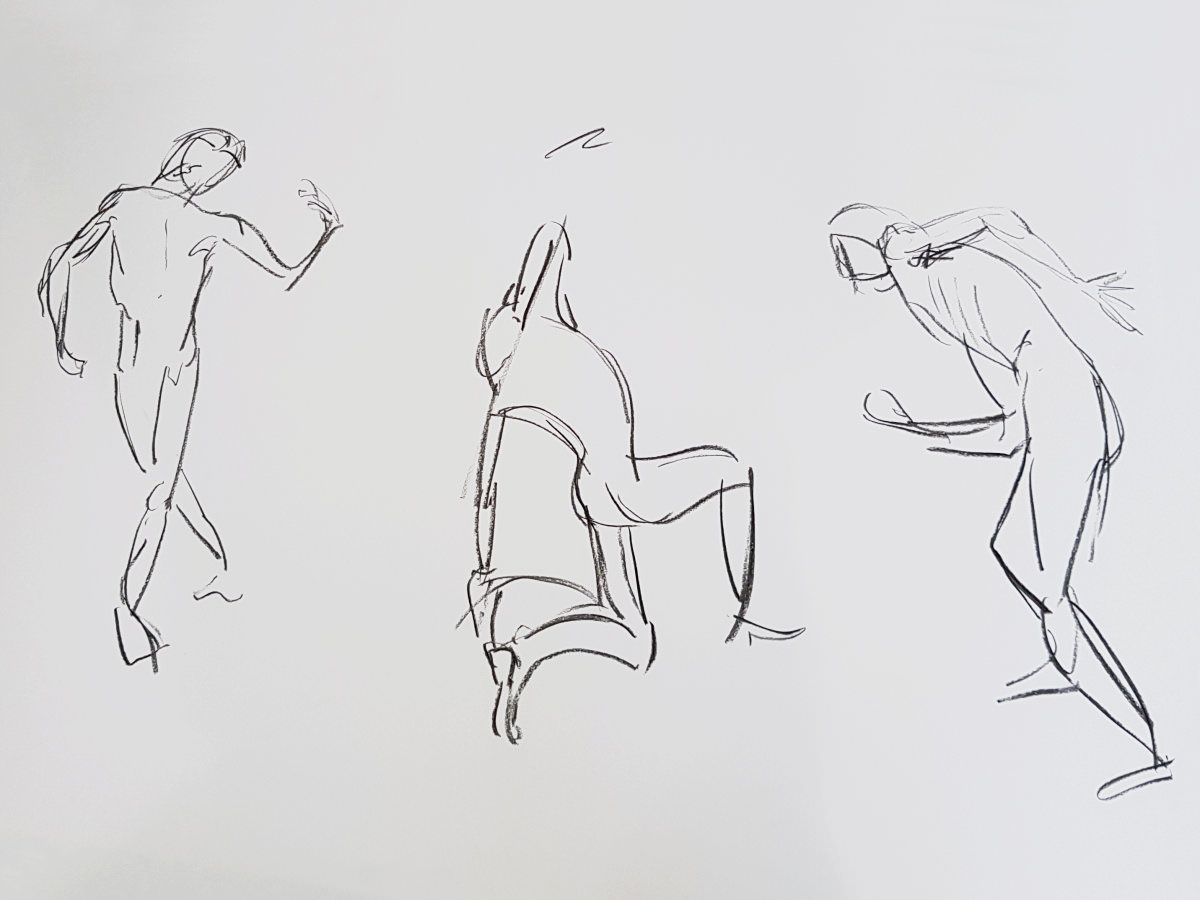
Tutor Victoria Rance was one of the few people I’d had a chance to catch-up with as lockdown eased. We’d met outdoors a couple of times by her wonderful ‘In Real Life‘ installation at Cable Depot (I feature in her film ‘Myth‘). Now here I was, posing in the round for her and seven artists. I counted down to call the times for our opening three 1-minute poses. Next came poses of 5 and 10-minutes, give or take a few minutes…

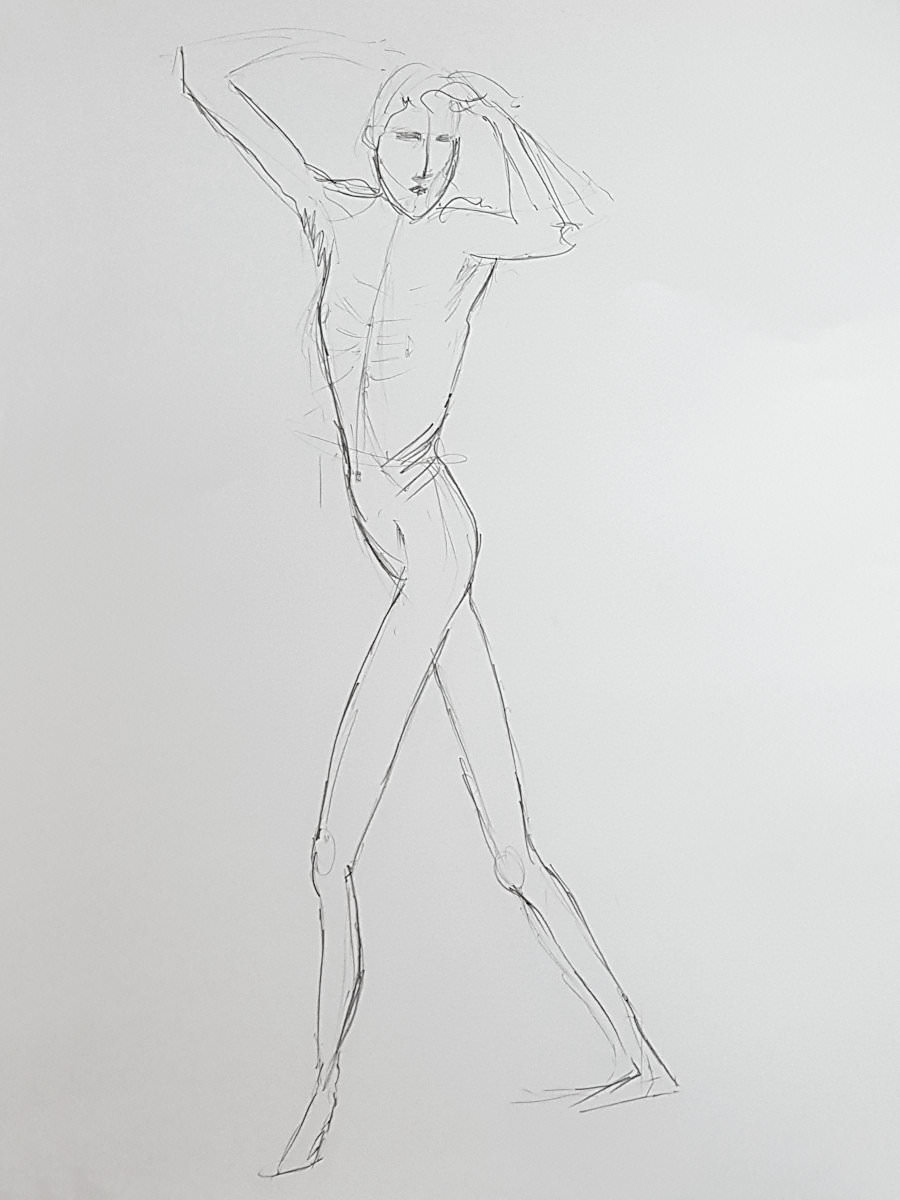

These quick poses got us warmed-up from 7:30pm to 8pm, and would be followed by one long pose up to 10pm. When Victoria asked what I would like to do, I said I didn’t mind as long as it wasn’t a back-bend. She looked a little disappointed but I’m far too rusty to be bending backward for two hours – even with three breaks! Instead I stood symmetrically upright with hands on hips; Victoria likes me to be symmetrical.
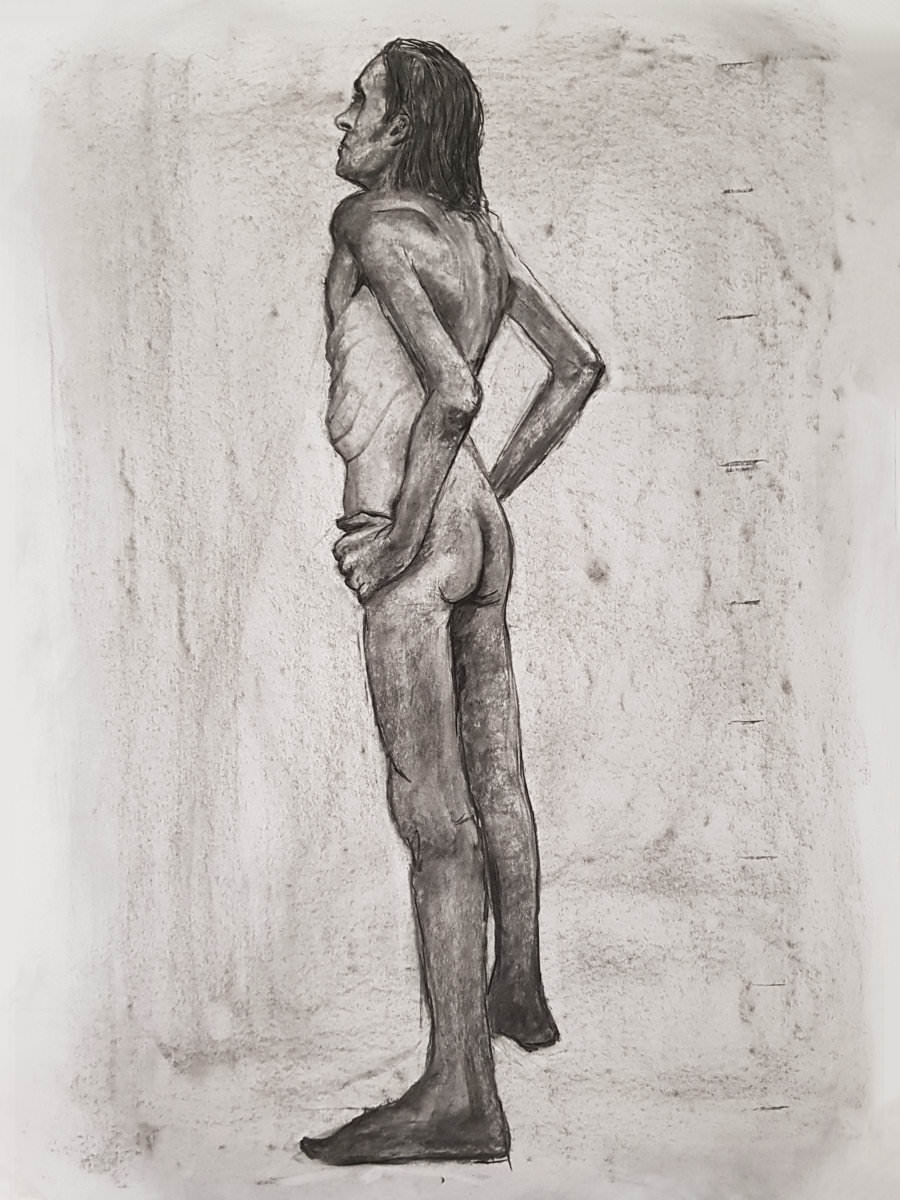
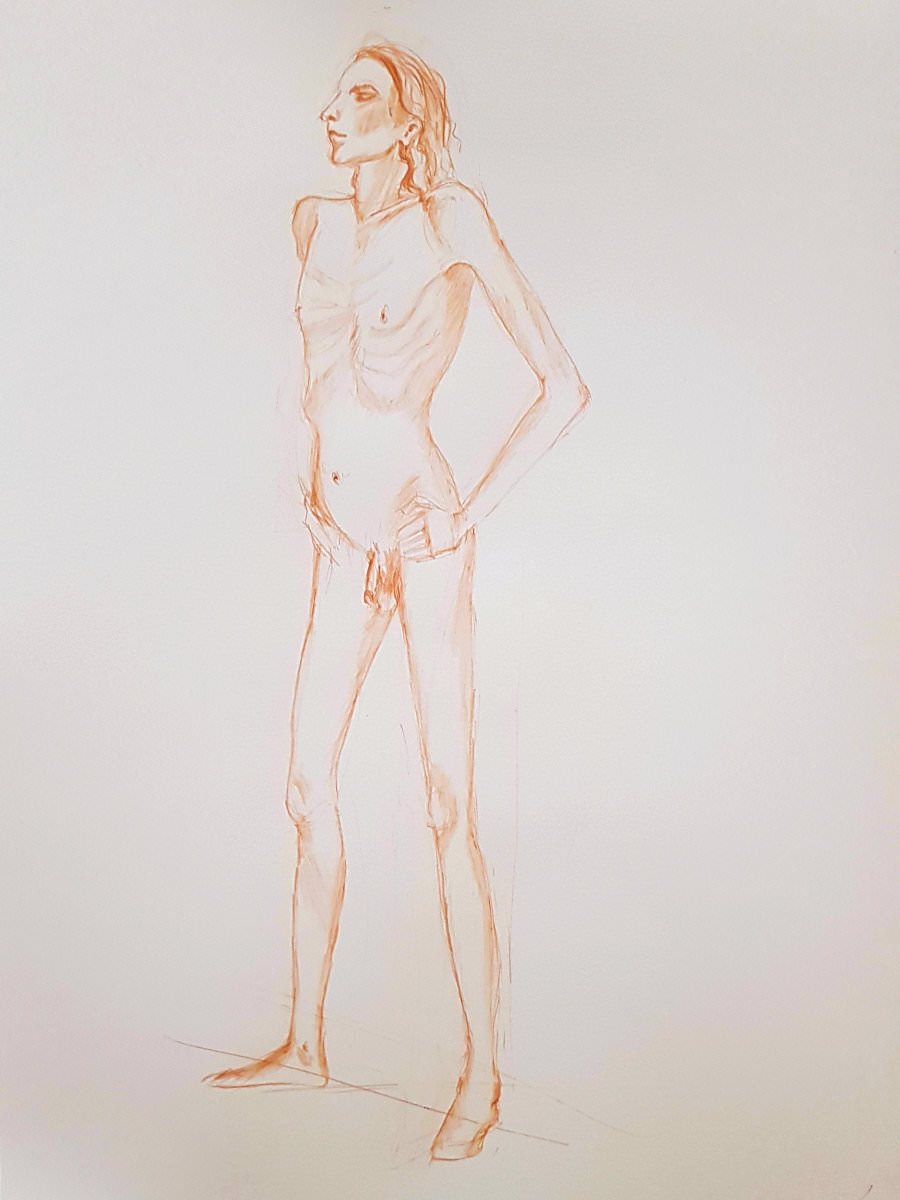
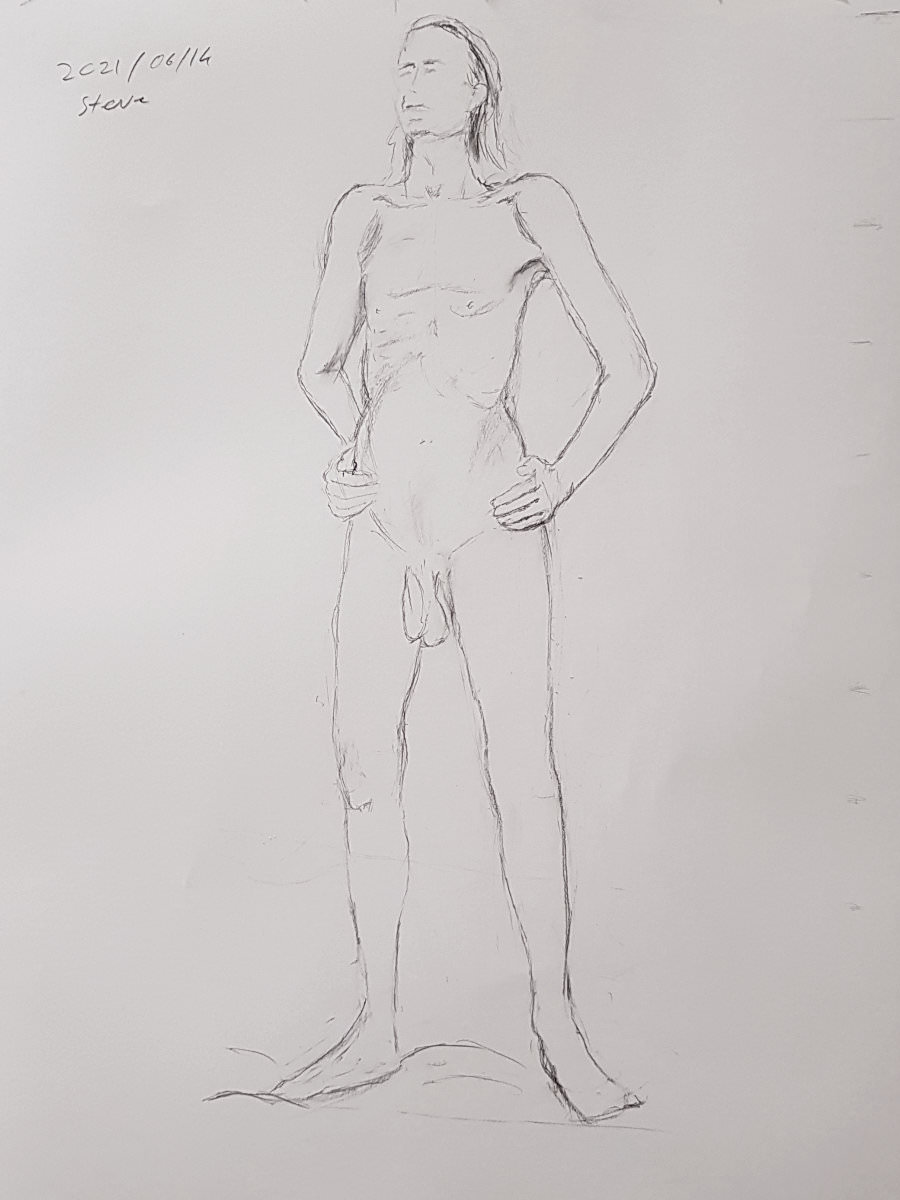

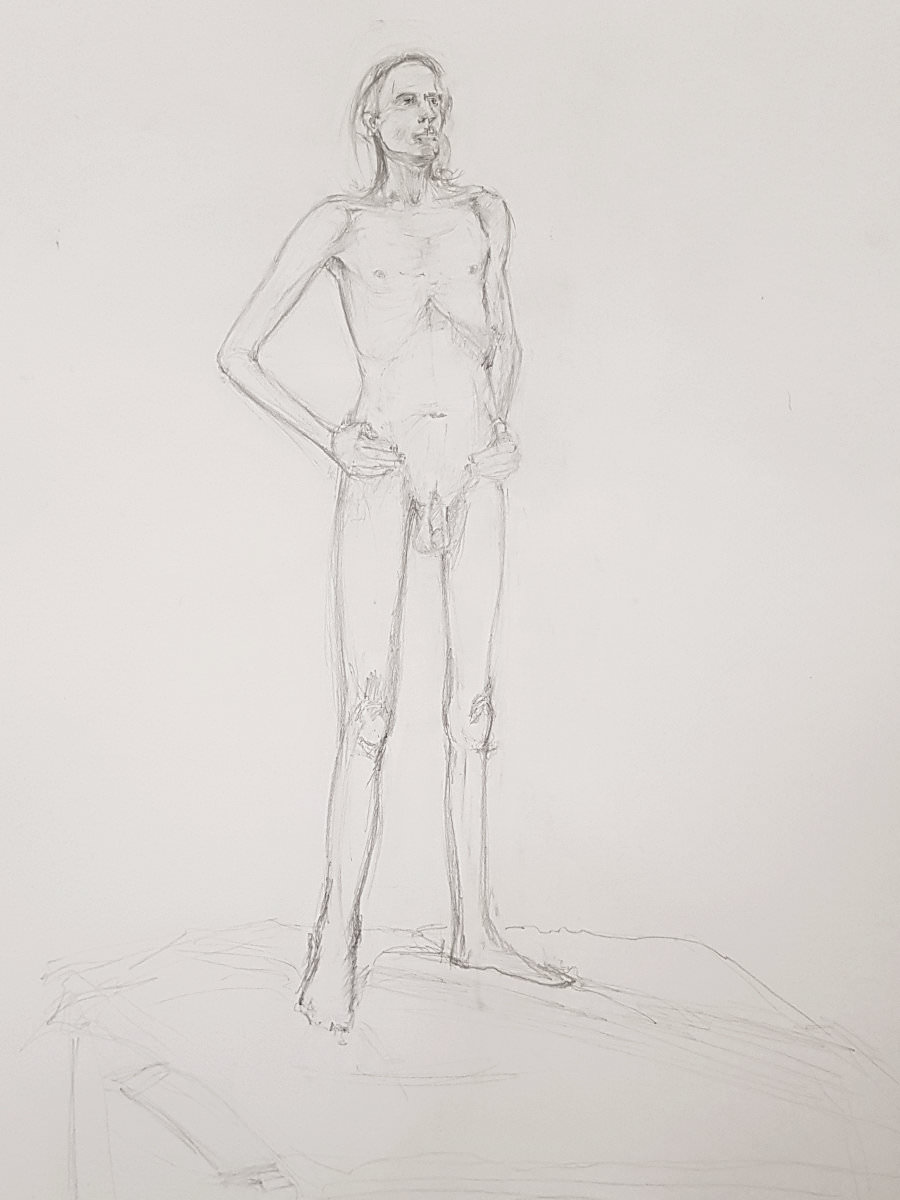
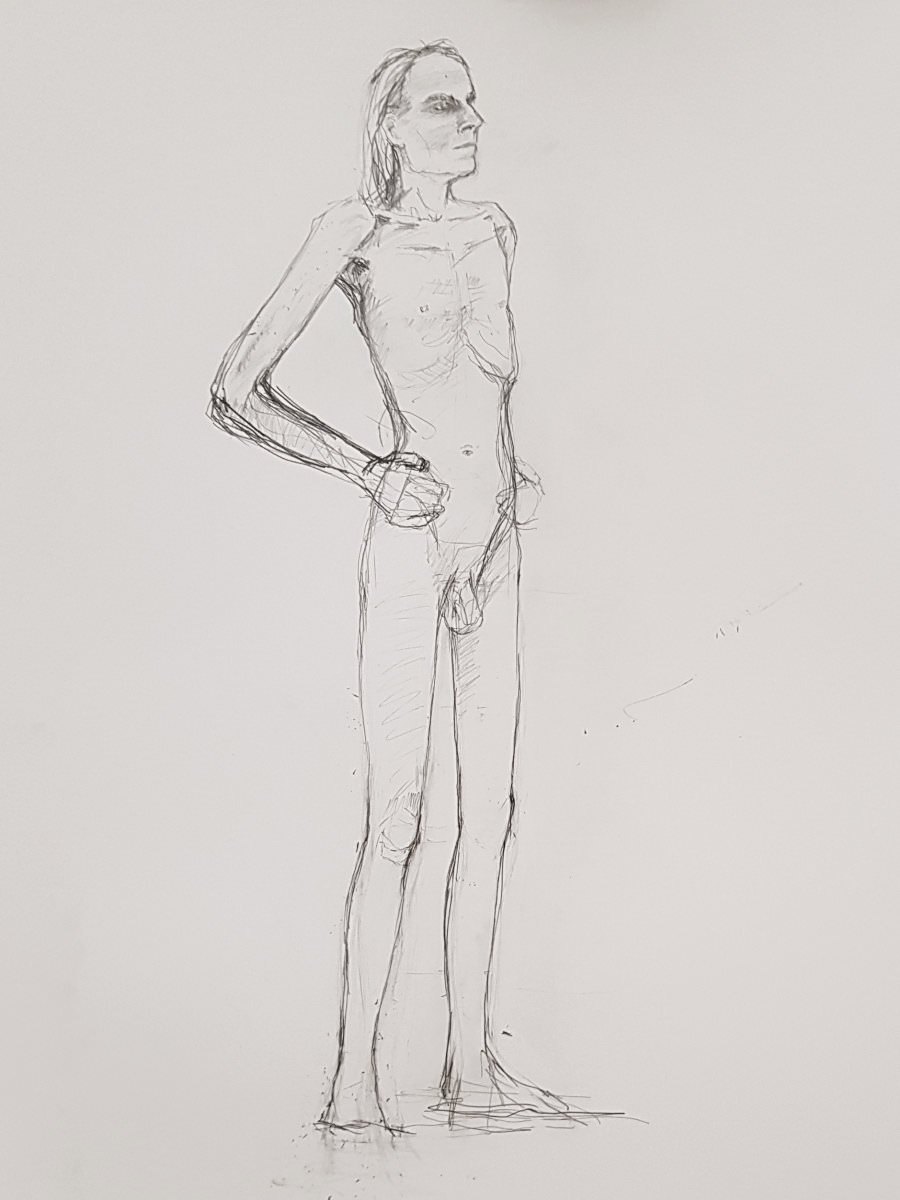

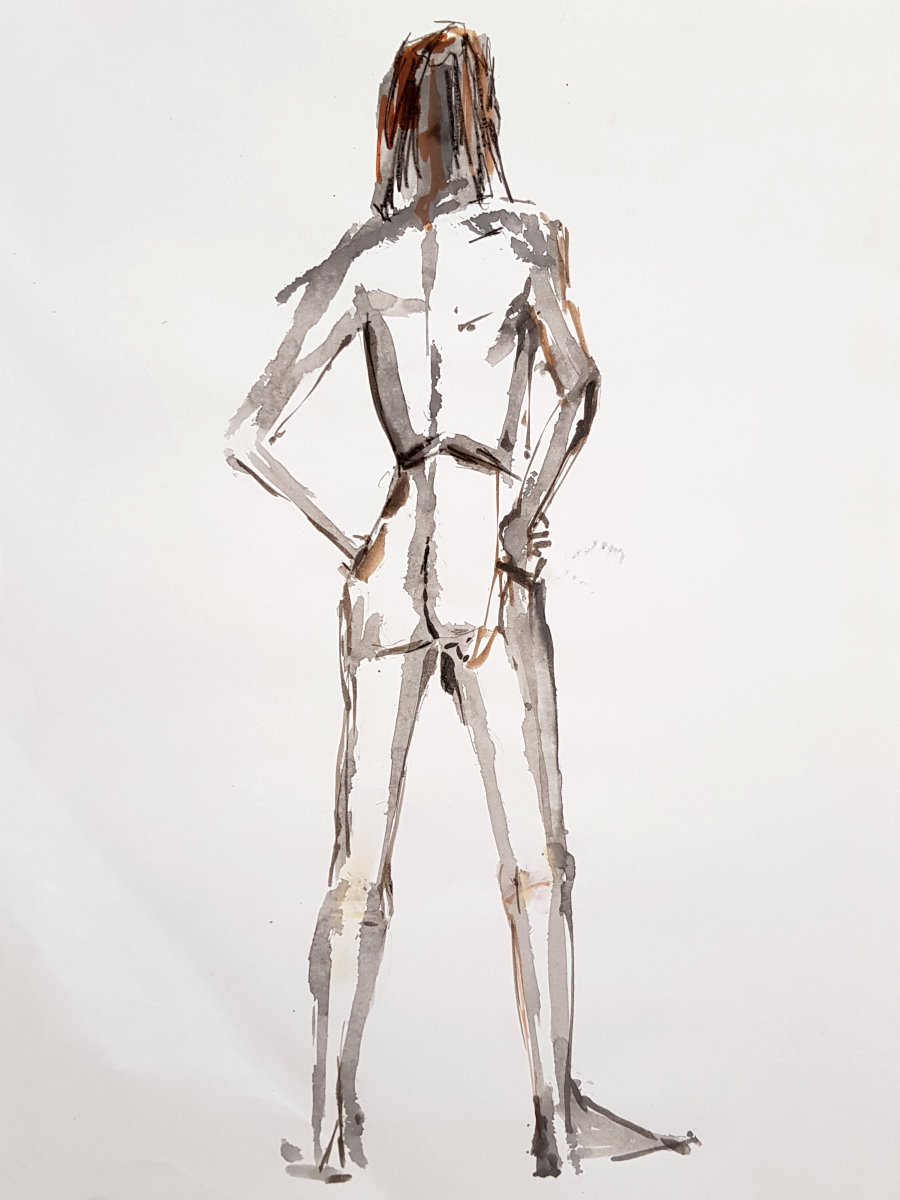
When getting into pose I’d thought nothing of the stance in relation to my nakedness, yet I was surprised to find I felt curiously exposed and brazen when at first the artists walked round me scrutinising aspects and angles. Fleeting self-consciousness aside, it was a physically-undemanding, painless position. The only challenge on this humid evening was to keep my palms from slipping slowly down the ledge of my pelvis.
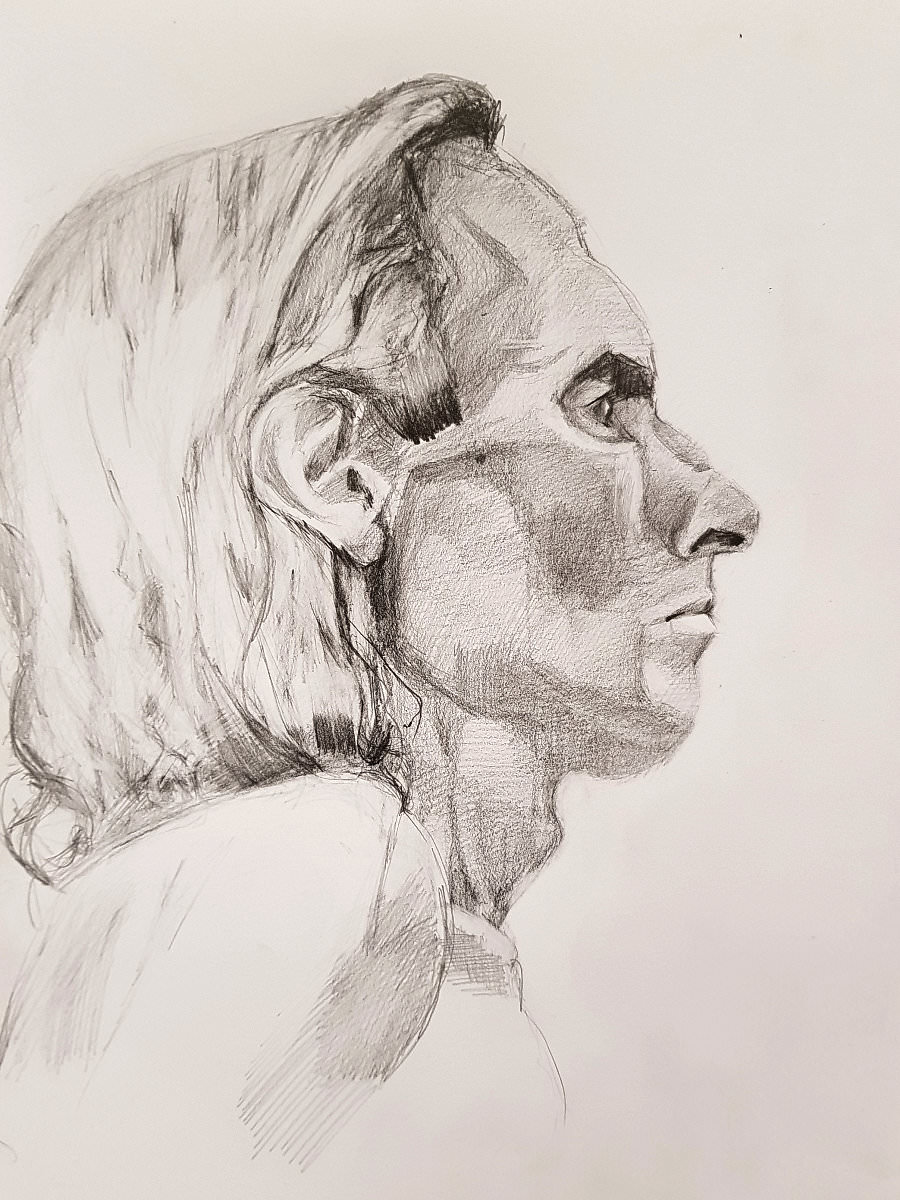
During the deepest darkest hours of lockdown I couldn’t help but wonder whether my modelling days were over. There was no existential crisis, just uncertainty as to what kind of figurative art scene might emerge. If the rise of online life drawing had fuelled appetites solely for young sexy flesh, there may be no place for physiques outside of mainstream body ideals. Happily we’re not there yet. It’s good to be back.
One of the more exciting aspects of providing poses for gesture drawing – poses that last mere seconds rather than minutes, hours, days – is that neither artists nor model have any idea what their next pose will be till the moment it manifests. In this session, for example, I was asked to start with twelve poses lasting just 10 seconds each. Not the kind of routine that can be planned in advance.


This online life drawing class was one of a series organised by artist Jo McCormick. She had invited me to model for this particular session as my physique lends itself to variety and the observation of clear lines within the form. Whilst the intention was not that students should draw ‘stick men’, it didn’t harm their practice to have a stick man for their subject. Next the poses lengthened: four of 30 seconds each.


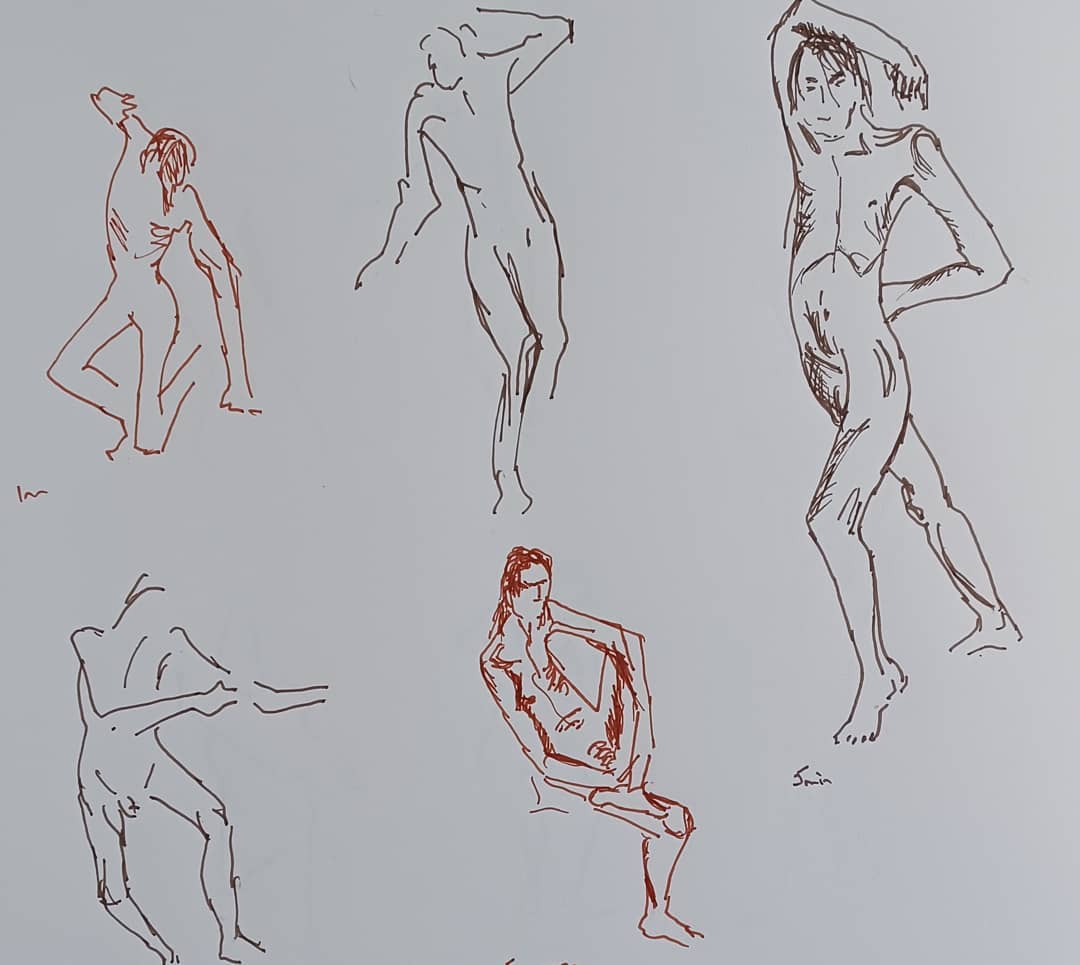


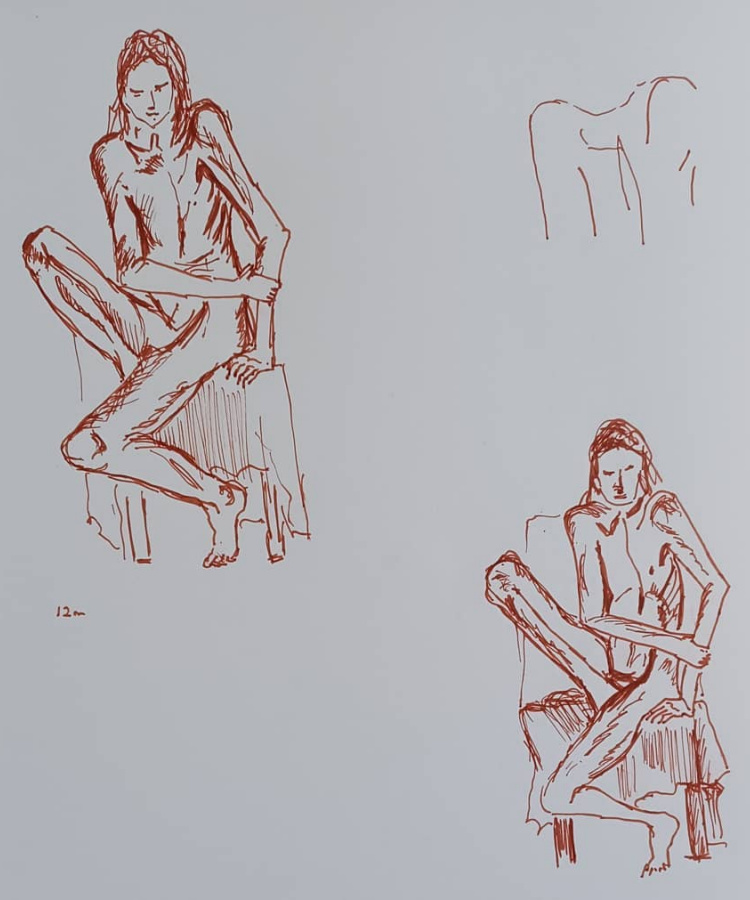
After the half-minute poses came five of 1-minute. I know several life drawing groups where 1-minute poses are a warm-up; here, however, I had already barrelled through sixteen poses just to reach this point. The two 5-minute poses that followed felt like a sedate luxury, and the subsequent 20-minute pose might have been an eternity. How to proceed from there? With a portrait study, of course.
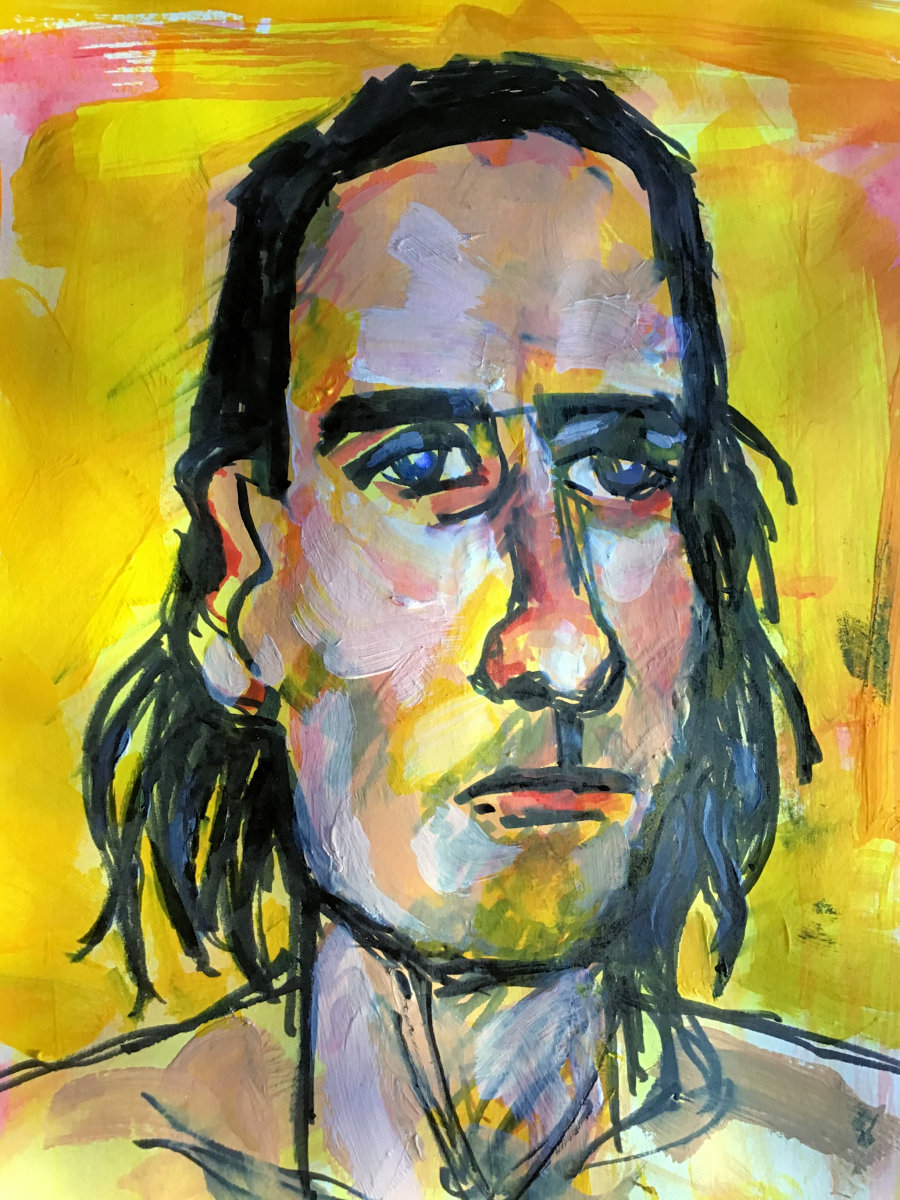
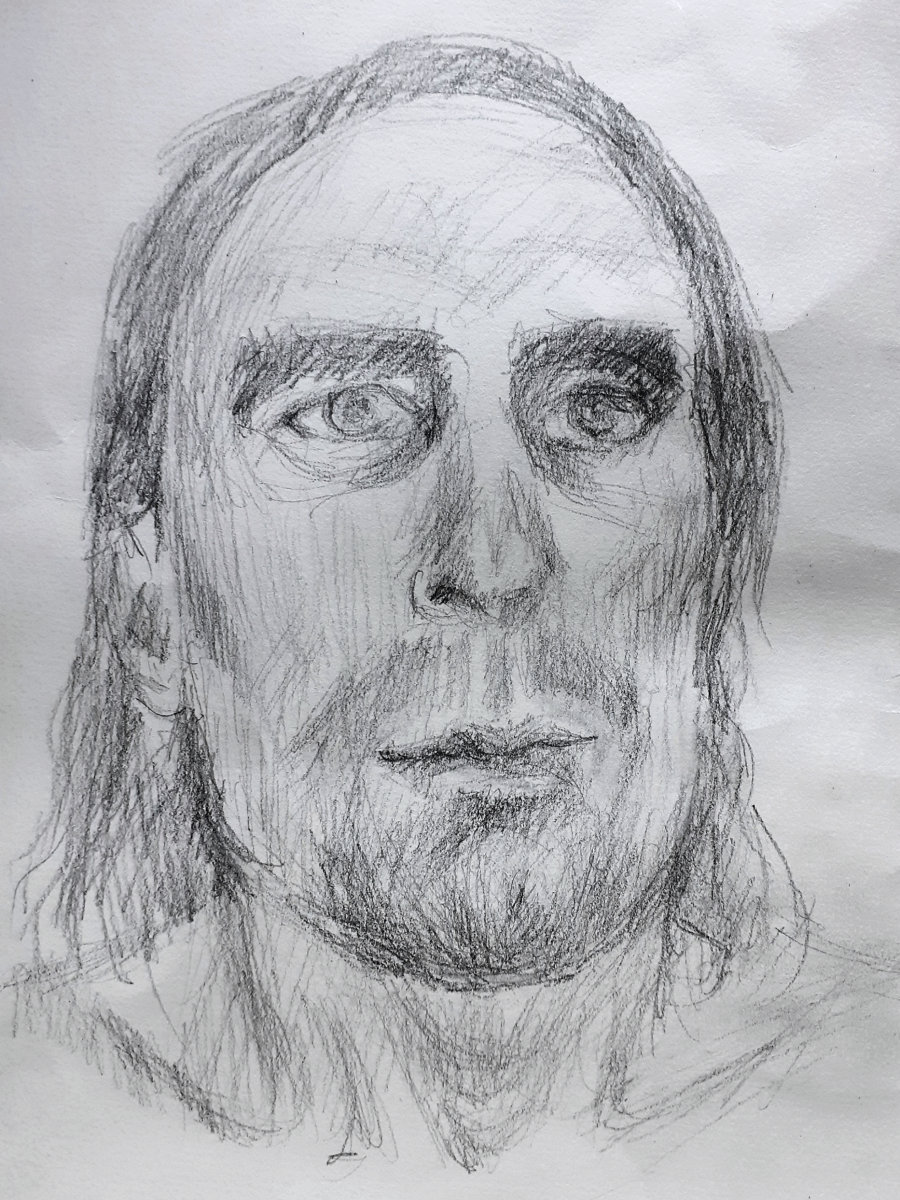


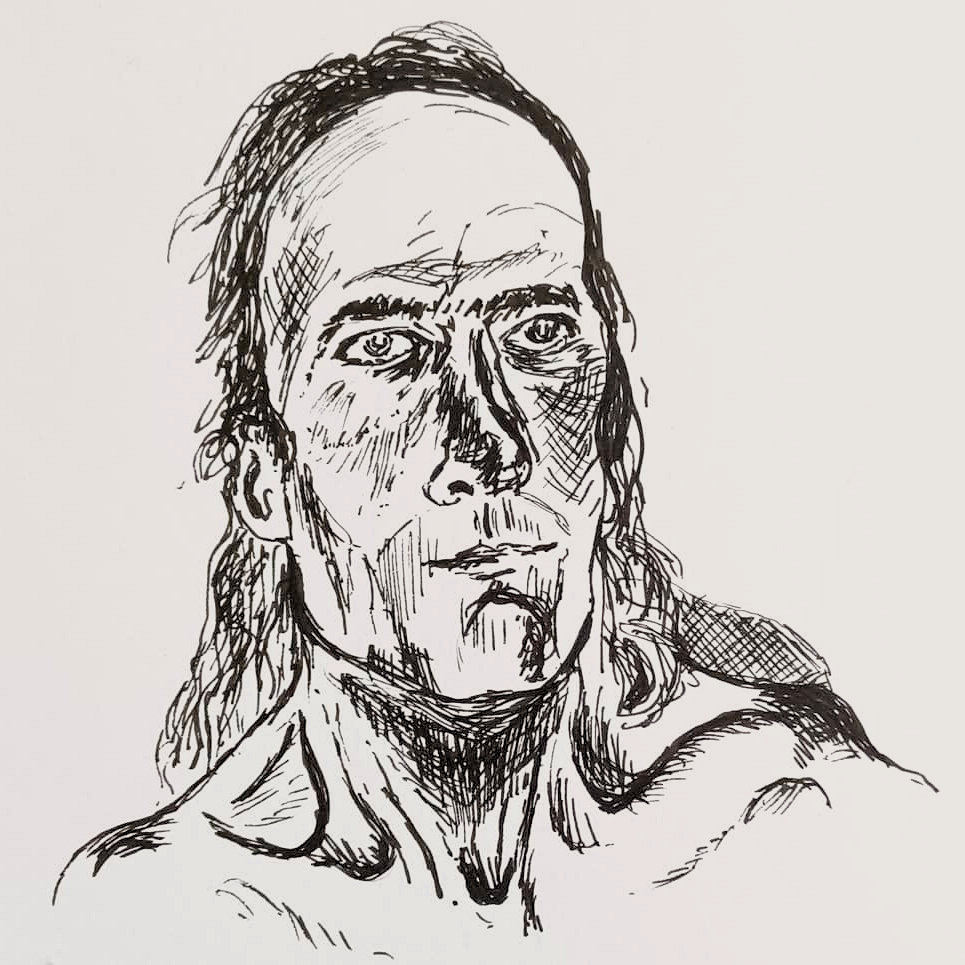
For 35 minutes I sat with my phone positioned a few inches from my face so persons unseen could study it and all its flaws in unflinching detail. Psychologically, it’s not for the faint-hearted, but in practice the artists have more than enough lines, shapes and shades to grapple with through their computer screens. Hopefully soon we can return to these challenges in-person, face to maskless face. Surely it’s coming.
Locking down
I’d said I wasn’t going do this. The idea of online life modelling hadn’t appealed to me right from day-one. Through much of last year that feeling only strengthened.
In September 2020, I’d shared my unease at how online life drawing had manifested during the UK’s first coronavirus (COVID-19) lockdown. My primary concern was that: “newcomers to London-based life drawing might see it as an elitist scene accepting only bodily perfection” as “the overwhelming majority of models being booked were either conventionally attractive, physically athletic or – most likely – both.”
After its incipient rush of blood, the scene eventually calmed down but I still harboured reservations. As recent as December 2020, a tutor for whom I have the highest regard offered me an ‘in-person’ booking with a caveat that it might have to be moved online. I declined ruefully, saying:
“It has emerged that online life drawing is by far the most profitable format for models – even if the rate isn’t increased, there’s still a saving on travel – and potentially the most comfortable, but the idea of it still leaves me very cold (metaphorically). Perhaps it’s too much like my day job, which also currently keeps me stuck at home in front of a computer with no real life human interaction.
“Furthermore, having seen so much of London life modelling being ‘sexed up’ over the past year, I’ve become slightly disenchanted with the whole profession recently. I need to rediscover my love of it properly, as it was always meant to be, and leave the online world to those with a greater need or passion.
“So in short, if you remain in the position of potentially having to flip an in-person booking to be an online booking at relatively short notice, I will respectfully bow out and leave the floor to my fellow models who can commit to either.”
Even as 2020 drew to a close, in my Life during lockdown, part 2 blog, I was clear: “I’m yet to find a place in my heart for life drawing online and still see it as a substitute of last resort rather than a desirable practice.”
Opening up
I can’t trace the mollifying of my stance to a single moment. I’d helped Esther set-up cameras and presided as Zoom gatekeeper for her events, in which she was model, performer or host. I’d also modelled for a ‘hybrid’ event at Lewisham College, where some artists were in the room while others were online. Maybe these soft encounters were a first dose of vaccine against my doubts.
I was also aware that the New Year lockdown would probably ease from early spring, allowing in-person life drawing to come back. I’m certain the online version will never disappear but I could foresee it slipping in my consciousness without me ever having tried it. Even so, I still had no appetite for a full evening of modelling alone at home in front of my laptop, straight after a full day of non-modelling work in the same manner.
On 4 February 2021, I received a text message from Joanna McCormick asking me whether I might like to repeat my hybrid event of last year for Lewisham College, only this time fully online. It would be from 10am to 3:30pm on the Saturday of a weekend to which I’d already tagged a day’s leave from my day job on the Monday. It felt like a now-or-never alignment of chance and opportunity, so… I accepted.
Of course, I still had technical matters to work out. First I bought add-ons to convert a top-notch but decades-old Velbon camera tripod into a tilting, turning smartphone grip that could be extended to almost 2m high. Next, I tested simultaneous Zoom links on my phone and laptop. Finally I created a pose space in front of a bare wall at the rear of a spare room that gets plenty of natural light. Everything seemed fine. I was ready.
Being me
Cometh the day, Jo opened the Zoom session at 9:55am. I signed-in using my phone and laptop – the former to capture my modelling; the latter so I could engage with the session between poses. After about dozen artists had joined us, Jo secured the room and we began: five 1-minute poses as a warm-up; three 3-minute poses searching for circles, rectangles, triangles; two 5-minute poses for negative space and shadows.
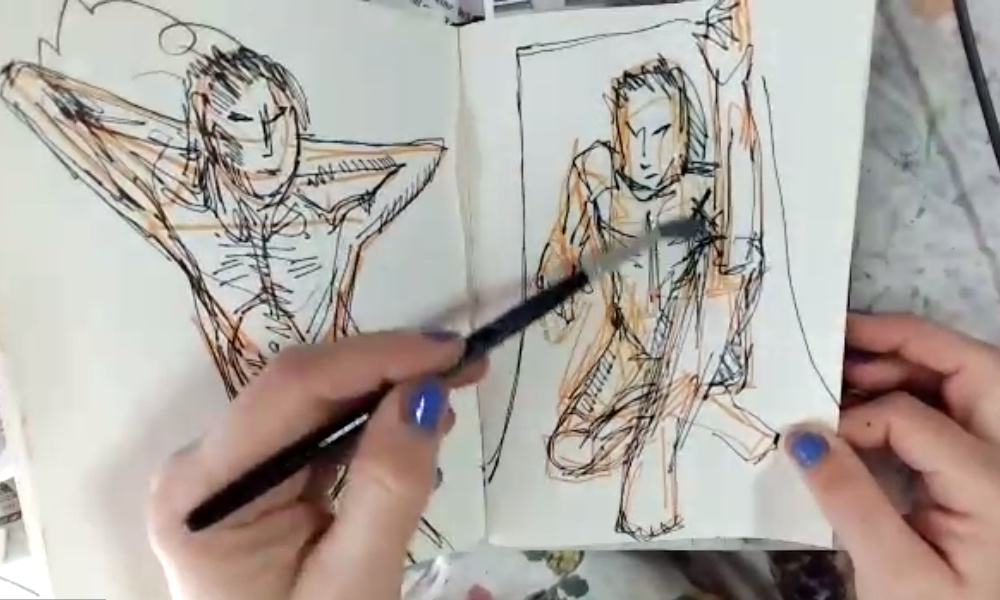
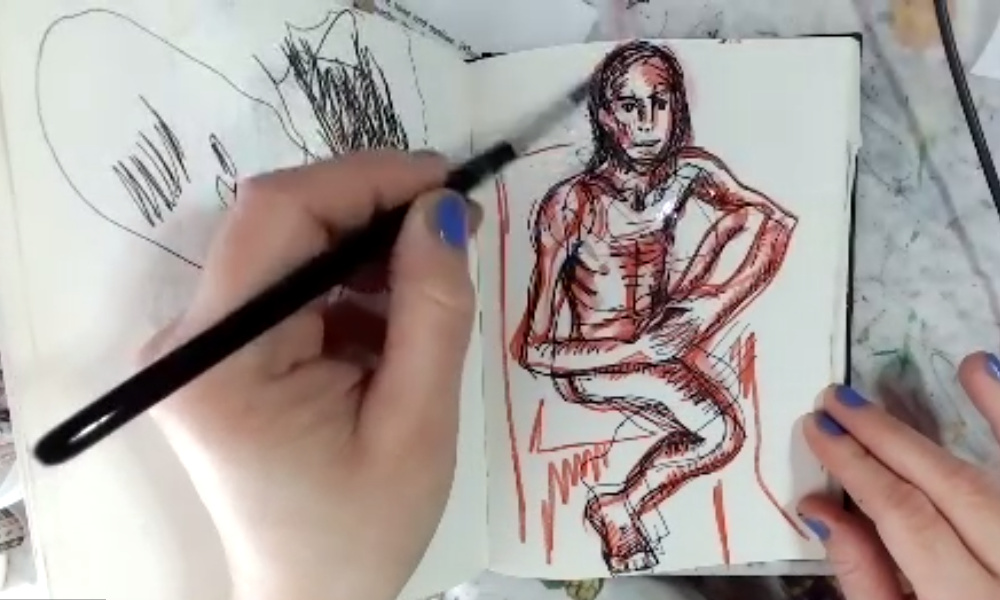
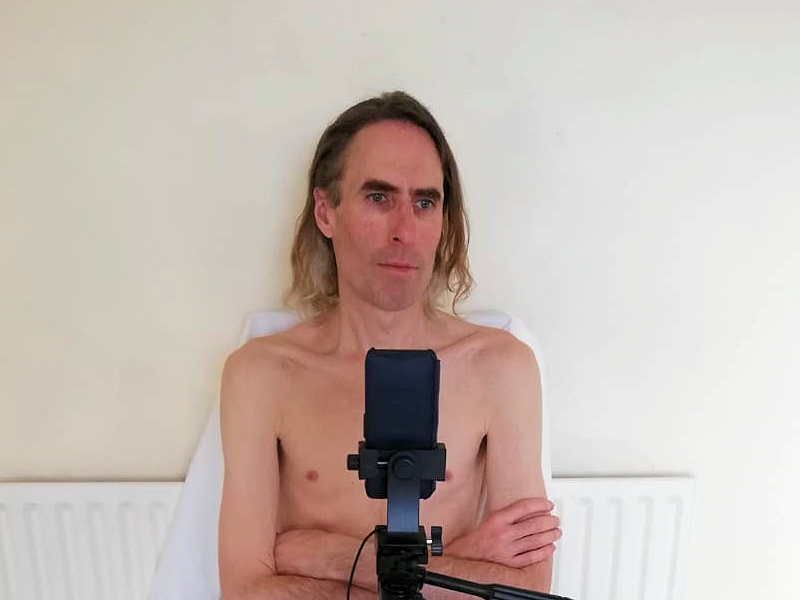
The plan was to have music playing with each pose but that ended when Jo’s Spotify account ground to a halt. Instead we enjoyed the soothing sounds of her pen at work. My next offerings were 10 minutes seated holding one knee, 15 minutes striding with one arm high, one arm low, and a 20-minute portrait sitting for which the camera had to be moved unnervingly close. At intervals, Jo demonstrated drawing techniques.
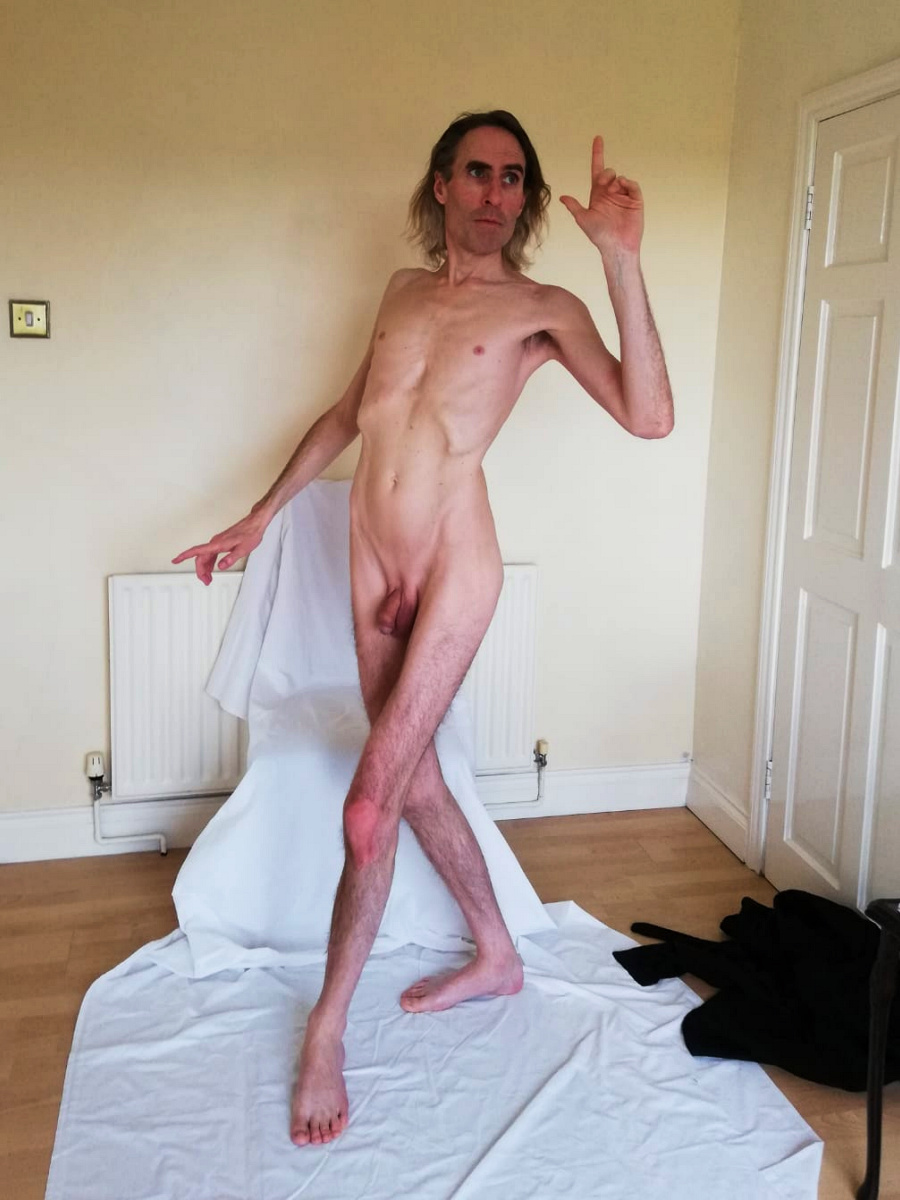
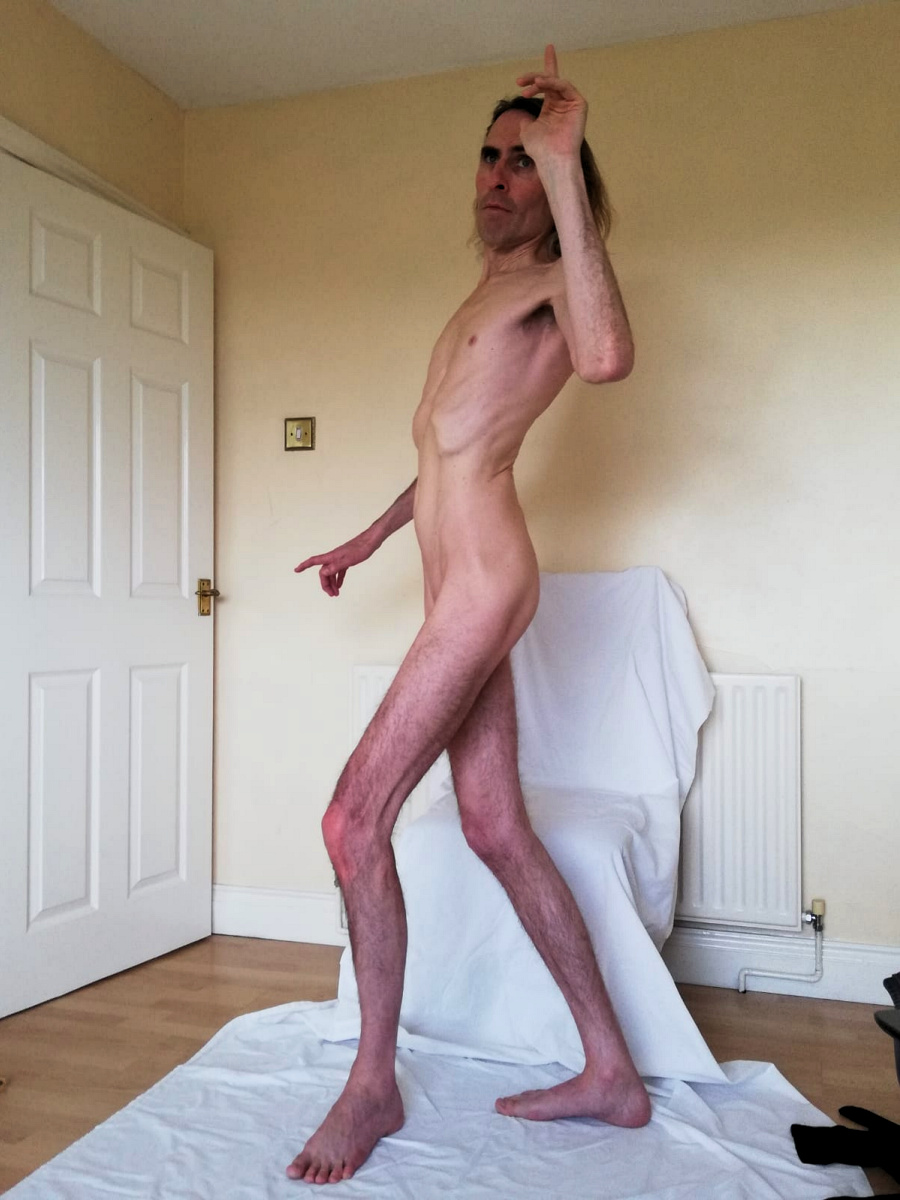
It wasn’t all plain sailing. For an upcoming 35-minute pose I had made up my mind to stand with one arm across my head and all my weight bearing down through one leg. From the outset my body warned me the leg had been weakened by a previous pose, but I didn’t listen and duly endured a lot of pain. This was compounded when an artist asked me to stand for a further 2 minutes while they re-measured my proportions.
As a recovery pose for the next half an hour, I slouched upon the floor with head and arms resting on a chair. This was the first and only pose in which I couldn’t see either my phone or laptop, and thus it was also the only pose in which I wouldn’t know if my internet connection dropped. Needless to say it dropped, albeit only enough to knock out the camera for a couple of minutes. Jo’s voice alerted me. Lesson learned.
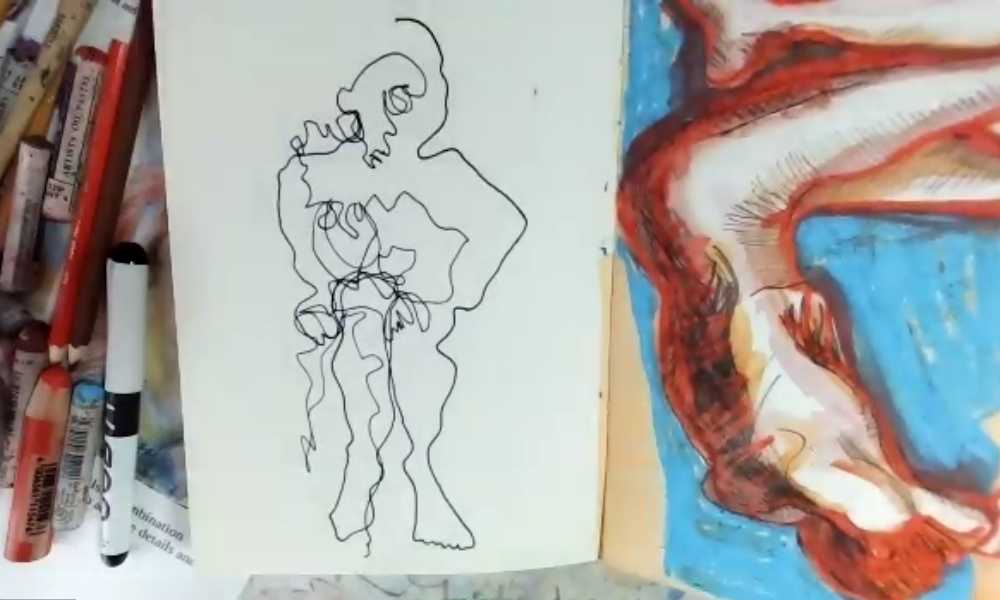
We reconvened after lunch to finish with an hour-long pose. Before getting underway, Jo demonstrated blind contour drawing using a continuous line – unusual techniques to deploy on a long pose but suggested mainly as a means of making initial marks for subsequent refinement. I positioned myself comfortably on a padded chair and, whilst offered the chance to take regular stretch breaks, opted to stay in situ throughout.

Once I had completed my hour it was time for artists to take the Zoom spotlight. Each took a turn in holding up favourite works and saying a few words. Their feedback was positive and the mood appeared genuinely upbeat, which is especially gratifying after a long day. I felt the same way myself, having suppressed most of my earlier agonies by that stage… although I was destined to be achy for a couple more days.
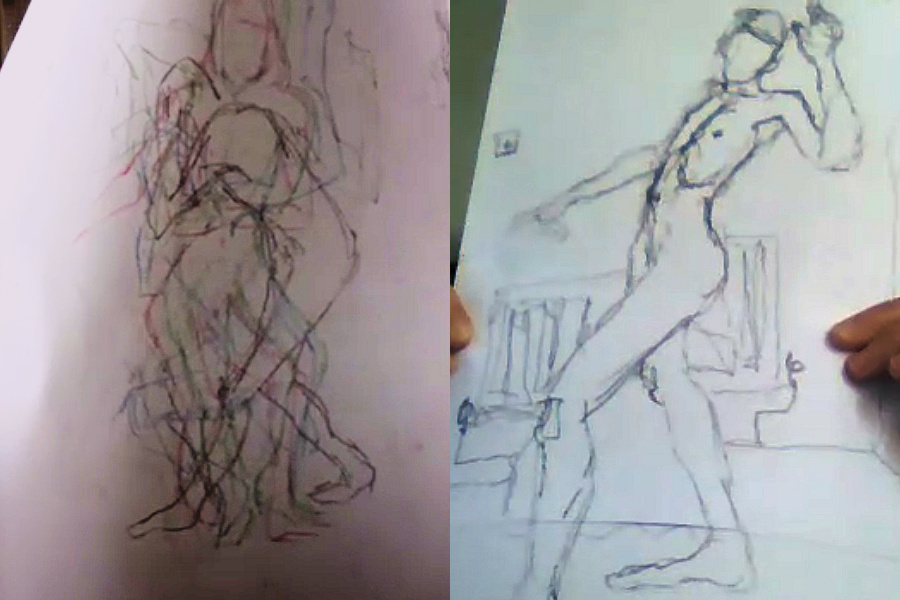
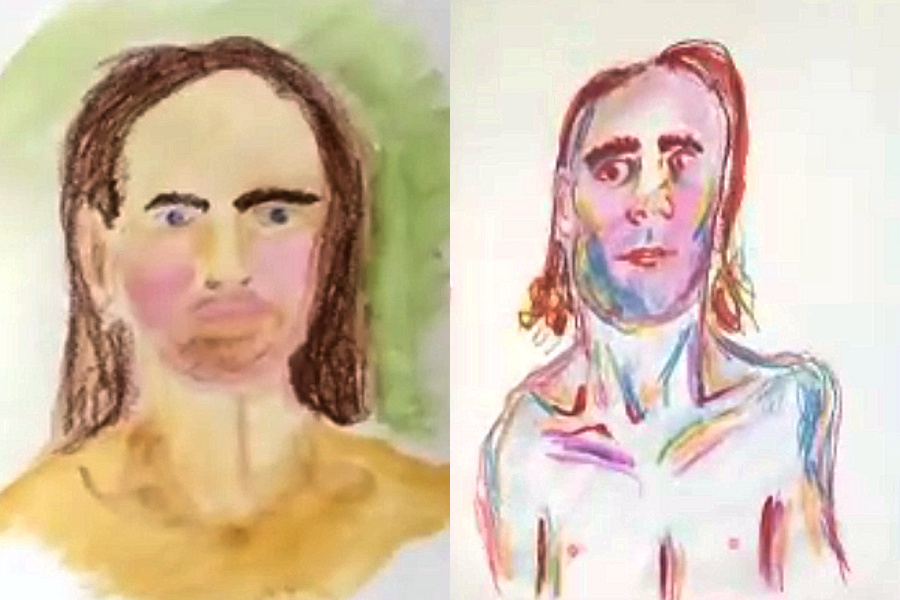
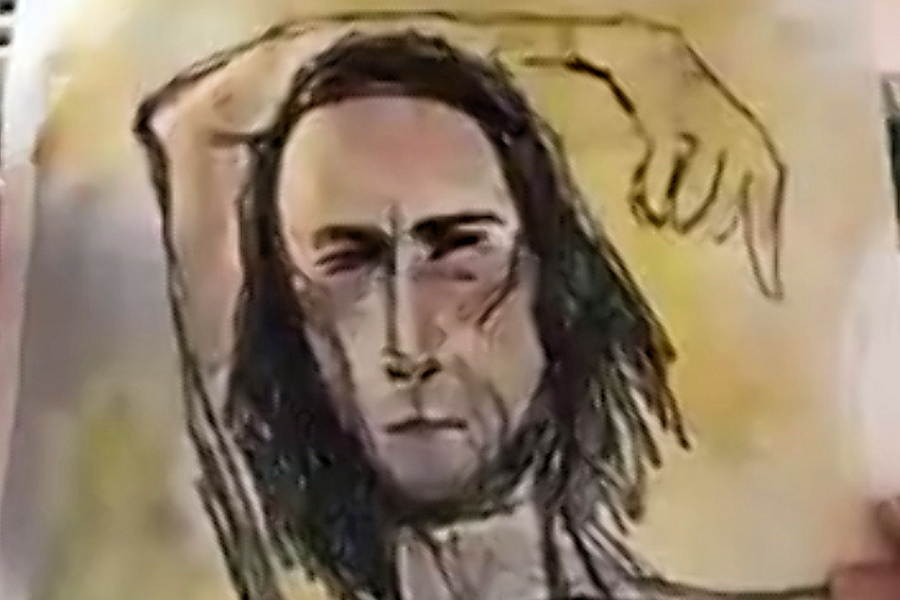
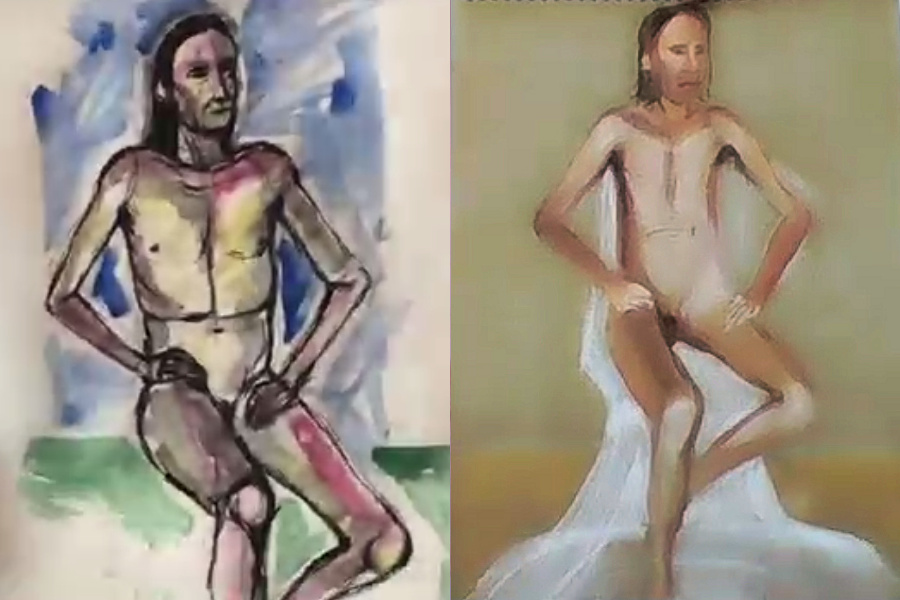
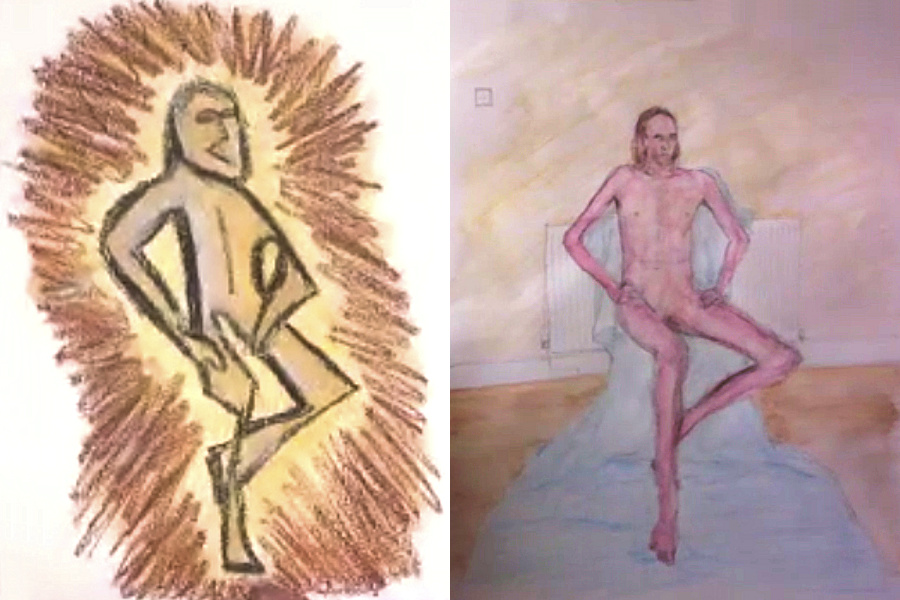
Despite this enjoyable experience, the opinion I expressed in December remains true: “I’m yet to find a place in my heart for life drawing online and still see it as a substitute of last resort rather than a desirable practice.” Really, however, that says more about me than about online life drawing. I’ve now seen the happiness and satisfaction it can bring others, and I wouldn’t deny that to anyone. Thank you, Jo, for giving this.
 steve ritter